
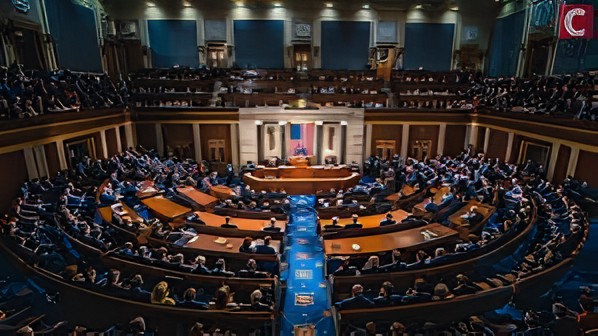
United States lawmakers on Tuesday held another round of briefing over allegations of persecution of Christians in Nigeria, citing “religious cleansing” in Christian communities in the middle belt of the country.
The latest session comes after U.S President Donald Trump had called on the lawmakers to investigate the allegations of persecution of Christians in Nigeria.
Trump, on October 31, instructed the House Appropriations Committee to investigate what he described as the slaughter of Christians in Nigeria and report their findings to the White House.
Pan-Atlantic Kompass reports that Tuesday’s session was led by House Appropriations Vice Chair and National Security Subcommittee Chairman Mario Díaz-Balart.
The session brought together members of the House Appropriations and House Foreign Affairs Committees alongside religious freedom experts.
Participants included Reps Robert Aderholt, Riley Moore, Brian Mast, Chris Smith, US Commission on International Religious Freedom Chair Vicky Hartzler, Alliance Defending Freedom International’s Sean Nelson, and Dr Ebenezer Obadare of the Council on Foreign Relations.
Díaz-Balart began the briefing by describing global religious freedom as “both a moral obligation and an essential American interest.”
He emphasised that “no one should have to fear for their safety because of how they choose to worship.”
He said he is “committed to advancing policies that protect the freedom to live according to one’s faith without fear of violence and retribution.”
Díaz-Balart noted that his FY26 funding bill addresses this commitment and added that he plans to reinforce these efforts by passing a full-year funding measure, which he said is critical to advancing the America First agenda.
Similarly, Reps Aderholt echoed the same concerns on the allegations of persecution of Christians in Nigeria, saying that the situation is “a crisis that can’t be ignored.”
He added: “We must stand firmly with Nigeria’s Christian communities and all persecuted believers worldwide, and I commend our collaborative efforts to provide the President with the information needed to confront this growing tragedy.”
In his address, Moore, who has been vocal about allegations of persecution of Christians in Nigeria, argued that the recent re-designation of Nigeria as a Country of Particular Concern is a good step.
The Congressman explained: “Our brothers and sisters in Christ are being persecuted and slaughtered in Nigeria simply for professing their faith in our Lord and Saviour Jesus Christ. ‘’The world will no longer turn a blind eye to the persecution of Christians in Nigeria.”
Also, Foreign Affairs Committee Chairman Mast framed the violence as part of a broader campaign.
“This is a targeted campaign of religious cleansing,” he said, arguing that extremist groups aim to “drive Christians out of their ancestral lands in the Middle Belt.”
He urged the Nigerian government to “disarm these militias, return displaced families to their homes, and bring the perpetrators to justice.”
In his remarks, House Foreign Affairs Africa Subcommittee Chairman Smith described Nigeria as “the ground zero of religious violence,” saying Christians and moderate Muslims face “the constant threat of murder, rape, and torture.”
He criticised the Nigerian government for allowing perpetrators to act “with complete impunity,” adding, “We must act quickly and decisively to save more lives.”
Similarly, during the joint House briefing, Council on Foreign Relations Senior Fellow Dr. Ebenezer Obadare testified that the primary drivers of violence exploit Sharia frameworks and Hisbah officials to impose extremist ideology, enforce forced conversions, and operate with near-total impunity.
Obadare laid out a strategy for dealing with the violence and killings.
Obadare stated: “The policy goal should be two-fold: first, work with the Nigerian military to neutralise Boko Haram.
“Second, the United States should put pressure on President Tinubu to (1) make Sharia law unconstitutional in the twelve northern states where they has been adopted since 2000 and (2) disband the various Hisbah groups across northern states seeking to enforce and impose Islamic law on all citizens regardless of their religious identity.”
He argued that authorities downplayed the role of religion in the attacks and highlighted Nigeria’s blasphemy laws, which in some states permit the death penalty.
Pan-Atlantic Kompass reports that committee officials, following the conclusion of the hearing at Tuesday’s session, said they are preparing a comprehensive report for Trump with recommendations on how Congress can support the administration’s efforts to curb religious persecution in Nigeria and elsewhere.
Recall that the latest briefing comes amid a U.S.-Nigeria security working group that was recently formed.
President Bola Tinubu had approved Nigeria’s delegation to the new U.S.–Nigeria Joint Working Group, established to implement security agreements from high-level talks in Washington led by National Security Adviser Nuhu Ribadu.
The group, which includes senior ministers and security officials, aims to enhance counterterrorism efforts, intelligence sharing, border security, and coordination on humanitarian and civilian security issues.