
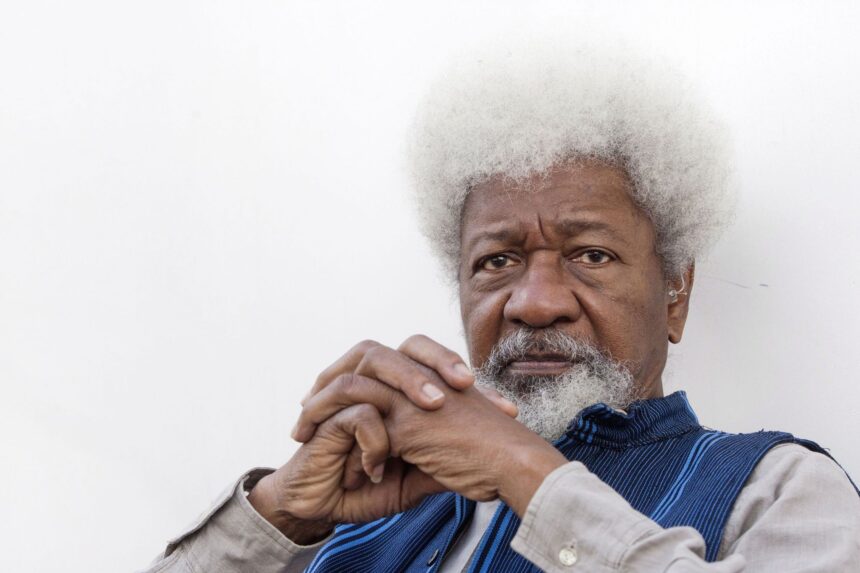
Nobel Laureate, Professor Wole Soyinka, has criticized President Bola Tinubu’s military action in the Benin Republic following a recent attempted coup.
Speaking while presenting an honorary award to Odia Ofeimun, the famous poet and activist who was honoured by the Wole Soyinka Centre for Investigative Journalism, Soyinka said Tinubu should have sent his son, Seyi Tinubu to lead the charge instead of committing the nation’s military to what he called “another needless military entanglement next door.”
Soyinka said this while referencing an incident he witnessed, claiming that he counted at least “15 or so heavily armed to the teeth” security officials who accompanied the president’s son at a hotel in Ikoyi, Lagos.
He said he initially mistook the scene for a film production, but a young man detached himself from the group to greet him, and he only learned from his driver afterwards that the individual was Seyi Tinubu, the president’s son.
Soyinka stated: “I was coming out of my hotel, and I saw what looked like a film set. A young man detached himself from the actors, came over, and greeted me politely. When I asked if they were shooting a film, he said no. I looked around and there was nearly a whole battalion occupying the hotel grounds.
“When I got back in my car and asked the driver who the young man was, he told me. And I saw this SWAT team, heavily armed to the teeth. They looked sufficient to take over a neighbouring small country or city like Benin.”
The playwright added that he was so disturbed that he attempted to reach the National Security Adviser (NSA) to verify whether the deployment was official.
He continued: “I began looking for the NSA immediately. I said, track him down for me. They got him somewhere in Paris, but he was in a meeting with the president. I described the scene and asked: ‘Do you mean a child of the head of state goes around with an army for his protection?’ I couldn’t believe it.
“Tinubu didn’t have to send the air force or military to deal with any insurrection. There is an easier way.
“Next time there’s an uprising, the president should call that young man and say, ‘Seyi, go and put down those stupid people there. You have troops under your command.’”
“Children should know their place. They are not potentates; they are not heads of state.
“The security architecture of a nation suffers when we see such heavy devotion of security to one young individual.”
Soyinka’s comments on Tinubu’s military action in the Benin Republic come a few days after the country suffered an attempted coup.
Pan-Atlantic Kompass had reported that on Sunday, a group of soldiers identifying themselves as the “Military Committee for Refoundation” (CMR), led by Lieutenant Colonel Pascal Tigri, appeared on state television to announce the dissolution of all state institutions and the removal of President Patrice Talon.
Benin’s government later announced that the coup attempt had been suppressed and control restored.
Speaking of the development, Tinubu confirmed that the deployment of the Nigerian troops to the Benin Republic came at the request of the Beninese Government, which sought Nigerian air support for surveillance, airspace control, and rapid intervention against the coup plotters.
A statement signed by the President’s Special Adviser on Information and Strategy, Bayo Onanuga, said Tinubu acting on the request, ordered Nigerian Air Force fighter jets to take control of Benin’s airspace and assist in flushing out the mutineers from strategic locations, including the national broadcaster and a military camp.
Also, Soyinka’s criticism comes weeks after Tinubu ordered the withdrawal of police officers assigned to Very Important Persons (VIPs) across the country, directing that they refocus on their core duties of protecting the public.
The presidential directive, issued at a security meeting in Abuja with the police, Air Force, Army chiefs, and the Director-General of the State Security Service (SSS), stated that VIPs requiring personal protection must now request well-armed personnel from the Nigeria Security and Civil Defence Corps (NSCDC).