

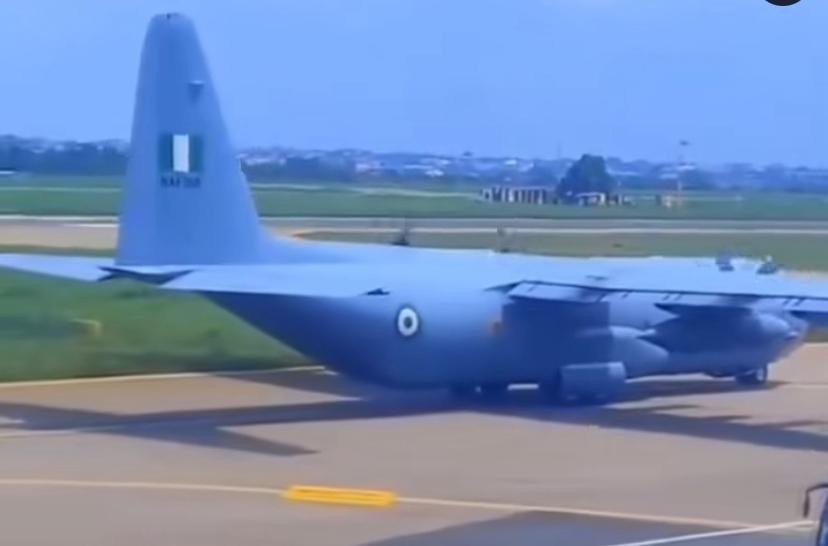
Three days after a Nigerian Air Force (NAF) C-130 transport aircraft was forced to land in Bobo-Dioulasso, Burkina Faso, the fate of the 11 Nigerian soldiers aboard remains a subject of confusion.
The fate of the 11 Nigerian soldiers became unclear following conflicting reports emerging from the authorities of Burkina Faso and Nigeria.
The incident began on Monday when the NAF C-130, reportedly en route Lagos to Portugal for a ferry mission, made an unscheduled emergency landing in Burkina Faso.
The Alliance of Sahel States (AES), comprising Burkina Faso, Mali, and Niger, issued a strongly worded statement condemning the landing as an “unfriendly act carried out in defiance of international law,” claiming that the Nigerian aircraft violated their airspace without clearance.
Sources from the Nigerian military disclosed to the media of the press that neither the personnel nor the aircraft had been released.
One of the officials said: “They have not been released. We are still waiting (for their release).”
Another senior official, who insisted the military did nothing wrong, confirmed the same position.
“We are still monitoring the situation. Article 25 of the Chicago Convention (1944) requires countries to permit aircraft in distress to land and to provide assistance.
“This is one condition on which military aircraft are allowed to enter foreign airspace without permission. Emergencies override because the priority is saving lives. The aircraft is not entering for operational or hostile reasons; it is considered a force majeure situation.”
However, reports from the BBC and the UK Guardian offered a conflicting account.
The two international media outlets cited Burkinabè security sources who claimed that the 11 military soldiers had only been briefly held and were already cleared to return.
The report stated: “Eleven Nigerian military officers were briefly detained in Burkina Faso after their aircraft made an emergency landing in the country, Burkinabè security sources told the BBC. The soldiers were released and permitted to fly back to Nigeria.”
Pan-Atlantic Kompass reports that amid the uncertainty of the fate of the 11 Nigerian soldiers, media reports emerged that the Nigerian government is intensifying diplomatic efforts to secure their release and the C-130 military aircraft currently held in Burkina Faso.
Confirming the ministry’s involvement, the spokesperson for the Ministry of Foreign Affairs, Kimiebi Ebienfa, told the press that the Nigerian Embassy had initiated talks with the Burkina Faso government.
He said: “The Embassy of Nigeria in Ouagadougou is engaging with the host authorities to secure their release.”
Pan-Atlantic Kompass reports that this comes after the Nigerian Air Force (NAF) had said that personnel aboard the C-130 aircraft that landed in Bobo-Dioulasso, Burkina Faso, were safe and receiving cordial treatment from Burkinabè authorities.
According to a statement on Tuesday by the NAF Director of Public Relations and Information, Air Commodore Ehimen Ejodame, the crew diverted to the nearest airfield in line with standard safety procedures.
The statement read: “The Nigerian Air Force wishes to clarify reports regarding the diversion of a NAF C-130 aircraft during its ferry mission to Portugal on 8 December 2025. Following takeoff from Lagos, the crew observed a technical concern that necessitated a precautionary landing in Bobo-Dioulasso, Burkina Faso, the nearest airfield, in accordance with standard safety procedures and international aviation protocols. The NAF crew is safe and has received cordial treatment from the host authorities.”
The rupture between the Alliance of Sahel States (AES) and ECOWAS dates back to January, when Burkina Faso, Mali, and Niger formally quit the regional bloc. The military-led governments accused ECOWAS of heavy-handed interference following their coups, the sanctions that followed it, ultimatums, and pressure to return to civilian rule, which they argued pushed them away from traditional Western partners and into deeper security and political alignment with Russia.
This tense split continues to shape cross-border relations, including the current standoff over the detained Nigerian soldiers.