
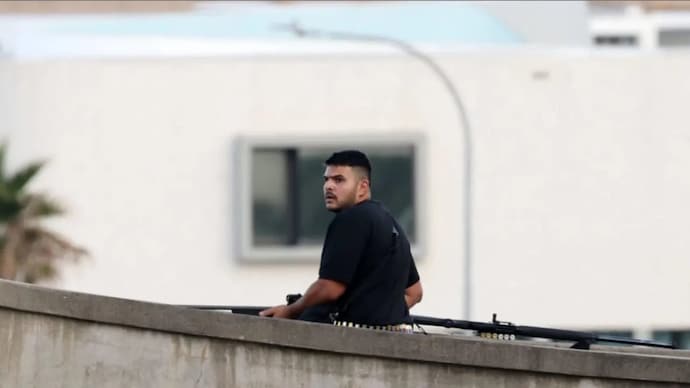
24-year-old Naveed Akram has been formally charged with 59 offences, including 15 counts of murder and committing a terrorist act following Australia’s deadliest mass shooting in decades.
The Bondi Beach terror attack, which occurred during a Hanukkah celebration on Sunday evening, has left the nation in mourning.
The charges were laid at a bedside court hearing on Wednesday after Naveed Akram regained consciousness in a Sydney hospital.
He had been in a coma since Sunday night after being shot by police during a confrontation that also claimed the life of his father and co-attacker, 50-year-old Sajid Akram.
Authorities allege the pair opened fire on a crowd of over 1,000 people gathered near the iconic Bondi Pavilion, targeting the Jewish community’s “Festival of Lights.”
New South Wales (NSW) Police confirmed the extensive charge sheet under Operation Arques.
In addition to the 15 murder charges, the Bondi Beach terror attack legal proceedings include 40 counts of wounding or causing grievous bodily harm with intent to murder, one count of committing a terrorist act, one count of placing an explosive near a building with intent to cause harm, and one count of publicly displaying a prohibited terrorist symbol.
Magistrate Daniel Covington formally refused bail during the virtual court appearance.
Naveed Akram, a Bonnyrigg resident, did not enter a plea and is scheduled to remain under police guard until he is medically fit to be transferred to a high-security correctional facility.
The New South Wales court said the case has been adjourned until April 2026.
Earlier, Police Commissioner Mal Lanyon said investigators were waiting for Akram’s medication to wear off before questioning him.
“For his fairness, we need him to understand exactly what is happening,” Lanyon said.
Police have formally designated the shooting a terrorist incident. Prime Minister Anthony Albanese said the attack appeared to have been “motivated by Islamic State” group ideology.
Twenty people remain hospitalised across Sydney, with one still in critical condition. Among those injured were two police officers. One officer, 22-year-old Jack Hibbert, has lost vision in one eye and faces a “long and challenging recovery”, his family said.
Investigations have revealed that Naveed Akram and his father travelled to the Philippines in November. Philippine immigration authorities told the BBC they were in the country from November 1 to November 28, with their final destination being Davao. Naveed travelled on an Australian passport, while Sajid used an Indian passport.
Sajid Akram was originally from Hyderabad in southern India and had “limited contact” with family there, according to police in Telangana state.
Victims of the attack included two rabbis, a Holocaust survivor, and a 10-year-old girl, Matilda. Boris and Sofia Gurman, who were filmed wrestling with one of the gunmen during the early moments of the attack, were also among those killed.
On Wednesday, thousands gathered for the funeral of British-born Rabbi Eli Schlanger, the first burial held for victims of the shooting. Speaking at the service, Rabbi Levi Wolff described the loss as an “unspeakable loss” for the community.
“Eli was ripped away from us, doing what he loved best,” Wolff said.
“Spreading love and joy and caring for his people with endless self-sacrifice in his life and in his death, he towered above as one of the highest and holiest souls.”
Rabbi Schlanger had helped organise the Hanukkah event. Funerals for other victims, including Matilda, are expected in the coming days.