
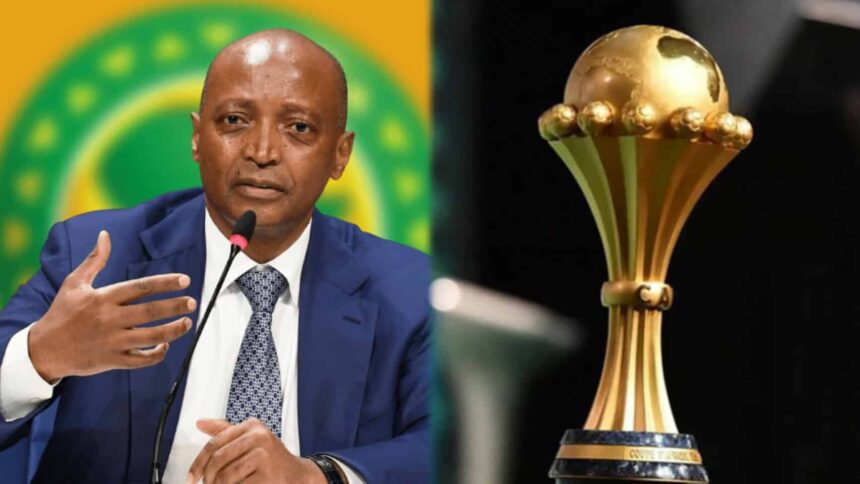
The Confederation of African Football (CAF) has officially announced that the Africa Cup of Nations (AFCON) will be held every four years following the conclusion of the 2028 edition.
The announcement was made by CAF President Patrice Motsepe during a press conference in Morocco on Saturday, December 20, 2 ahead of the kickoff of the 2025 tournament.
This development marks the end of a decades-long tradition of biennial competitions.
Motsepe explained that the decision that AFCON will be held every four years was made to harmonize the African football calendar with international fixtures.
For years, the biennial format created friction between CAF and top European clubs, who often faced the loss of key African stars during the peak of their domestic seasons.
By switching to a four-year cycle, the CAF President said the administration aims to reduce player fatigue and minimize the scheduling conflicts that have historically overshadowed the build-up to the tournament.
“Our focus now is on this AFCON, but in 2027 we will be going to Tanzania, Kenya, and Uganda, and the AFCON after that will be in 2028,” Motsepe told reporters in Rabat on Saturday, on the eve of the opening game of this year’s Morocco-hosted Cup of Nations.
He said a bidding process would be opened up for nations interested in hosting the 2028 Cup of Nations.
“Then, after the FIFA Club World Cup in 2029, we will have the first African Nations League… with more prize money, more resources, more competition.
“As part of this arrangement, the AFCON will now take place once every four years.”
It was gathered that the transition will not happen overnight. CAF will still go ahead with the 2025 AFCON edition in Morocco.
In 2027, AFCON is to be hosted across Kenya, Tanzania, and Uganda.
2028 will see a final “bridge” edition before the new cycle begins.
In 2032, the first edition was under the official quadrennial format.
To fill the gap between tournaments and maintain revenue streams, CAF will launch the African Nations League in 2029.
This annual competition is designed to provide consistent high-level competitive matches for all 54 member nations while ensuring that “the best African players who play in Europe will be on the continent every year,” according to Motsepe.
Pan-Atlantic Kompass reports that AFCON has usually been held at two-year intervals since the very first edition in 1957, but over the last 15 years, it has struggled to find a convenient place in the global calendar.
This year’s tournament in Morocco will be the eighth to be held going back to the 2012 edition in Equatorial Guinea and Gabon.
The 2019 edition in Egypt took place in June and July, a move away from the traditional slot at the beginning of the year seen as a way of appeasing major European clubs by avoiding playing in the middle of their season.
But the last two AFCONs, in Cameroon in 2022 and the Ivory Coast in 2024, reverted to January-February to avoid coinciding with the rainy season in those regions.
The latest Cup of Nations was initially due to take place in June and July this year but was forced to move because of the first edition of FIFA’s expanded Club World Cup in the United States.
However, CAF could not wait until next June because of the 2026 World Cup, and they can no longer stage the Cup of Nations in January and February because of the new UEFA Champions League format.
The solution is to start in December and continue into the New Year, at a time when some European leagues – where so many African stars play – take a break, but the Premier League has a packed schedule.
Motsepe said the change, along with the introduction of the Nations League, was made “to make sure the football calendar worldwide is more in harmony”.
“Of course, our primary duty is to African football, but we also have a duty to the players from Africa playing for the best clubs in Europe,” he added.
“We want to make sure that there is more synchronisation and that the global calendar allows the best African players every year to be in Africa.”
He said the new annual Nations League would start by being regionalised, with 16 teams each in the east, west, and central-southern zones, and six in the northern zone.
Matches will be played in September and October, with the top teams from each zone coming together for the finals to take place in one location in November.