
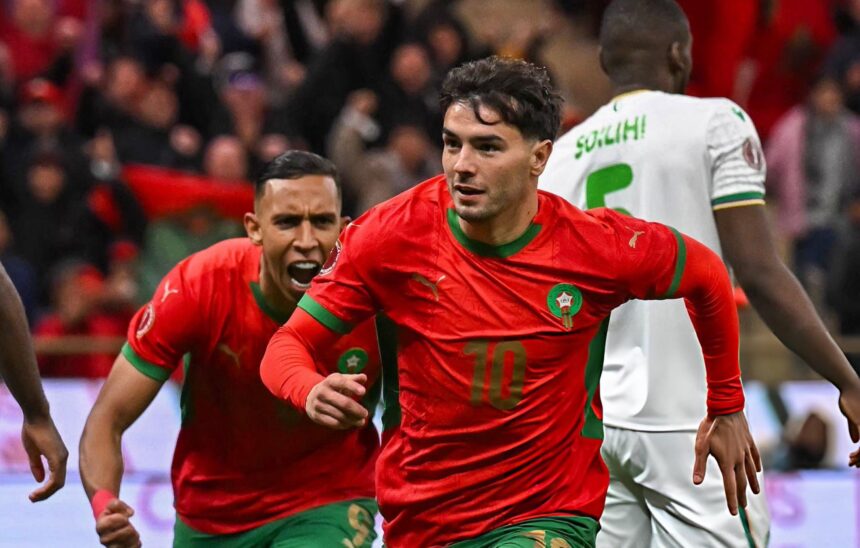
The host nation made a statement on opening night as AFCON 2025 kicks off with a convincing 2–0 victory for Morocco over Comoros.
Playing in front of a home crowd at the Prince Moulay Abdellah Stadium in Rabat, the Atlas Lions of Morocco overcame a stubborn Comorian defense to secure three vital points in Group A.
While the first half ended in a frustrating stalemate, including a missed penalty, the North African giants found their rhythm after the break to delight the home supporters.
After a tense opening 45 minutes where Comoros goalkeeper Yannick Pandor produced several heroic saves, the deadlock was finally broken in the 56th minute.
Real Madrid star Brahim Diaz capitalized on a loose ball in the box to slot home the tournament’s first goal, sending the stadium into a frenzy.
The highlight of the night, however, came in the 74th minute. Ayoub El Kaabi doubled the lead with a spectacular overhead scissor kick, a goal that is already being hailed as a potential goal-of-the-tournament contender.
This moment of individual brilliance ensured that as AFCON 2025 kicks off, the hosts are firmly positioned as the team to beat.
Pan-Atlantic Kompass reports that in the edition of the AFCON 2025, 24 teams have been split into six groups of four, with the hosts in Group A alongside Mali, 2012 winners Zambia, and Comoros.
Group F contains a heavyweight match-up, with holders Ivory Coast drawn alongside five-time champions Cameroon. Senegal against DR Congo in Group D also looks tasty.
Elsewhere, Egypt face 1996 winners South Africa in Group B, while Group C has an East African flavour, with Uganda and Tanzania taking on Nigeria and Tunisia.
Group A: Morocco, Mali, Zambia, Comoros.
Group B: Egypt, South Africa, Angola, Zimbabwe.
Group C: Nigeria, Tunisia, Uganda, Tanzania.
Group D: Senegal, DR Congo, Benin, Botswana.
Group E: Algeria, Burkina Faso, Equatorial Guinea, Sudan.
Group F: Ivory Coast, Cameroon, Gabon, Mozambique.
The top two in each group and the four best-ranked third-placed teams will advance to the last 16, with quarter-finals, semi-finals, a match for third place, and the final to follow.
Nine stadiums will be used in six host cities, with four venues in the capital Rabat.
- Prince Moulay Abdellah Stadium, Rabat (capacity 69,500)
- Complexe Sportif Prince Moulay Abdellah Olympic Stadium, Rabat (capacity 21,000)
- Complexe Sportif Prince Heritier Moulay El Hassan, Rabat (capacity 22,000)
- Stade El Barid, Rabat (capacity 18,000)
- Grande Stade d’Agadir, Agadir (capacity 45,480)
- Complexe Sportif de Fes, Fes (capacity 45,000)
- Grande Stade de Marrakech, Marrakech (capacity 45,240)
- Stade Mohammed V, Casablanca (capacity 67,000)
- Grande Stade de Tangier, Tangier (capacity 68,000)