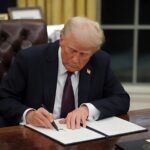

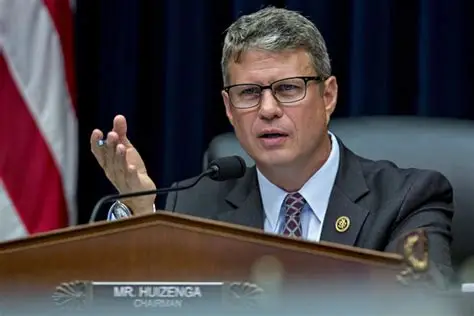
A United States Congressman, Bill Huizenga, has issued a rally call to the Nigerian government to be proactive in order to avoid the “boots on the ground” threat by U.S President Donald Trump.
Huizenga, who spoke with Arise TV during an interview monitored by the Pan-Atlantic Kompass, said the Nigerian government must take immediate, decisive action to protect religious freedom in Nigeria or face the possibility of a “boots on the ground” threat.
The U.S Congressman made this known on his second visit to Nigeria since the recent redesignation of Nigeria as a “Country of Particular Concern” (CPC) by Trump, a status reserved for nations that engage in or tolerate “systematic, ongoing, and egregious” violations of religious liberties.
Since the announcement, the Nigerian government has held several meetings with U.S officials over the possible removal of the country from the CPC designation. Part of the effort is the National Security Adviser, Nuhu Ribadu, leading a Nigerian delegation to a meeting with U.S officials.
Speaking during the interview, Huizenga commended the Nigerian government for showing efforts to address the issue of Christian genocide in the country.
However, he maintained that the Nigerian government must put in place concrete steps that have the potential to eradicate the issues. He stated that if the Nigerian government put in place these steps, the U.S. government would then be able to provide financial aid, thereby avoiding the “boots on the ground” threat.
He stated, “Well, proof is in the pudding, as the saying goes, in the US. And we’ll see, I think, as I said there, they (Nigerian government) seem to be coming into this with an attitude of wanting to work with and find common ground with the U.S government.
“That’s a very good first step. We will see that with actions. I tell you that with the time spent with the elected officials and the other government officials, we have had positive discussions, but again, we need to see how that really manifests.
“What I would say is we have seen intervening in some steps. Those intervening steps, the CPC designation, controlling those visas, putting some restrictions on visas, there are certainly many other steps.
“And I think as you and I talked back in Washington, I talked about some of those other steps that could and should be, in my opinion, taken before that.
“One of my colleagues had a great line where he said, we may not have boots on the ground right now, but we have a lot of shoes on the ground. And I thought that was, that was a great line, and in that, what he was trying to convey is we want to be there.
“If we see a program and a willingness that has a significant impact, or a potential for a significant impact, that’s the kind of thing that could warrant a significant investment of U.S taxpayer dollars.
“It may be through the World Food Program, UNHCR, or some other non-U.S. government entity. It could be nonprofits and religious faith-based organizations. But that’s the kind of mile marker I think that people like myself will be looking for from the Nigerian government. What are they doing to warrant that type of support?”
The U.S Congressman also warned that the Nigerian government must stop negotiating with terrorists and paying ransom.
He continued: “The general rule of thumb is that you don’t negotiate with terrorists. I can’t tell a local government official here in Nigeria what they should or shouldn’t be doing. I can encourage the federal government to take a hard line, which is what I think they ought to do for the betterment of their own future, just as a student of history and a student of college, politics, watching what is happening around the world, I think General Musa is probably very right.”