
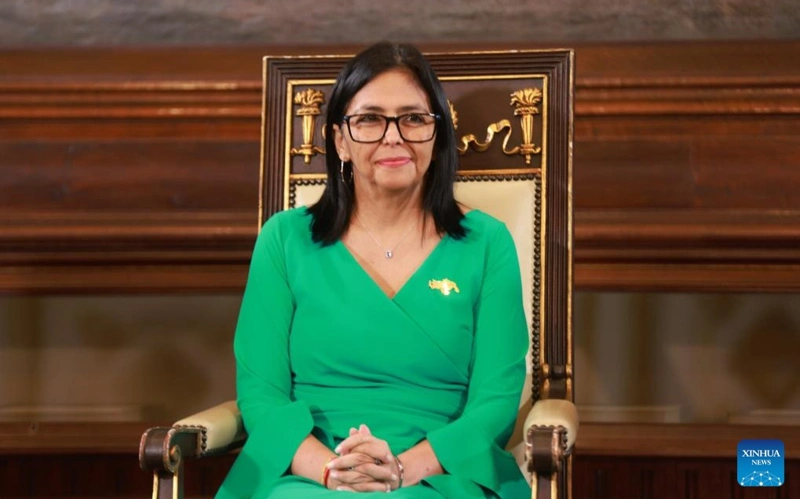
Delcy Rodríguez has officially been sworn in as the interim president of Venezuela.
The ceremony took place in the National Assembly, marking a significant transition of power following the capture of former President Nicolás Maduro by United States forces.
Rodriguez, who has served as the nation’s Vice President since 2018, took the oath of office administered by her brother, National Assembly President Jorge Rodriguez.
The swearing-in follows a ruling by the Venezuelan Supreme Court, which designated her as the acting leader to “guarantee administrative continuity” during what the government has termed the “kidnapping” of Maduro.
Addressing a packed chamber, Delcy Rodriguez expressed a “heavy heart” but remained firm in her new role.
Despite her long-standing loyalty to the Maduro administration, Delcy Rodriguez has signaled a willingness to engage with the United States.
In a statement released shortly after her inauguration, she invited the U.S. government to collaborate on an “agenda of cooperation” aimed at peaceful coexistence and shared development.
She said she was “in pain over the kidnapping of our heroes, the hostages in the United States,” referring to Maduro and his wife, Cilia Flores, who are currently on trial on alleged drug charges.
Also, the Venezuelan parliament denounced the capture of Maduro while vowing support for his stand-in, Rodriguez, after the U.S military attack that shocked Caracas and the world.
As Monday’s session opened, lawmakers chanted: “Let’s go, Nico!” — a slogan of Maduro’s presidential campaign ahead of the 2024 elections that were widely denounced by the opposition and dozens of global capitals, including Washington, as fraudulent.
Pan-Atlantic Kompass reports that Delcy Rodríguez, 56, is a powerful figure and longtime confidant of Maduro, and she has been backed thus far by Venezuela’s military commanders. She served as Venezuela’s vice president from 2018 until Sunday. Her brother Jorge Rodríguez also holds a senior role in the country, as president of the National Assembly, Venezuela’s legislature, which the Maduro regime has long controlled.
Rodríguez is also known for building bridges with Venezuela’s economic elites, foreign investors, and diplomats, presenting herself as a cosmopolitan technocrat in a militaristic and male-dominated government.
After Venezuela’s economy endured a crash from 2013 to 2021, she spearheaded a market-friendly overhaul.
Rodríguez rose to prominence after Maduro became president in 2013, following the death of Hugo Chávez, the founder of Venezuela’s Bolivarian political movement, which blends left-wing and nationalist ideals.
Maduro appointed her as communications minister, before naming her foreign affairs minister, the first woman to hold that post in Venezuela.
Shuttling between Latin American capitals, she often seemed to revel in feuding with conservative leaders.
In 2018, Rodríguez was promoted again, this time to the vice presidency, and the head of SEBIN, a Venezuelan intelligence agency. She took on additional duties in 2020 as economy minister and proceeded to extend an olive branch to business elites in Venezuela.
But she has also been targeted by sanctions from the United States, Canada, and the European Union for her role in supporting and helping to oversee crackdowns on dissent in Venezuela.
She is the daughter of Jorge Antonio Rodríguez, a Marxist leader who led the kidnapping in Venezuela of William Niehous, an American businessman who was held for three years in a jungle hideout and rescued in 1979.
Her father was arrested and charged for his role in the kidnapping and died in 1976, at the age of 34, after being interrogated by intelligence agents.