
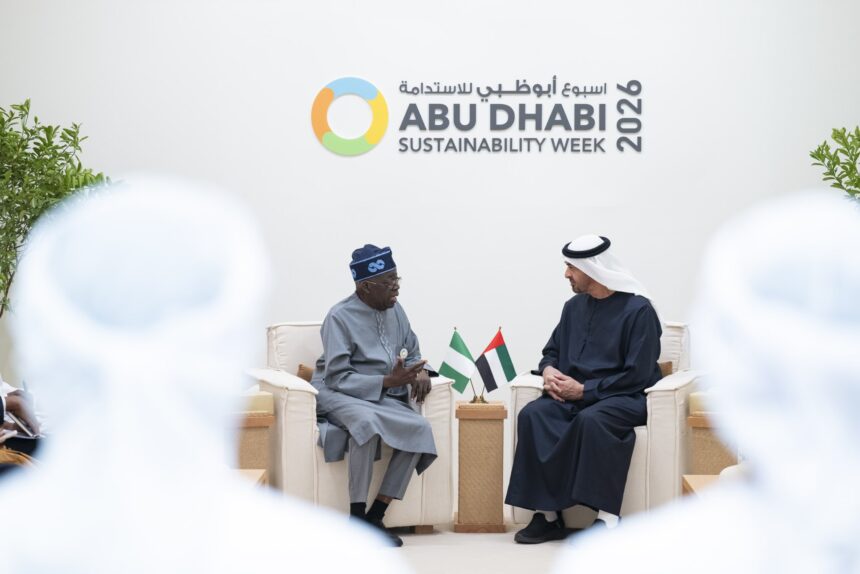
President Bola Ahmed Tinubu signed a trade and visa deal with the United Arab Emirates (UAE) on Tuesday, January 13, 2026.
The deal signed under the Comprehensive Economic Partnership Agreement (CEPA) represents significant development in bilateral relations between the two countries after years of friction.
Pan-Atlantic Kompass reports that Tinubu signed the trade and visa deal with the UAE at the ongoing Abu Dhabi Sustainability Week.
The deal promises to boost trade, unlock massive investments, and create new opportunities for Nigerian businesses, exporters, and workers.
The agreement, signed by Tinubu and UAE President Sheikh Mohamed bin Zayed Al Nahyan, focuses on deepening cooperation across key sectors including renewable energy, infrastructure, logistics, agriculture, digital trade, and climate-smart initiatives.
According to the Federal Ministry of Industry, Trade, and Investment, the deal with the UAE prioritizes market access for Nigerian goods and services while facilitating high-quality investment inflows.
One of the most beneficial aspects for Nigerian exporters is the elimination of tariffs on over 7,000 products by the UAE. This includes agricultural items like fish, seafood, oil seeds, and cereals, as well as industrial goods such as pharmaceuticals and chemicals.
As a result, Nigerian manufacturers and farmers can now scale up production and access the UAE market duty-free, boosting revenue and encouraging value-added exports.
The deal also positions Nigeria as an attractive gateway for international investors eyeing the African Continental Free Trade Area (AfCFTA), with its 1.4 billion consumers. UAE institutional investors, including major players like First Abu Dhabi Bank, have already shown strong interest in Nigerian infrastructure financing.
Additionally, the agreement enhances mobility for professionals. Nigerian business visitors can enter the UAE for up to 90 12 months to explore opportunities, and intra-corporate transferees such as managers and specialists can relocate with their companies for renewable three-year periods. These provisions make it easier for Nigerian entrepreneurs and skilled workers to engage in cross-border activities.
The statement reads: “Today marks a historic milestone in Nigeria’s trade relations. The Federal Republic of Nigeria and the United Arab Emirates signed a Comprehensive Economic Partnership Agreement CEPA that will transform economic ties between our two nations and deliver tangible benefits for Nigerian businesses, professionals, and workers.
“This Agreement is the product of focused and determined negotiations led by the Federal Ministry of Industry, Trade and Investment under the direction of the Honourable Minister and Chief Negotiator for Nigeria, Jumoke Oduwole.
“It prioritises market access for Nigerian goods and services, facilitates quality investment inflows, and advances our national economic diversification under the Renewed Hope Agenda of President Bola Tinubu.
“For Nigerian exporters, the UAE will eliminate tariffs on over 7,000 products. Immediately, our agricultural and industrial products – fish and seafood, oil seeds, cereals, cotton, pharmaceuticals, chemicals, and more- will enter the UAE market duty-free.
“Over the next three to five years, the UAE will eliminate tariffs on Nigerian machinery, vehicles, electrical equipment, apparel, and furniture. Nigerian industrial exports now have a clear and competitive pathway into one of the world’s most dynamic trading hubs
“In addition, Nigerian businesses can establish operations in the UAE through new corporate entities, branches, and subsidiaries.
“Nigerian business visitors can enter the UAE for up to 90 days in 12 months to explore trade and investment opportunities, while intra-corporate transferees, our managers, executives, and specialists, can relocate with their corporate entities for renewable three-year periods.
“For Nigeria’s investment climate, this Agreement addresses longstanding impediments to foreign direct investment. UAE investors now have clarity and confidence to invest in Nigeria’s productive sectors.
“This will support Nigeria’s industrialisation agenda, enhance transport and logistics connectivity, and contribute to the creation of quality jobs for our youthful population.”
Further breakdown revealed that under Nigeria’s tariff commitments, the country will immediately eliminate tariffs on 3,949 out of 6,243 products, representing 63.3% of covered goods.
A further 2,294 products, or 36.7%, will see tariffs eliminated over five years, while 123 products are excluded. In total, 6,243 products will be liberalised by Nigeria.
Pan-Atlantic Kompass reports that Tinubu signed the trade and visa deal with the UAE at the 2026 edition of Abu Dhabi Sustainability Week (ADSW), which began on Monday.
The Nigerian delegation, led by Tinubu, is currently in Abu Dhabi for the summit.
According to a statement from the Presidency, aside from the Minister of Trade, several other ministers, including the Minister of Budget and Planning, Atiku Bagudu; Nigeria’s Minister of Foreign Affairs, Ambassador Yusuf Maitama, and the Director-General of the National Intelligence Agency, Ambassador Mohammed Mohammed, are also in Abu Dhabi.
The 2026 Abu Dhabi Sustainability Week, with the theme “The Nexus of Next, All Systems Go,” is a global platform that brings together world leaders, policymakers, investors, and experts to advance dialogue and action on sustainable development, climate action, energy transition, and inclusive economic growth.