

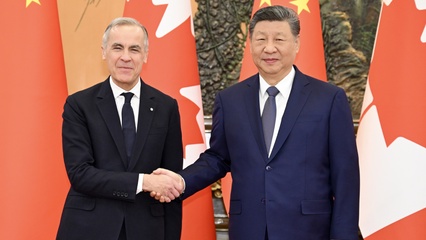
China has signaled stronger ties with Canada through high-level engagements during Canadian Prime Minister Mark Carney’s landmark visit to Beijing, the first by a Canadian leader in nearly a decade.
The trip is said to be a step in thawing China-Canada relations, which have been strained for years due to trade disputes, tariffs, and geopolitical tensions.
Carney met with Chinese President Xi Jinping at the Great Hall of the People on Friday, where both leaders expressed optimism about rebuilding bilateral cooperation.
Xi described their previous encounter at the APEC summit in South Korea in October 2025 as a “turnaround” point, stating that it opened a new chapter in improving China-Canada relations.
He emphasized that the healthy and stable development of these ties serves the common interests of both nations.
The visit comes amid shifting global dynamics, particularly Canada’s efforts to diversify trade partnerships away from heavy reliance on the United States, which has imposed new tariffs and created economic uncertainties under the current U.S. administration of President Donald Trump.
After China signaled stronger ties with Canada, the two countries are expected to trade tariffs.
China is expected to lower levies on Canadian canola oil from 85% to 15% by 1 March, while Ottawa has agreed to tax Chinese electric vehicles at the most-favoured-nation rate, 6.1%, Carney told reporters.
The deal could also see more Chinese investments in Canada, right on America’s doorstep.
Carney told the press that the development was a result of Trump’s tariffs.
He told reporters that Canada’s relationship with China had been more “predictable” in recent months and that he found talks with Beijing “realistic and respectful”.
He also made clear Ottawa does not agree with Beijing on everything, adding that in his discussions with Xi, he made clear Canada’s “red lines”, including human rights, concerns over election interference, and the need for “guardrails”.
“We take the world as it is – not as we wish it to be,” he said when asked about China’s human rights record.
Carney said the “world has changed dramatically” and that how Canada positions itself “will shape our future for decades to come,” he added.
Speaking to reporters, Carney was clear that with countries that do not share the same values, Ottawa will engage in a “narrower, more specific” manner.
“We’re very clear about where we cooperate, where we differ,” he said, adding that Chinese claims over self-governed Taiwan and Hong Kong’s jailed pro-democracy figure Jimmy Lai came up in “broad discussions”.
Canada and China have “different systems”, he said, which limits the breadth of their cooperation.
“But to have an effective relationship, we have direct conversations. We don’t grab a megaphone and have the conversations that way.”
As the Chinese and Canadian delegations sat down in the Great Hall of the People on Friday, Xi said: “The healthy and stable development of China-Canada relations is conducive to world peace, stability, development, and prosperity.”
Recall that in 2024, Canada imposed 100% tariffs on Chinese electric vehicles.
Last year, Beijing retaliated with tariffs on more than $2bn (£1.5bn) of Canadian farm and food products like canola seed and oil. As a result, Chinese imports of Canadian goods fell by 10% in 2025.
In the deal struck on Friday, Canada will allow only 49,000 Chinese electric vehicles into the Canadian market at the 6.1% tariff rate.
The cap is in response to Canadian automakers’ fears of an influx of affordable Chinese EVs.
As well as relief for canola producers, there will also be reduced tariffs on Canadian lobsters, crabs, and peas.
China is Canada’s second-largest trading partner but it’s still a long way behind the U.S in volume.