
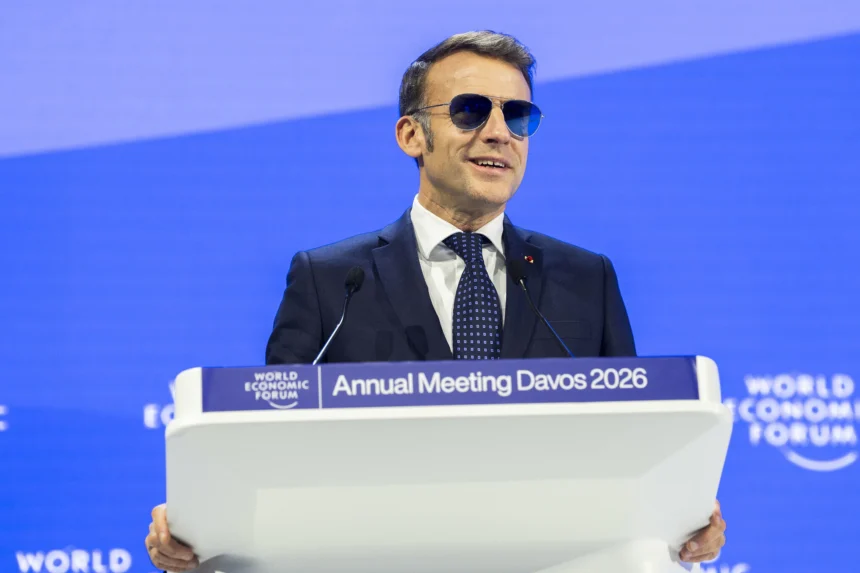
French President Emmanuel Macron has drawn a line in the sand, labeling U.S President Donald Trump’s tariff threats against Europe “neocolonial aggression.”
Marcon, addressing global leaders at the World Economic Forum in Davos, Switzerland, maintained that France will not be bullied into geopolitical concessions through economic blackmail.
Trump’s tariff threat against Europe was made days ago. A 10% tariff will be applied to all goods from eight European nations—Denmark, France, Germany, the UK, Norway, Sweden, Finland, and the Netherlands—unless Denmark agrees to the “complete and total purchase” of Greenland by the United States.
Trump has been pushing to seize Greenland, and he has vowed to place tariffs on imports from Denmark and seven other European Union allies.
Trump further warned that these duties would skyrocket to 25% on June 1 if a deal is not reached.
However, Macron called Trump’s tariff threats against Europe “a very concerning time” in international cooperation.
Marcon stated: “It’s as well a shift towards a world without rules. Where international law is trampled underfoot and where the only laws it seems to matter is that of the strongest. And imperial ambitions are resurfacing. Obviously the Russian war, the Russian war of aggression against Ukraine, which will enter into its fourth year next month, and conflicts continue in the Middle East and across Africa.
“This is as well as shift towards a world without effective collective governance and where multilateralism is weakened by powers that obstruct it or turn away from it, and rules are undermined.
“And I can multiply the examples of international bodies weakened or left by the key economies. And when we look at the situation, it’s clearly a very concerning time, because we are killing this structure where we can fix the situation and the common challenges we have.
“Without collective governance, cooperation gives way to relentless competition. Competition from the United States of America through trade agreements that undermine our export interests, demand maximum concessions and openly aim to weaken and subordinate Europe, combined with an endless accumulation of new tariffs that are fundamentally unacceptable – even more so when they are used as leverage against territorial sovereignty.
“And competition from China, where massive excess capacities and distortive practices threaten to overwhelm entire industrial and commercial sectors. Export control has become more dangerous, new tools destabilizing global trade and the international system.
“And the answer, in order to fix this issue, is more cooperation. And building new approaches. And it’s clearly building more economic sovereignty and strategic economy, especially for the Europeans, which, for me, is the core answer.
“In this context. I want to exclude two approaches. The first approach would be to, I would say, to passively accept the law of the strongest, leading to vassalization and bloc politics. I think accepting the sort of new colonial approach doesn’t make sense. And all the heads of state and government and business leaders, which would be too complacent with such an approach, will take a huge responsibility.
“The second would be to adopt a purely moral posture, limiting ourselves to commentary. That would condemn us to marginalization and powerlessness. Faced with the brutalization of the world, France and Europe must defend an effective multilateralism because it serves our interests and those of all who refuse to submit to the role of force.
“And for me, the two answers, on one side more sovereignty and more autonomy for the Europeans, on the other side, an efficient multilateralism to deliver results through cooperation. Obviously, France and Europe are attached to national sovereignty and independence, to the United Nations and to its charter. And it’s not an old-fashioned way to leave multilateralism.”
Speaking also to the World Economic Forum, President of the European Commission Ursula von der Leyen said that geopolitical shocks must “serve as an opportunity for Europe”.
She added that the “seismic change” that the world is seeing is an opportunity to build a “new form of European independence”.
The EU President said: “If this change is permanent, then Europe must change permanently too.
“It is time to seize this opportunity and build a new independent Europe”
She further stated that the EU is choosing “fair trade over tariffs, partnership over isolation, sustainability over exploitation”.