
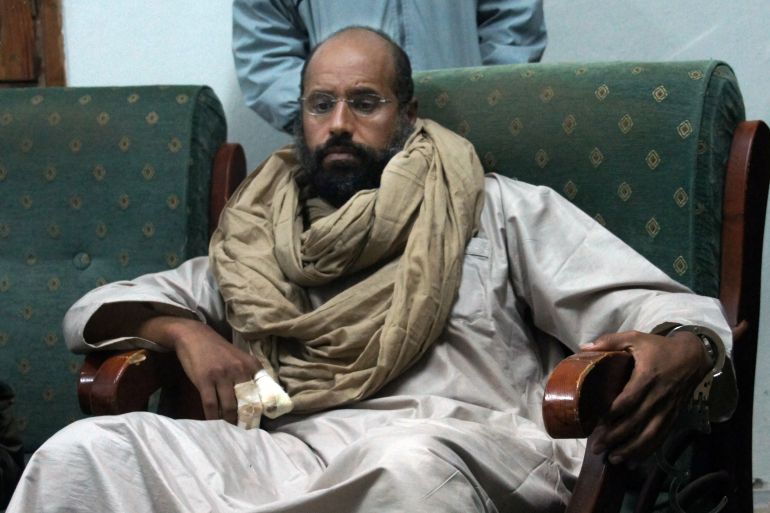
Saif al-Islam Gaddafi, the most prominent son of former Libyan leader Muammar Gaddafi has been reportedly killed in Libya by gunmen at his residence in the western city of Zintan.
The 53-year-old son of the late Gaddafi was reportedly targeted in a sophisticated operation that has sent shockwaves through the North African nation and the international community.
According to statements from his political office and legal team, the assault occurred in the early hours of Tuesday.
A group of four masked assailants reportedly disabled the residence’s surveillance systems before engaging in a “confrontation” with Gaddafi.
While some conflicting reports initially suggested he died near the Algerian border, his advisor, Abdullah Othman, and lawyer, Khaled al-Zaidi, have since corroborated the accounts of a targeted hit within Zintan. The Libyan Attorney General’s Office has reportedly opened an investigation, though no group has yet claimed responsibility for the operation.
The statement said that he clashed with the assailants, who closed the security cameras at the house “in a desperate attempt to conceal traces of their heinous crimes”.
Pan-Atlantic Kompass reports that Saif al-Islam Gaddafi never had an official position in Libya, but was considered to be his father’s number two from 2000 until 2011, when Muammar Gaddafi was killed by Libyan opposition forces, ending his decades-long rule.
Saif al-Islam Gaddafi was captured and imprisoned in Zintan in 2011 after attempting to flee the North African country following the opposition’s takeover of Tripoli.
He was released in 2017 as part of a general pardon and has been living in Zintan since then.
Born in June 1972 in Tripoli, Saif al-Islam Gaddafi was the second-born son of Libya’s longtime ruler.
A Western-educated and well-spoken man, Gaddafi presented a progressive face to the oppressive government run by his father, and he played a leading role in a drive to repair Libya’s relations with the West, beginning in the early 2000s.
He led talks on Libya abandoning its weapons of mass destruction and negotiated compensation for the families of those killed in the bombing of Pan Am Flight 103 over Lockerbie, Scotland, in 1988.
Educated at the London School of Economics and a fluent English speaker, he also championed himself as a reformer, calling for a constitution and respect for human rights. His dissertation dealt with the role of civil society in reforming global governance.
But when the rebellion broke out against the elder Gaddafi’s long rule in 2011, Saif al-Islam Gaddafi immediately chose family and clan loyalties, becoming an architect of the brutal crackdown on dissidents, whom he called rats.