
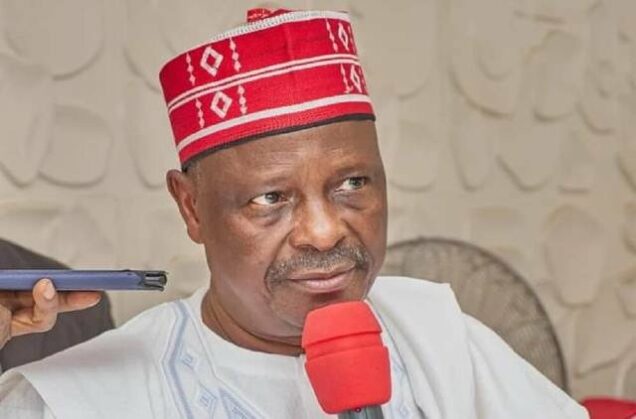
A diplomatic firestorm kicked off on Tuesday after a new bill before the United States House of Representatives named former Kano State Governor and the leader of the New Nigeria Peoples Party (NNPP) Rabiu Musa Kwankwaso as part of people facing potential U.S sanctions over Christian genocide allegations.
The proposed legislation, introduced in the U.S. House of Representatives, signals the first time a politician was publicly named complicit in religious freedom violations in Nigeria since the discussions emerged on the front burner in 2025.
The bill, titled the Nigeria Religious Freedom and Accountability Act of 2026 (H.R. 7457), was introduced on February 10, 2026, by a group of Republican lawmakers including Congressmen Chris Smith and Riley Moore.
The legislation seeks to compel the U.S Secretary of State to provide a comprehensive report on religious persecution and mass atrocities in Nigeria.
Central to the bill is the recommendation for targeted U.S sanctions over Christian genocide claims, specifically invoking the Global Magnitsky Human Rights Accountability Act.
These measures would include visa bans and the freezing of U.S.-based assets for individuals listed as “persons of concern.”
While the inclusion of Kwankwaso, a prominent political figure and former presidential candidate, has sent shockwaves through the Nigerian political caucus, the possible reason behind the decision has emerged.
It was gathered that many U.S lawmakers have pointed to Kwankwaso’s record, specifically the institution of Sharia law during his tenure as Governor of Kano State.
Critics in the U.S Congress argue that the legal frameworks established during that era contributed to an environment where religious minorities face systemic discrimination.
Specifically, Congressman Riley Moore has questioned Kwankwaso’s role in the implementation of Sharia-based capital punishment for blasphemy, linking such legal structures to broader patterns of religious violence.
Recall that after Kwankwaso reacted to the designation of Nigeria as a Country of Particular Concern (CPC), Moore criticised him for being the cause of the issue.
Moore had written to Kwankwaso saying, “Governor, do you care to comment on your own complicity in the death of Christians? You instituted Sharia law. You signed the law that makes so-called blasphemy punishable by death.”
Kano State, under Kwankwaso’s leadership, implemented the Islamic legal code, joining other northern states such as Zamfara, Sokoto, Katsina, Yobe, Jigawa, and Borno.
Meanwhile, reactions have begun to trail the naming of Kwankwaso as part of people facing U.S sanctions over alleged involvement in Christian genocide.
The All Progressives Congress and the New Nigeria Peoples Party have rejected the proposed visa bans and asset freezes recommended by United States lawmakers against Kwankwaso, the Miyetti Allah Cattle Breeders Association of Nigeria, and the Miyetti Allah Kautal Hore over alleged violations of religious freedoms in Nigeria.
The APC Director of Publicity, Bala Ibrahim, described the United States as a symbol of democracy and cautioned its government against taking action solely based on allegations.
He stated, “I think they (the United States of America) cannot just act on allegations. America is the beacon of democracy. America is the beacon of freedom, and it ought to be seen to be behaving in that manner.
“Now, whatever the allegation against former Kano State Governor, Rabiu Musa Kwankwaso, and others is, it remains an allegation until it is proven.
“They cannot, on the strength of an allegation alone, go ahead to suggest a ban or restriction on the freedom of movement of an individual without substantiating it, without subjecting him to a fair hearing and trial.
“So I think that is a wrong move. It infringes on his right to a fair hearing, and I don’t support that.”
The NNPP, on the other hand, described the planned censure of its national leader as blackmail.
The National Publicity Secretary of the party, Ladipo Johnson, stated, “We see this development as a contrived action against an innocent man who clearly has no relationship with religious fundamentalism in Nigeria.
“His record is there in the public domain, either in public office or in private life and people should investigate such things properly, before reaching such conclusions.
“The months before the latest development, Kwankwaso had openly reacted when President Donald Trump re-designated Nigeria as a Country of Particular Concern over alleged religious persecution.
“In a statement posted on his X handle at the time, Kwankwaso cautioned against what he described as oversimplified characterisations of Nigeria’s internal challenges.
“Kwankwaso stated that it was important to emphasise that our country is a sovereign nation whose people face different threats from outlaws across the country.
“But is this enough to accuse Kwankwaso of severe religious freedom violations? Why were the other state governors who introduced Sharia in their states not accused as well? Is Rep Moore being fair or selective?
‘Isn’t the US in a good relationship with Qatar and Saudi Arabia (both Sharia countries)? Why is this coming just after our government apparently paid for a consultant in the US? Isn’t it strange that it is Kwankwaso, an opposition leader who has spoken out so many times about the insecurity under this administration, that the United States now seems to be turning on?”