

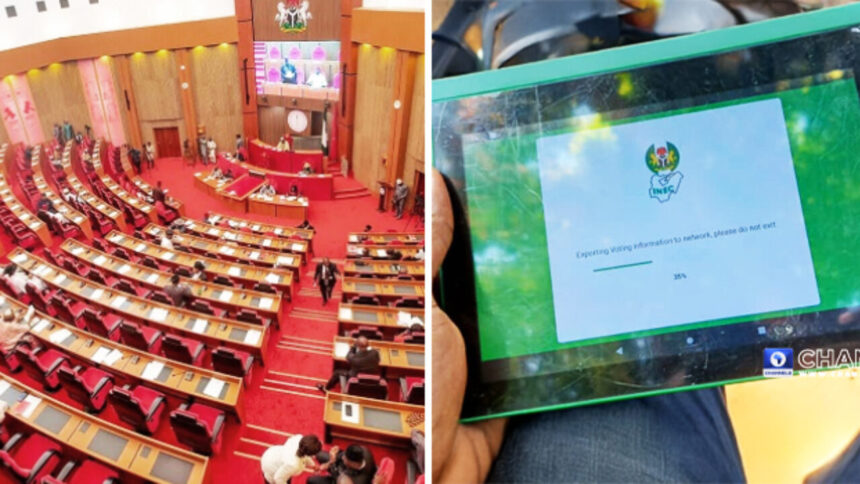
As the 2027 general elections approach, the debate over how votes are to be counted and reported has moved to the forefront of national discourse.
The National Assembly recently passed the Electoral Act (Repeal and Enactment) Bill of 2026 which introduced digital and manual transmission of results.
The primary concern for stakeholders remains the implications of dual result transmission, a policy that integrates both electronic uploads and manual paper trails to determine election outcomes.
In the Senate, lawmakers voted for the manual backup for results transmission, retaining provisions in Clause 60 of the Electoral Act Amendment Bill.
This provision allows manual transmission of election results where a network failure occurs.
55 senators, mostly from the ruling All Progressives Congress and two opposition members, voted in favour of retaining the proviso allowing manual transmission where the network fails.
Fifteen opposition senators voted against it, insisting on mandatory real-time electronic transmission.
With the decision, the Senate effectively reaffirmed its earlier position that while electronic transmission of results is permitted, the duly signed Form EC8A by the Presiding Officer and counter-signed by party agents (where available) shall serve as the primary source of results in the event of network failure.
Also, the House of Representatives has stepped down from its earlier decision on real-time transmission of election results and adopted the Senate version.
Following the development, experts argue that this hybridity is a double-edged sword.
While lawmakers argued that the inclusion of digital and manual results transmission acknowledged the reality of Nigeria’s digital divide, many Nigerians pointed out that it creates a “discretionary gap” that critics fear could be exploited.
Speaking on the development, a former Resident Electoral Commissioner of the Independent National Electoral Commission, INEC, Mike Igini, has warned that the hybridity of election results transmission in the Electoral Act amendment bill could endanger the lives of presiding officers during the 2027 general elections.
Igini raised the concern on Wednesday while speaking on The Morning Show on Arise Television, monitored by the Pan-Atlantic Kompass.
According to him, the proposed changes could reintroduce a system similar to the former “Incident Form,” particularly in situations where election officials claim there is no network connectivity for electronic transmission of results.
He warned that such a scenario of having digital and manual transmission of results could create tension at polling units, especially where voters can confirm network availability on their mobile devices while a presiding officer insists otherwise.
Igini said this could expose presiding officers, many of whom are members of the National Youth Service Corps (NYSC), to potential danger from aggrieved voters.
He noted that the children of political elites are not the ones deployed to polling units, but rather youth corps members who bear the brunt of election-day responsibilities.
Igini said: “The consequence, the danger of what has been passed is that we are bringing back what they call “incident form”. This is another version of the incident form because there will be no network.
“The danger of what is going to happen in 2027 is as follows – the polling units presiding over officers’ lives are going to be in danger. This is because when Nigerians are gathered and the results of polling units are being announced, everyone can look at their telephone and see the network, but if the presiding officer says there is no network, you are going to put the life of that presiding officer in danger.
“Meanwhile, the children of all the political elites are not going to be at the polling unit. It’s the youth corps members who are going to be faced with this clear danger.
“You know that in 2015 and 2019 there was evidence of collusion of some of our staff, when they gave the serial number of ECA in certain polling units for people to print, where you will now have the same serial number and the essential feature. And where they are transmitted to the iReV, which one are you going to pick?”
Meanwhile, in a surprising turn of event Nigerian telecommunications operators have strongly refuted claims by the Senate that inadequate network coverage prevents mandatory real-time electronic transmission of election results.
The Association of Licensed Telecom Operators of Nigeria (ALTON), representing key players including MTN Nigeria, Airtel, Globacom, and others, described the Senate’s position as relying on “half-truths” and outdated or unsubstantiated data.
ALTON Chairman Engr. Gbenga Adebayo emphasized that Nigeria’s telecom infrastructure is more than sufficient to support the upload of polling unit results to the Independent National Electoral Commission’s (INEC) Result Viewing Portal (IReV).
“Over 70% of the country is covered with 3G and 4G networks, with 5G now at about 11% coverage, and the remaining areas served by 2G,” Adebayo stated.
He stressed that transmitting scanned result sheets (Form EC8A) requires only basic connectivity, which even 2G networks can reliably provide.
“Even in reality, 2G is strong enough to transmit results electronically,” he added.
The telcos urged lawmakers and the public to rely exclusively on official statistics from the Nigerian Communications Commission (NCC) rather than selective or inaccurate claims.