
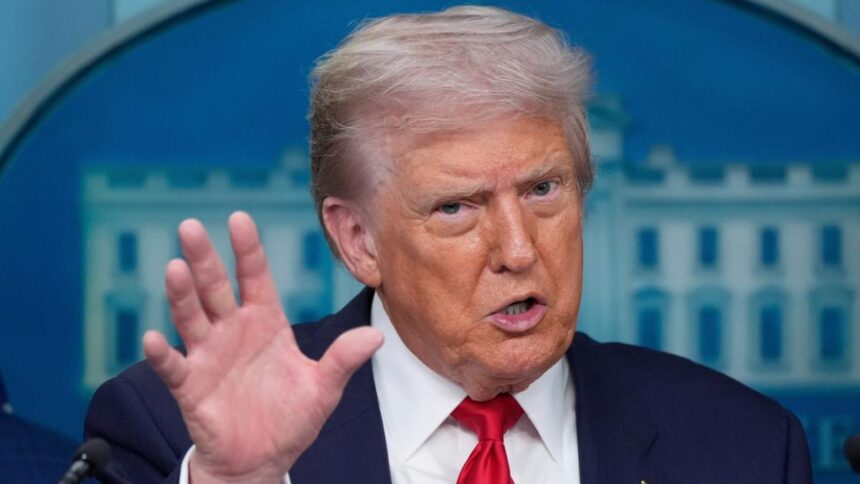
The administration of United States President Donald Trump is set for a massive fiscal and legal challenge as many importers have begun to submit tariff refund requests following a Supreme Court ruling that invalidated billions of dollars in import duties.
Official data from the U.S. Customs agency revealed that Trump’s administration has already collected $133 billion in International Emergency Economic Powers Act (IEEPA) tariffs as of mid-December 2025.
This means the U.S government could be on the hook for nearly $133 billion in tariff refund requests after the highest court ruled 6-3 that the administration exceeded its constitutional authority.
Pan-Atlantic Kompass had reported that in the consolidated cases of Trump v. V.O.S. Selections, Inc. and Learning Resources, Inc. v. Trump, the Supreme Court held that the IEEPA does not grant the President the power to unilaterally impose taxes or tariffs.
Chief Justice John Roberts, writing for the majority, emphasized that the power to levy duties is a “branch of the taxing power” reserved exclusively for Congress under Article I.
This ruling effectively struck down the “Liberation Day” reciprocal tariffs and the “trafficking” duties placed on imports from China, Canada, and Mexico earlier in 2025.
While Trump has already moved to replace these with a 10% global surcharge under Section 122 of the Trade Act of 1974, the legal focus has shifted to the massive backlog of tariff refund requests from U.S importers who have been paying these “illegal” duties for over a year.
Already, two U.S. Governors have sent tariff refund requests to Trump’s administration.
Illinois Governor JB Pritzker sent Trump an invoice demanding nearly $9 billion in tariff refunds for Illinois families.
Pritzker urged the White House to “cut the check” after justices ruled 6-3 that Trump had exceeded his authority by invoking emergency powers to impose tariffs that reshaped global trade and pushed up prices at home.
“Your tariff taxes wreaked havoc on farmers, enraged our allies, and sent grocery prices through the roof,” the Governor wrote, warning further legal action could follow if compensation was not forthcoming.
In the letter, shared with the media, Pritzker demanded about $1,700 for every Illinois household, the amount Yale University experts said the average U.S household would pay on tariffs last year.
Also, California Governor Gavin Newsom said the money Trump’s tariffs had raised came from U.S voters’ pockets and should be refunded.
“Time to pay the piper, Donald. These tariffs were nothing more than an illegal cash grab that drove up prices and hurt working families, so you could wreck longstanding alliances and extort them,” he said.
“Every dollar unlawfully taken must be refunded immediately — with interest. Cough up!”
Similarly, Nevada State Treasurer Zach Conine has requested more than $2 billion from the federal government to recoup tariff costs for Nevadans.
Conine said the amount came from data from the U.S Joint Economic Committee, which found tariffs have cost Americans almost $2,000 per household since February of last year.
“As Nevada’s chief investment officer, I have a responsibility to try to recoup every single dollar that the Trump Administration takes from Nevada families,” said Conine in a statement.
Meanwhile, several economic experts have opined that while the end of the IEEPA tariffs could help the U.S economy by easing inflationary pressures, the impacts are likely to be modest.
Most countries still face steep tariffs from the U.S on specific sectors, and Trump intends to replace the IEEPA levies using other options.
Some legal experts have also pointed out that the U.S. Customs agency does have a process for refunding duties when importers can show there’s been some kind of error.
The agency might try to build on the existing system to refund Trump’s IEEPA tariffs, said trade lawyer Dave Townsend, a partner with the law firm Dorsey & Whitney.
“Just because the process is difficult to administer doesn’t mean the government has the right to hold on to fees that were collected unlawfully,″ said trade lawyer Alexis Early, partner at the law firm Bryan Cave Leighton Paisner.
Ryan Majerus, a partner at King & Spalding and a former U.S. trade official, said: “It’s hard to know how the government will deal with the massive demand for refunds. It might try to streamline the process, perhaps setting up a special website where importers can claim their refunds.”