
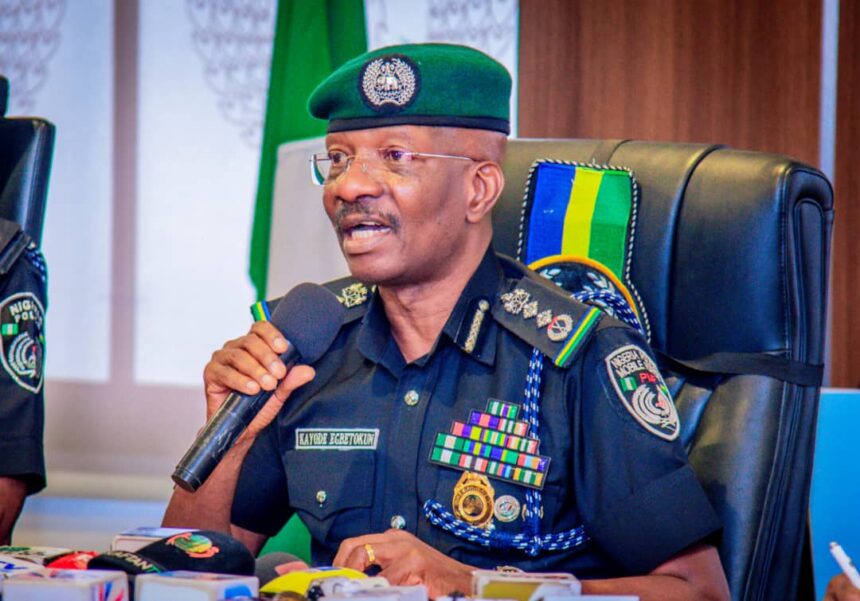
On Tuesday, President Bola Tinubu formally accepted the resignation of Inspector-General of Police, Kayode Adeolu Egbetokun (PhD).
- Creation of the Special Intervention Squad (SIS)
- Creation of Additional Squadrons
- Creation of Housing and Accommodation Scheme
- Insurance, Pension, and Financial Support
- Health, Safety, and Mental Wellness
- Recognition and Career Incentives
- Partnering with U.S to Train Police Officers
- Law, Intelligence, and Investigation
- Elevation of FID
- Safe School Protection Squad (SPS)
In a statement, the President lauded the outgoing IGP for his “professionalism and steadfast commitment” to the nation, specifically highlighting how his tenure laid a modern foundation for the Force.
The President noted that the police reforms under Egbetokun were instrumental in earning the NPF the award for the “Most Improved Service Delivery Parastatal” in 2024.
The statement reads: “I have accepted the resignation of the Inspector General of Police, Mr. Kayode Egbetokun, following his letter citing pressing family considerations.
“I thank him for his decades of distinguished service to the Nigeria Police Force and our nation. His dedication, professionalism, and commitment to strengthening our internal security architecture are deeply appreciated.”
Appointed, precisely, as the Inspector General of Police on June 19, 2023, Dr. Egbetokun, 61, assumed the mantle of leadership at the Force with a strong academic background in mathematics and security studies, having bagged a PhD in Peace and Security Studies.
Before he was appointed the IGP, Egbetokun had worked in sundry capacities within the Police Force; as Chief Security Officer to the Lagos State Governor from 1999 -2005; as Commander of the Rapid Response Squad, also in Lagos; as area Commander in Osogbo and Gusau, and even as Commissioner of Police in Kwara state.
Dr. Egbetokun, the first Inspector-General of Police from Ogun State, hails from Erinja-Orile, a Yewa town in the Ogun West Senatorial District, and is of royal lineage.
Charles Omole, a lawyer and Security Consultant who spoke with Channels TV Tuesday, monitored by Pan-Atlantic Kompass, highlighted the numerous police reforms under Egbetokun.
He said: “Egbetokun was the best choice of the cohort that the President had to choose from, where in 2023. So, from that perspective, he was the right man for the right time. Since his IGship, he has done a lot of heavy lifting.
“The challenge with the reforms, such as the police, is that a lot of the changes and improvements you’ve made take a bit of time for it to reflect in people’s day-to-day experience.
“Let me give you a typical example, the police act envisages that every police division has a lawyer, and must be a police officer. Part of the expectation of the lawmakers is that it will not only make sure the police officers behave within the ambit of the law, but also help strengthen human rights enforcement at the division level.
“But nothing has been done about that since the police act was in place. Except when Egbetokun got there, for example, just over 100 graduates from the police academy went to law school and became lawyers. That is the highest infusion of lawyers as officers in the history of the Nigerian police. Now, things like that will not feed into public perception until months or even years later.”
Pan-Atlantic Kompass, in this article, highlights key reforms under Egbetokun that will continue to shape the future of policing in Nigeria as the police czar exits the Force.
Creation of the Special Intervention Squad (SIS)
One of the police reforms under Egbetokun was the launch of a Special Intervention Squad, initially in the Federal Capital Territory (FCT), in January 2024, to combat kidnapping and banditry. It was designed as an elite, rapid-response unit and has been replicated across all 36 states.
Creation of Additional Squadrons
In February 2026, Egbetokun disclosed that the Nigeria Police Force had expanded its Mobile Force with the creation of six additional squadrons, thereby increasing the nationwide number from 74 to 80.
The IGP explained that the expansion was intended to enhance rapid response capability and provide improved tactical support in addressing high-risk security situations wherever they occur across the country.
Creation of Housing and Accommodation Scheme
Egbetokun launched a Police Housing Scheme to provide affordable houses to officers of all ranks across Nigeria. He also initiated the redevelopment of deteriorated police barracks nationwide.
Similarly, the Police Housing Summit convened under his leadership to strategise how to address the long-standing accommodation challenges.
Insurance, Pension, and Financial Support
Egbetokun has expanded and improved insurance schemes like Group Life Assurance, Personal Accident schemes, Family Welfare schemes, Nigeria Police Welfare Insurance Scheme.
He also regularised disbursements under the IGP Family Welfare Scheme. In January 2024, ₦2.86 billion was disbursed to 785 beneficiaries. As of September 2025, over Twenty-Four Billion, Two Hundred Million Naira (N24.2B) has been disbursed, benefiting 9,735 families of fallen officers.
Health, Safety, and Mental Wellness
The former police boss unveiled healthcare reforms within the Nigeria Police Force, which brought together all heads of Police Medical Facilities to chart a new course for officers’ wellbeing.
He also upgraded the Nigeria Police Medical Services to a full-fledged Directorate in August 2025. The Police Medical system was also expanded with 164 hospitals, clinics, and medical posts spread across Nigeria.
Recognition and Career Incentives
While Egbetokun was in the saddle, there was the introduction of awards and commendations for officers and teams who perform meritoriously. Also, there were more predictable/promised improvements in promotions, clearer expectations, and more engagement with personnel welfare beyond mere security operations.
Partnering with U.S to Train Police Officers
Under Egbetokun, the NPF, in collaboration with the International Narcotics and Law Enforcement Affairs (INL) of the United States of America, inaugurated a specialized tactical operational training programme for Commanders of the newly launched Special Intervention Squad (SIS).
The specialized training was designed to prepare the trainees for the challenges associated with their new responsibility of taking up the lead positions in combating the scourge of kidnapping, banditry, armed robbery, terrorism, and other evolving challenges of crime confronting our society.
Law, Intelligence, and Investigation
Under IGP Egbetokun, professionalism has accelerated. For the first time, the NPF’s Legal Department has become a full Directorate, supported by a pipeline of 100 Police Academy graduates admitted into the Nigerian Law School, with dozens called to the Bar to elevate investigative and prosecutorial quality within the Force.
Elevation of FID
The Force Intelligence Department (FID) was formally elevated to a DIG-led Directorate, with state and zonal FID offices realigned for tighter coordination and accountability. The Force Intelligence Department is strategically designed to provide timely, reliable, and actionable intelligence to support policing operations nationwide.
Safe School Protection Squad (SPS)
Under Egbetokun, the SPS was launched by state commands and zonal formations in Lagos, Benue, Delta, Osun, Bauchi, Nasarawa, among others. This specialised unit focuses on securing educational facilities, protecting students and teachers, and responding swiftly to threats against learning environments. Its creation aligns with Nigeria’s National Policy on Safety, Security, and Violence-Free Schools, supported by development partners such as UNICEF, which has consistently advocated for minimum safety standards in schools.