
A devastating new report from the Armed Conflict Location & Event Data Project (ACLED) has revealed that terrorist attacks in Nigeria, Benin, and the Niger border zone surged by 262% over the course of 2025.
This dramatic escalation marks a shift in the regional security landscape, as extremist groups successfully transition from rural insurgencies to coordinated cross-border offensives.
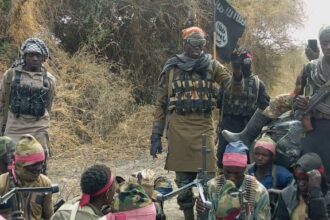
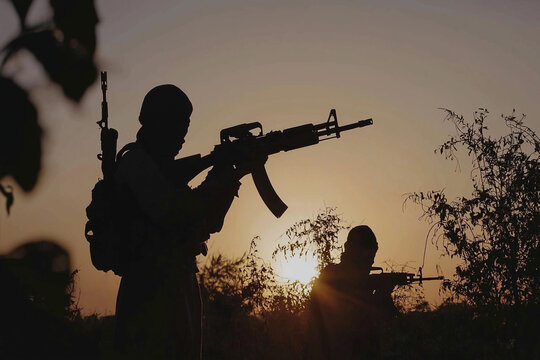
The report revealed that the tri-border area, which was once a series of remote transit corridors has now become the primary frontline for the al-Qaeda-linked Jama’at Nusrat al-Islam wal-Muslimin (JNIM) and the Islamic State Sahel Province (ISSP).
The report also revealed that terrorist attacks in Nigeria, Benin, and the Niger border zone surged by 262% as a result of a deliberate “southward expansion” strategy.
By exploiting porous borders and the breakdown of regional military cooperation, these groups have entrenched themselves in Benin’s Alibori and Borgou departments, as well as Nigeria’s Kebbi and Sokoto states.
Parts of Benin, the Niger Republic, and Nigeria’s Sokoto, Kebbi, Niger, and Kwara states contributed to an 86 percent increase in violent events.
In the Thursday report, Héni Nsaibia, ACLED’s senior analyst for West Africa, said the threats have taken on new dimensions as the militants expand their footprint.
The report noted that the militant groups have devised strategic communications as a means of inter-competition to demonstrate the capacity of maintaining presence and influence in the borderlands.
Between June and November 2025, JNIM publicly claimed a series of attacks in Basso, Wara, Nuku, and Karunji along the Benin-Nigeria border.
It was among the group’s first claimed operations inside Nigeria, announcing its presence in an area where its activity had previously been suspected but less overt.
Similarly, in December and February, ISSP began to signal its presence by officially claiming attacks in Goubey and Birni N’Konni in the Niger-Nigeria borderlands.
Before the attacks, the group’s activities had been attributed to the Lakurawa militants.
“Limited state presence and weak border control persist after several Sahelian states withdrew from ECOWAS, which led to weakened regional cooperation, bilateral tensions, and limited cross-border coordination,” the report stated.
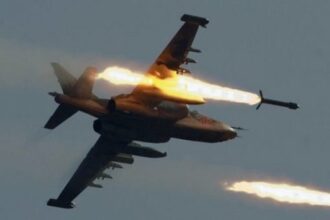
In December, the United States conducted precision strike operations against two major Islamic State (ISIS) terrorist enclaves in Sokoto with the permission of the Nigerian government.
The ACLED report noted that the US’s decision to strike ISSP inside Nigeria, away from its core areas in the central Sahel, suggested an effort to stop the group from spreading towards coastal West Africa while retaining Washington’s strategic presence in the region.
“A more immediate trigger for the strikes may have been ISSP’s October kidnapping of US citizen, missionary, and civilian pilot, Kevin Rideout, in Niger’s capital, Niamey,” the report said.
Beyond the kidnapping and disrupting ISSP activity, military cooperation between the US and Nigeria offers a practical way to militarily engage the Sahel-based Islamist groups.
This is especially significant given that in the central Sahel — the heart of the region’s jihadist insurgency — countries under the Alliance of Sahelian States have largely pushed out Western forces.
Through cooperation with Nigeria, the US retains regional access, allowing it to monitor and apply pressure on both Sahelian and Nigerian jihadist groups, the report noted.