

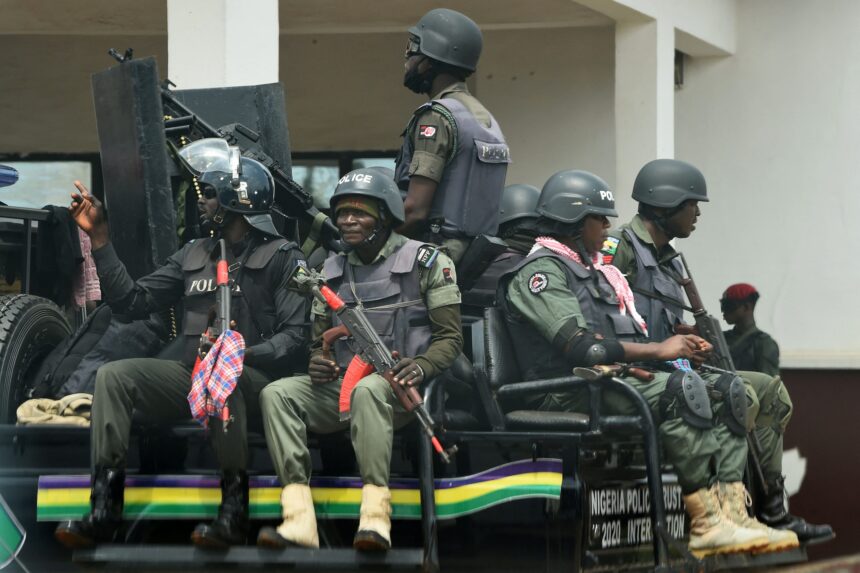
The newly sworn-in Inspector-General of Police (IGP), Tunji Disu, has officially set the wheels in motion for state police in Nigeria.
On Wednesday, March 4, 2026, during his inaugural conference with senior officers in Abuja, the IGP inaugurated a high-level steering committee to develop a functional framework for the establishment of state police in Nigeria.
The move comes just days after President Bola Tinubu urged the National Assembly to fast-track constitutional amendments to accommodate multi-level policing.
Addressing the top brass of the force, IGP Disu emphasized that the establishment of state police in Nigeria is no longer a matter of “if” but “how.”
He clarified that this transition is designed to complement, rather than replace, the existing federal structure.
Disu said the committee’s task was to examine the concept of state policing as part of efforts to strengthen Nigeria’s internal security architecture and improve community-based policing.
He said the committee would review existing policing models within and outside Nigeria, assess community security needs, propose an operational framework for state police structures, and address issues of recruitment, training, standards, funding, accountability, and oversight.
“Among other responsibilities, the committee is expected to review existing policing models within and outside Nigeria, assess community security needs and emerging risks across the country, propose an operational framework for the establishment and coordination of State Police structures, address issues relating to recruitment, training, standards, and resource allocation and develop robust accountability and oversight mechanisms to ensure professionalism and public trust,” he said.
Disu said state police formations could provide localised policing services focused on community safety, conflict prevention, neighbourhood patrols, and early response to emerging threats.
“This collaborative arrangement will encourage specialisation, strengthen professionalism, and ultimately deliver more effective security outcomes for our citizens,” he added.
The steering committee is chaired by Prof. Olu Ogunsakin, Director-General of the National Institute for Police Studies, Abuja, with CP Bode Ojajuni as secretary.
Other members are DCP Okebechi Agora, DCP Suleyman Gulma, ACP Ikechukwu Okafor, CSP Tolulope Ipinmisho, and CP Emmanuel Ojukwu (retd.).
Pan-Atlantic Kompass reports that the clamour for state police has always been caught between constitutional rigidity, political mistrust, and fiscal concerns.
Under Section 214 of the 1999 Constitution, policing remains the exclusive preserve of the Federal Government through the Nigeria Police Force. The provision recognises only one police force for the federation, meaning any attempt to establish state-controlled police structures would require a constitutional amendment.
Such an amendment must secure two-thirds support in the National Assembly and approval from at least 24 state Houses of Assembly — a politically delicate threshold in a country sharply divided along regional and partisan lines.
While the presidency and the police leadership are pushing forward, the establishment of state police in Nigeria remains a polarizing topic among stakeholders.
While some Nigerians have argued that localizing security will reclaim forests from marauders and improve intelligence gathering, critics have voiced significant reservations.
Some Nigerians raised concerns that state governors could weaponize local police against political opponents.
Speaking on the debate, a retired Assistant Inspector-General of Police, Ali Amodu, described the Inspector-General of Police’s decision to set up a special committee on state policing as “a right step in the right direction.”
“The decision or the thought of the IG in setting up a special committee is a right step in the right direction. The committee will actually provide the thinking, and then they will advise the Presidency because it is the police that they want to decentralise. It is good that the authority will want to hear from them,” he said.
He noted that he had canvassed the idea of decentralising the police as far back as 1981 after returning from detective training in the United Kingdom.
Amodu said, “As far back as 1981, I was a young superintendent. I came back from the UK and I actually made a suggestion to the police authority then that they should think of decentralising the police force because I saw the pattern in the UK.
“I said we can moderate our own and make adjustments. I was a very young officer, but the old hands were very angry with me to have said this. I remember my commissioner of police then said, ‘Young man, we sent you to the UK for detective training, and you are coming back thinking they should form a modality on how to decentralise the force.’”
However, the Yoruba socio-political group, Afenifere, expressed concern over whether the renewed push could be a ploy to gain cheap popularity and appeal to Nigerians desperate for reform.
The spokesman of Afenifere, Justice Faloye, said: “Let’s not be in a haste to dismiss the IGP’s committee, but at the same time, we hope it is not an election strategy.”
Faloye added that while Nigerians are yearning for state police, “let’s wait and see the draft the committee will come up with and pass through the IGP to Mr. President for onward transmission to the National Assembly. I doubt if it is something that can be done in a hurry between now and 2027, considering the constitutional processes.”
While commending the IGP’s initiative, former Deputy National Chairman of the Peoples Democratic Party (PDP), Bode George, said: “For state police to materialise, the process must follow a structured path: constitutional amendment; clear delineation of federal and state policing powers; establishment of independent oversight commissions; guaranteed funding mechanisms insulated from political interference; and enforceable safeguards against abuse of power.
“President Bola Tinubu has indicated openness to restructuring discussions, but consensus across regions remains uneven, particularly among stakeholders wary of security fragmentation.
“Until constitutional amendments align with political trust, fiscal capacity, and accountability safeguards, state police may remain more aspirational than operational. The newly inaugurated committee could mark a turning point, but only if it translates debate into actionable reform rather than another prolonged national conversation.”
The Nigeria Union of Journalists (NUJ) said the process is appropriate since state police would directly affect the existing police structure.
The National Secretary of the union, Achike Chude, said: “The IGP’s move is a natural response to public demand, and the existing police structure is required to make inputs if state police is to be achieved. I don’t see any politics in this.”
Questioning why the Federal Police is setting up a committee on state police, the Aare Ona Kakanfo of Yorubaland, Gani Adams, described the move as suspicious. He appealed to President Tinubu not to allow the central police to interfere in the creation of state police, warning that “else it will be counterproductive. I recall how, under the late General Sani Abacha’s military regime, attempts were made to bring the Federal Road Safety Corps (FRSC) under the central police, and that was what demystified the commission till today.”
He said the National Assembly should instead be allowed to perform its constitutional role of defining the responsibilities of federal and state police. Otherwise, if the central police assume that role, it could create confusion.
He, however, urged Nigerians to exercise patience and see what the committee will come up with.
Meanwhile, a lawyer and national security expert, Dr Charles Omole, said the confusion surrounding the eight-man committee set up by the IGP stemmed from the headline: “IGP Sets Up 8-Man Committee to Implement State Police.”
According to him, “No single police committee can implement state police in Nigeria. That is not possible.”
He explained that the IGP had merely constituted a committee to prepare a proposal on state police from the perspective of the Nigeria Police Force and submit it to him.
Omole recalled that several former IGPs, including the immediate past IGP, Kayode Egbetokun, had opposed the establishment of state police, arguing that Nigeria was not yet ready for it.
“To be frank, the eight-man committee cannot implement state police in Nigeria. However, whatever the committee comes up with will be a position paper, which the NPF will present during the all-inclusive government and stakeholders meeting to be led by the National Assembly,” he said.