
The United States Mission in Nigeria has issued an urgent notice, rescheduling visa appointments for all applicants previously slated for interviews on March 4 and 5, 2026.
The decision comes in response to heightened security concerns and the potential for large-scale demonstrations in the Federal Capital Territory, Abuja.
The embassy cited a “high potential for protests” in the capital city as the reason for rescheduling visa appointments for March 4 and 5.
The announcement was made in a statement posted on the U.S. Mission’s official X account on Thursday.
This comes after the U.S. Embassy in Abuja initially cancelled all visa appointments scheduled for Wednesday, March 4.
The closure has now been extended.
According to the U.S. Mission, applicants affected by the rescheduling should check their email or AVITs account for updated appointment dates
“Due to the potential for protests in Abuja, the U.S. Embassy will be closed for routine business until Monday, March 9, 2026.
“Visa appointments originally scheduled for March 4 and 5, as well as American Citizen Services (ACS) appointments scheduled for March 5, have been rescheduled to next week.
“Visa applicants: Please check your email or AVITs account for your new appointment date.
“ACS applicants: Please check your email for your new appointment date.
“If you do not see a new appointment, visa applicants should contact us through our Visa Navigator for assistance,” the statement read.
They are advised to continue monitoring the U.S. Mission’s website and social media channels for further updates.
Pan-Atlantic Kompass reports that the development comes after demonstrations have erupted in several Nigerian states following the escalation of the Middle East conflict.
Members of the Islamic Movement of Nigeria (IMN) staged demonstrations against the joint U.S.–Israeli military operation in Iran that killed Iran’s Supreme Leader, Ayatollah Ali Khamenei.
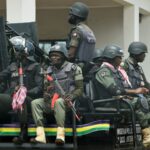
Protests were reported in Lagos, Kano, Sokoto, Gombe, Kaduna, and Yobe states, with demonstrators marching and holding placards denouncing foreign aggression. Security forces were deployed along protest routes, although no casualties have been confirmed.
In response, the League of Chief Imams cautioned Nigerians, against staging protests or actions that could disrupt peace. This warning was issued during the 2026 Ramadan Tafsir/Iftar programme held at Lagos House, Ikeja.
Speaking on behalf of the League, the National Missioner and Chief Imam of the Ansar-Ud-Deen Society of Nigeria, Sheikh Abdulrahman Ahmad, urged Nigerians to exercise restraint.
He emphasized that global events should not trigger unrest within the country, saying: “Beware of fitnah; when it happens, it will not only affect those who are responsible for it, but it will also affect all of us. The crisis in the Middle East is fitnah. This is a time for prayer, a time to be part of peace; this is not a time for protest and demonstration. This is not a time for insults. This is not a time for upheavals. It is a time of sober reflection.”
East began on Saturday, February 28, 2026, when the U.S and Israel launched strikes on Iranian cities.
As a result, multiple countries, including Iran, Iraq, Kuwait, Bahrain, Qatar, the United Arab Emirates, Saudi Arabia, Oman, Jordan, and Israel have experienced explosions, strikes, and airspace disruptions.
Global oil and gas shipping rates surged as tensions rose, with supertanker costs in the Middle East reaching all-time highs.
The IMF had warned that the conflict’s impact on the global economy will depend on its duration and intensity, noting that volatility in financial markets is expected to continue.