
A new report emerging on Thursday has revealed that the United States (U.S) government under the administration of President Donald Trump reportedly spent a total of $11.3bn on its joint war operation against Iran.
The New York Times reported that Department of Defense officials told U.S lawmakers about the $11.3bn spent in the first week of the war against Iran.
This figure means the U.S is averaging nearly $1.9 billion per day, an indication of the financial toll of high-intensity modern warfare.
According to sources quoted by the New York Times, sources familiar with the Pentagon’s report to the Senate revealed that more than half of the initial expenditure was swallowed by the rapid use of high-value precision munitions and advanced air defense interceptors.
During the first 48 hours alone, the U.S military reportedly expended $5.6 billion in assets.
This surge in the Iran war cost is attributed to the deployment of AGM-154 JSOW Aerial Bombs, which cost up to $836,000 per unit,Modified Tomahawk Cruise Missiles, which were utilized for deep-strike missions against hardened Iranian infrastructure, andAdvanced Interceptors, which were used to shield regional bases and allies from retaliatory ballistic missile barrages.
Similarly, the Centre for Strategic and International Studies, an independent think tank in Washington, estimated that the first 100 hours of Operation Epic Fury cost $3.7 billion, or more than $891 million per day.
The Iran War Cost Tracker website, which estimates the conflict’s cost in real-time, displayed a figure of more than $17 billion on its counter at approximately 08:00 GMT on Thursday.
According to the site, the United States is spending $1 billion per day on the war.
However, it points out that the true cost of the war is likely higher, as the figures do not account for long-term expenses, such as veteran healthcare.
While the financial data is staggering, U.S. Central Command (CENTCOM) reported that it has been making significant tactical progress since the war started.
According to CENTCOM, since the campaign began on February 28, 2026, American and Israeli forces have struck over 5,500 targets.
They also claimed that Iranian ballistic missile capabilities have been degraded by 90%, and their drone-launching capacity has seen an 83% reduction.
Despite these gains, it appears that the U.S government is facing growing scrutiny over the long-term economic impact.
With global energy markets in flux and the Pentagon’s munitions stockpiles depleting, the debate over how much longer the U.S can sustain this level of spending is just beginning.
This comes as Iran has sharply escalated its response. Iranian forces targeted the world’s busiest international airport on Wednesday and attacked commercial ships in the region, effectively choking global trade routes.
Iran has also struck oil fields and refineries across Gulf Arab nations and blocked cargo traffic through the Strait of Hormuz, the narrow waterway through which a fifth of all traded oil passes.
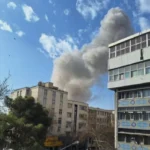
On Thursday, an Iranian attack triggered a major fire on Bahrain’s Muharraq Island, home to the country’s international airport. Authorities urged residents to stay indoors. A separate strike on Iraq’s Basra port killed at least one person and forced a halt to operations at all of Iraq’s oil terminals.