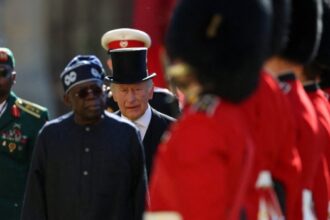

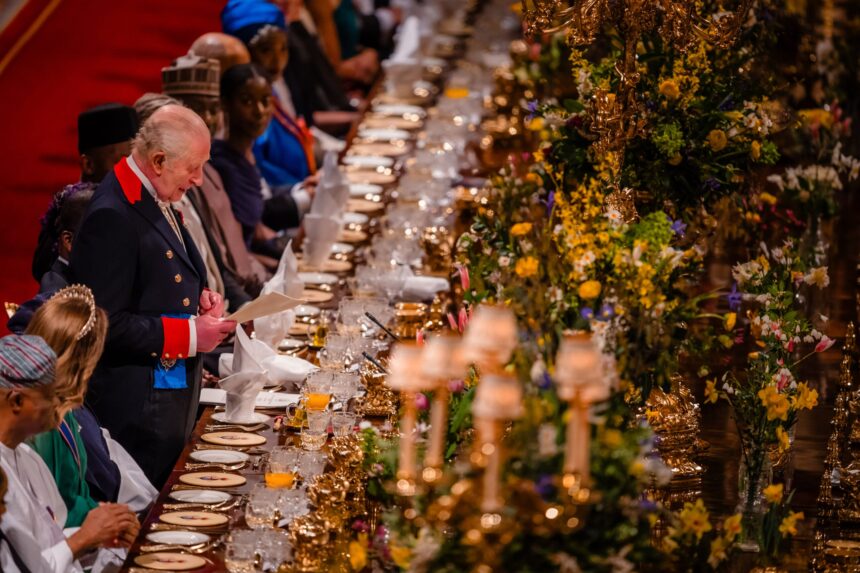
King Charles III hosted a state banquet for President Bola Tinubu at Windsor Castle on Wednesday evening.
The state banquet comes as Tinubu arrived in the UK on Tuesday at the invitation of King Charles.
On Wednesday, Tinubu was welcomed by a full military honour shortly before the state banquet began
Speaking during the banquet, the British monarch celebrated the influence of Nigerian culture on the United Kingdom, specifically highlighting the global dominance of Afrobeats and a lighthearted endorsement of Nigerian Jollof rice.
He recalled hosting a “Jollof and Tea” party at St. James’s Palace just last week, where he was “firmly assured” that Nigerian Jollof is indeed the best.
Also, the monarch noted how Afrobeats is currently “filling concert halls” across the United Kingdom, Nollywood continuing to captivate British screens, and how Nigerian excellence is visible in the Premier League, the NHS, and the British judicial system.
The hall also erupted in laughter and applause when the King concluded a section of his speech with the popular Pidgin English phrase, “Naija no dey carry last,” during the state banquet with Tinubu.
“We in the United Kingdom are blessed that so many people of Nigerian heritage, having chosen Britain as their home, are now at the heart of British life through excelling at the highest levels of business, technology, academia, law, science, sport, literature, and the arts,” he said.
“I have met so many of these quiet heroes in our schools, businesses, National Health Service and universities, including countless young people who have flourished through the work of my King’s Trust over the last fifty years,” he said.
“Only last week, I was delighted to host a rather lively group of them for a ‘Jollof and Tea’ party at St. James’s Palace. I was firmly assured that the jollof was only the best: Nigerian, of course… or perhaps Ghanaian or Senegalese. Diplomatically, I cannot remember!”
Earlier, King Charles set aside royal protocol by greeting Tinubu and the Nigerian delegation in Yoruba.
“Ẹ káàbọ̀, şé dáadáa ni,” King Charles said to the 160 guests in Yoruba, which translates to “Welcome, how are you doing?”
Proposing a toast during the state banquet with Tinubu, King Charles said: “I can only wish you and the millions of Muslims in our countries Eid Mubarak. Let me propose a toast to the president and people of Nigeria. Naija no dey carry last.”
Below is the full speech of King Charles during the state banquet with Tinubu
Your Excellency, Mr. President, and Distinguished First Lady,
Ekabo. Se Daaa Daa Ni. (Greetings! I hope you are well.)
My wife and I are delighted to welcome you to Windsor Castle here on this occasion. We are most grateful to you for travelling during this holy month which, I acknowledge, is no small sacrifice, and so it is my particular pleasure to wish you, Mr. President, peace, blessings, and an abundance of joy.
Ramadan Mubarak!
During my most recent visit to Nigeria in 2018, when I was fortunate enough to be able to spend some time with your highly respected traditional leaders, the Sultan of Sokoto, the Ooni of Ife, Onitsha, Warri, and The Emir of Kano, it was self-evident that while the warmth of the Nigerian welcome remains constant, the country itself is transforming at a remarkable pace. Nigeria hasn’t merely changed. It has arrived. Yours is now a nation of over two hundred and thirty million people, half of whom are under eighteen, with the energy, ingenuity, ambition, and resolve to address the great challenges of our age.
We in the United Kingdom are blessed that so many people of Nigerian heritage, having chosen Britain as their home, are now at the heart of British life through excelling at the highest levels of business, technology, academia, law, science, sport, literature, and the arts, and public service.
I have met so many of these quiet heroes in our schools, businesses, National Health Service, and universities, including countless young people who have flourished through the work of my King’s Trust over the last fifty years. Only last week, I was delighted to host a rather lively group of them for a ‘Jollof and Tea’ Party, at St. James’s Palace. I was firmly assured that the Jollof was only the best: Nigerian, of course… or perhaps Ghanaian or Senegalese. Diplomatically I cannot remember!
But who could have imagined that, when I first visited Nigeria thirty-six years ago today, so many of those I might have met would have gone on to have such an impact in the United Kingdom. From Afrobeats filling our concert halls and Nollywood captivating our screens, to stars competing in our Premier League and adjudicating our highest courts, so much of Britain’s culture is, in truth, profoundly enriched by Nigeria. Whether they are Nigerians who have chosen Britain as their adopted place to invest, trade, or study, or Britons who cherish their personal connection to Nigeria, they all represent a living bridge of over half a million people who connect our nations, Mr. President, and help make our cultures richer, our shared security stronger and our economies more prosperous.
We are proud that so many great examples of this living bridge join us this evening.
As the connections between our nations deepen every day, so too do the economic ties. Your visit has provided the opportunity to celebrate the fact that Nigeria is investing in Britain’s future as much as Britain is investing in Nigeria’s – leading Nigerian banks have chosen the City of London as a global base, examples of the best Nigerian companies have listed on London’s Stock Exchange, and U.K. Export Finance is supporting investment in Nigeria’s ports. In education, British schools and universities are opening their doors in Nigeria, and British and Nigerian technology companies are forming ever closer partnerships. I was pleased to see that visitors from Nigeria spent £178 million in Britain in 2024, and 251,000 people from Britain travelled to Nigeria and spent just as much, in return. In January of this year, Nigeria became the United Kingdom’s biggest export market in Africa and whilst I hear that in Nigeria the phrase ‘Made in U.K.’ has always symbolised the highest quality, it evidently now has a distinctively Nigerian flavour…
The friendship between our two countries, Mr. President, is a partnership of equals that has brought us both enormous benefits. It has been described to me as a deeply spiritual connection – beyond churches and mosques – a deep bond through which we have strengthened our shared security, ensured our economies are more prosperous, and empowered each other to believe in a more hopeful future.
The many dynamic connections between our two nations have deep roots and yet I do not pretend that those roots are without a shadow. There are chapters in our shared history that I know have left some painful marks. I do not seek to offer words that dissolve the past, for no words can. But I do believe, as I know you believe, Mr. President, that history is not merely a record of what was done to us – it is a lesson in how we go forward together to continue building a future rooted in hope and growth for all, and worthy of those who bore the pains of the past.
This afternoon, in another part of the Castle, Mr. President, you and I witnessed one such example of how we are learning from one another when we met leaders of the British Christian and Muslim communities. The gathering was a deeply meaningful symbol of what Nigeria has long shown: that people of different faiths can, do, and must live alongside one another, in peace, in harmony, and in shared purpose. It was also a timely reminder of the importance of standing with you – and in us strengthening your Quick Reaction Forces, or in providing food, nutrition, and protection services in Northern Nigeria when challenges disturb the age-old balance between these communities.
Your nation, Mr. President, is an economic powerhouse, a cultural force, and an influential diplomatic voice from a continent that is playing an increasingly important role in the world. In a vastly interconnected global environment, one that is changing at unimaginable speed, that leadership brings responsibility – and opportunity. I heed the Yoruba wisdom – and forgive me if I say it in English… that “rain does not fall on one roof alone”. As you observed so astutely before the Commonwealth Heads of Government Meeting in Samoa in 2024, “if we didn’t have this global alliance… of fifty-six member states, 2.7 billion people and a combined G.D.P. forecast soon to surpass twenty trillion U.S. dollars… there would be a need to create one”. I believe firmly that, when rain clouds gather, we can tighten the grip of friendship between us and, in so doing, reinforce the central role of the Commonwealth in our shared future.
As the world changes, these are lessons we must heed now more than ever. As the Hausa saying goes, “when the music changes, so does the dance”. We can learn from Nigeria, and the best of the U.K. and Nigeria’s partnership, and harness the advantage that comes from our common languages, our similar legal systems, and the web of cultural ties and spiritual connections that provide such deep trust between us, and look to the future and learn new dance steps, together.
Mr. President, you have spoken, in particular, of the importance of expanding intra- Commonwealth trade by creating shared standards, regulatory and digital alignment, and removing barriers that deter investment – as the U.K. and Nigeria’s Enhanced Trade and Investment Partnership is just such an example – so that our economies can grow, in harmony with Nature, and create the millions of jobs our citizens need. So as we look towards C.H.O.G.M this year, I hope that, far from being past its time we can demonstrate that the Commonwealth’s time has come, as you so rightly said. In achieving that, my wife and I will gain strength from seeing Nigeria take her rightful place at the heart of the Commonwealth and standing alongside you as a friend, who believes the future is best when built together. As the Igbo say, “Knowledge is never complete two heads are better than one”.
So as I close, Mr.r President, in anticipation of Eid El-Fitr in Nigeria and across the world, I can only wish you and the millions of Muslims in our countries, Eid Mubarak.
And, in doing so, let me propose a toast,
To the President and people of Nigeria –
“Naija No Dey Carry Last!” (Nigerians Never Come Last)