
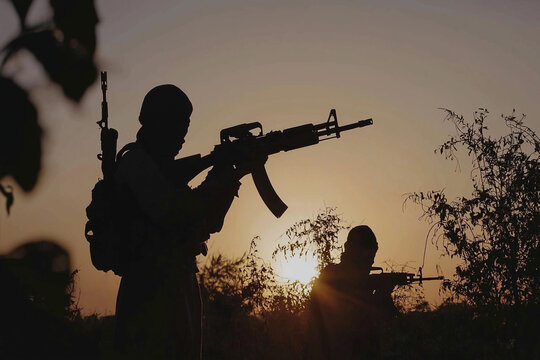
The latest Global Terrorism Index (GTI) report has ranked Nigeria as the fourth most impacted country by terrorism globally.
This new ranking marks a significant deterioration from previous years, highlighting a 46% surge in terrorism-related fatalities within the last year alone.
According to the 2026 Global Terrorism Index report, Nigeria recorded 750 deaths in 2025, up from 513 in 2024.
While global terrorism deaths actually dropped to a decade low, Nigeria’s contrary trend has sparked intense debate.
According to the report, global terrorism trends showed a significant improvement in 2025.
“Deaths from terrorism fell by 28 per cent to 5,582, and incidents decreased by 22 per cent to 2,944, marking the lowest figures since 2007,” the report said.
The report also revealed that “Nigeria recorded the largest increase in 2025, with fatalities rising by 46 per cent to 750. Islamic State West Africa Province (ISWAP) and Boko Haram were responsible for 80 per cent of all terrorism deaths in the country.”
The report further noted that terrorism remains highly concentrated globally, stating that “just under 70 per cent of deaths from terrorism occurred in only five countries: Pakistan, Burkina Faso, Nigeria, Niger, and the Democratic Republic of the Congo.”
It added that “Nigeria and the Democratic Republic of the Congo had the largest increases in deaths from terrorism, with rises of 237 deaths and 102 deaths, respectively.”
According to the report, Nigeria recorded two out of the 20 most fatal terrorist attacks in 2025, all of which occurred in Borno State and were carried out by the Islamic State West Africa Province (ISWAP) and Boko Haram.
The report said, “Gunmen attacked the village of Darajamal, Bama local government area, Borno state, on September 5, 2025, killing 58 villagers and 5 soldiers. 30 of the gunmen were reportedly killed by the Nigerian army after the attack.
“No organisation has claimed responsibility for the assault at the time of writing, although local media sources have attributed the attack to Islamic State West Africa Province (ISWAP).”
Also, on May 15, 2025, “Jihadists attacked the neighbouring villages of Mallam Karamti and Kwatandashi in Kukawa local government area, Borno state.
“According to local press reports, approximately one hundred civilians were rounded up and taken into the forest, with fifty-seven bodies later recovered and seventy individuals still missing. Media reports attribute the attack to Boko Haram’s JAS faction.”
Pan-Atlantic Kompass reports that the Global Terrorism Index report is produced by the Institute for Economics & Peace.
It is a comprehensive study analysing the impact of terrorism across 163 countries, covering 99.7 per cent of the world’s population.
The report uses data from Terrorism Tracker and other sources to rank countries based on the impact of terrorism using a scale from 0 to 10.
The report emerged after Nigeria came under international scrutiny over Christian genocide.
The development was spotlighted after United States President Donald Trump redesignated Nigeria as a Country of Particular Concern (CPC).
The situation led to the bombing of ISIS targets in Sokoto on Christmas Day of 2025.
Meanwhile, Nigerians have started reacting as the Global Terrorism Index report stated that insurgency is growing in Nigeria.
In its reaction, the African Democratic Congress (ADC) linked the rising wave of terrorist attacks and increasing civilian deaths in Nigeria to what it described as a breakdown in governance under President Bola Tinubu.
This was contained in a statement issued on Thursday by its National Publicity Secretary, Bolaji Abdullahi.
The statement reads: “That is not an abstract statistic. It is a direct reflection of the failure of the Bola Tinubu-led APC government to secure the country. At a moment when Nigerians are grieving, and communities across the country are living under constant threat, Tinubu, his National Security Adviser, and the Minister of Defence are abroad. The contrast is clear: a country in crisis, and an absent leadership.
“Nigerians should take note of this moment. It raises a fundamental question about Tinubu and the APC’s priorities. At a time that demands focus, discipline, and urgency, the Tinubu government appears more concerned with pageantry, paparazzi, and propaganda—rather than real performance.
“The Global Terrorism Index confirms what Nigerians already know from lived experience. Terror attacks have surged by 43 per cent, rising from 120 incidents in 2024 to 171 in 2025. Violence is increasingly concentrated in Borno State, which now accounts for 67 per cent of attacks and 72 per cent of deaths. Most concerningly, civilians now make up 67 per cent of those killed—a measure of how exposed ordinary Nigerians have become.
“The threat to Nigerian families is also evolving. ISWAP is responsible for over half of all attacks and deaths across the country. Boko Haram remains active and deadly. New groups like Lakurawa are emerging, showing that Tinubu’s national security strategy is not containing the insecurity problem but expanding it.”
Also, the 2023 presidential candidate of the Labour Party, Peter Obi, in his reaction said: “The latest Global Terrorism Index report ranks Nigeria among the most terrorized nations in the world, showing one of the highest increases in deaths from terrorism. This is a painful indictment of failed leadership.
“While many countries are seeing a decline in terrorism, Nigeria is moving in the opposite direction. This trend is a direct result of misplaced priorities, weak governance, corruption, a lack of rule of law, and the persistent neglect of security, which is the government’s most fundamental duty.
“From the insurgency of Boko Haram to the growing threat posed by the Islamic State West Africa Province, the crisis of kidnapping, and unchecked violence in our rural communities by heavily armed bandits, Nigerians are dying daily while those in power continue to feast.
“What is the purpose of government if it cannot protect lives? Why are we normalizing tragedy while other nations make progress?”
Below are some other reactions;