
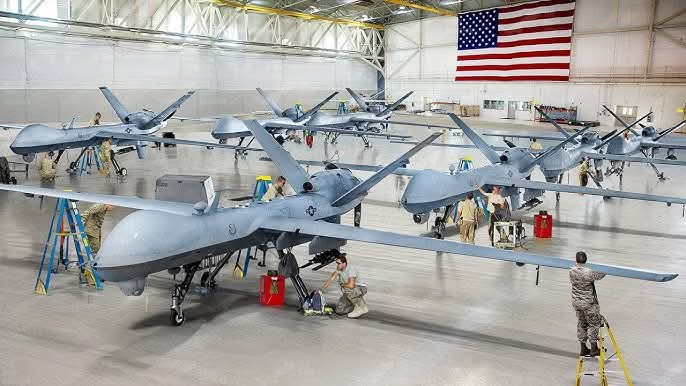
The United States (U.S) has officially deployed several MQ-9 Reaper drones and about 200 troops to Nigeria.
It was gathered that the U.S deployed 200 troops and drones to provide critical military support in Nigeria.
The deployment is said to be aimed at bolstering Nigeria’s ongoing struggle against Islamist militants, including Boko Haram and Islamic State West Africa Province (ISWAP).
According to U.S. and Nigerian defense officials, the mission is strictly focused on intelligence, surveillance, and reconnaissance (ISR).
The 200 troops, consisting largely of analysts, trainers, and technical advisers, are operating out of the Bauchi airfield in northeastern Nigeria.
Also, U.S officials emphasized that these forces are in a non-combat role. They are not embedded with frontline Nigerian units, nor are the MQ-9 drones authorized to conduct airstrikes. Instead, they serve as “eyes in the sky,” providing surveillance for over 27 hours at a time to track insurgent movements across the volatile northern regions.
“The U.S. military has multiple MQ-9 drones operating in Nigeria alongside 200 troops to provide training and intelligence support to the military,” U.S. and Nigerian officials told the press.
It was also gathered that the deployment was requested by Nigerian authorities to help identify, track, and respond to terrorist threats in the region.
“We see this as a shared security threat,” a U.S. defence official told Reuters, underscoring that the mission is limited to intelligence collection and advisory support.
Major General Samaila Uba, director of defence information at Nigeria’s Defence Headquarters, confirmed that U.S forces are operating from Bauchi airfield in the northeast.
“This support builds on the newly established U.S.-Nigeria intelligence fusion cell, which continues to deliver actionable intelligence to our field commanders. Our U.S. partners remain in a strictly non-combat role, enabling operations led by Nigerian authorities,” he said.
The MQ-9 drones, sometimes called Reaper drones, are capable of loitering at high altitude for more than 27 hours and can perform both intelligence gathering and strike missions.
“Our US forces are helping Nigeria identify, track, and respond to terrorist threats,” Uba said, without elaborating on specific operations.
“We continue to assess that these organisations will seek opportunistic targets and may attempt to demonstrate relevance through high-visibility attacks,” Uba said.
The Nigerian military said the duration of the current U.S. deployment will be determined in agreement with its American partners. The mission underscores an intensifying focus on intelligence-sharing and capacity-building in response to evolving insurgent threats across northern Nigeria.
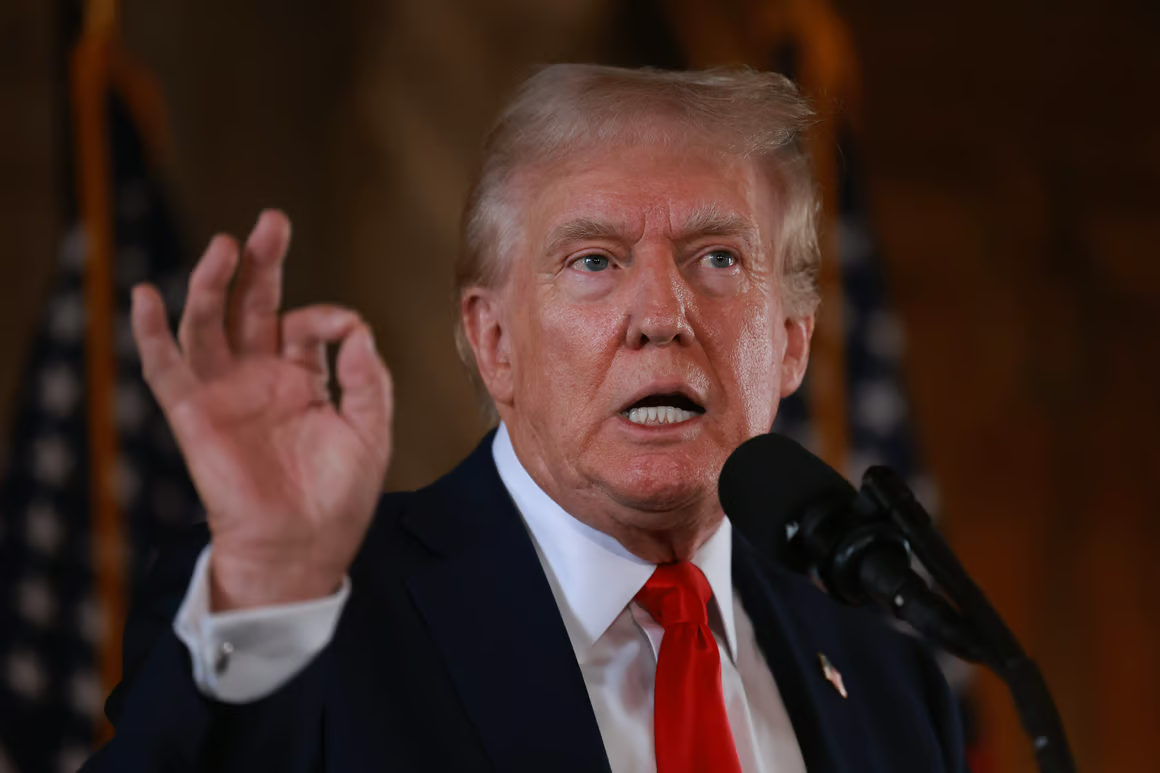
Pan-Atlantic Kompass reports that the recent move by the U.S to deploy 200 troops and drones to Nigeria comes after President Donald Trump sanctioned strikes that targeted ISIS-linked terrorist elements in northwest Nigeria.
The Nigerian Government confirmed that the strikes were part of a coordinated security partnership with international allies aimed at combating terrorism and violent extremism.
In February, the United States also deployed 200 troops to Nigeria to provide training and operational support to the country’s military in its fight against Islamist militants. An American military official said that the deployment came weeks after Trump criticised Nigeria for failing to protect Christians from terrorist attacks.
The report noted that the troops were expected to strengthen Nigeria’s counterterrorism capacity, particularly through training programs and intelligence support.
The latest deployment also comes amid escalating violence in Nigeria’s northeast and northwest. Recall that on March 16, suicide bombers attacked a Maiduguri, Borno State, underscoring the continued threat from Boko Haram and Islamic State West Africa Province (ISWAP).