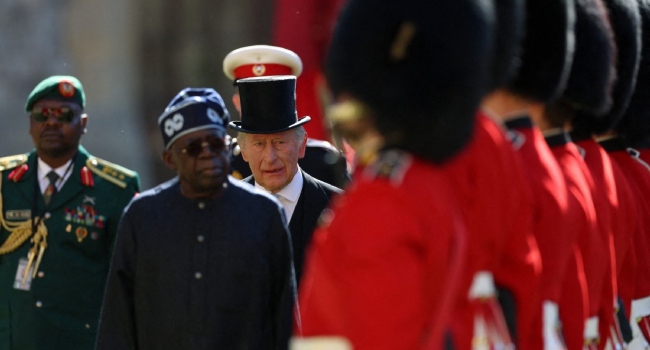
A heated national debate has emerged on the front burner after a scathing analysis from a London-based think tank, Chatham House, which suggested that President Bola Tinubu’s state visit to the United Kingdom (UK) has failed to translate into tangible benefits for the average Nigerian.
While the presidency has hailed the three-day engagement with King Charles III and the UK’s Prime Minister Keir Starmer as a diplomatic masterstroke, the report titled “Tinubu’s UK State Visit: Diplomacy Alone Won’t Fix Nigeria’s Problems” argued that Tinubu’s foreign policy is increasingly detached from the harsh economic realities of rising food insecurity and poverty back home.
The report, authored by Leena Koni Hoffmann, an associate fellow at Chatham House, acknowledged that the administration has been “strategically astute” in positioning Nigeria as a regional powerhouse and a key Commonwealth state.
However, it pulls no punches regarding the domestic impact of Tinubu’s state visit to the UK.
She argued that though “Tinubu’s administration has also sought international validation for its key domestic reforms–fuel subsidy removal, naira devaluation and tax reform, his prominent international profile has not delivered material gains to Nigerians in the past three years of his government.
“But nearly three years into Tinubu’s presidency, the key question is whether this visibility-driven foreign policy has delivered domestic gains. So far, the president’s prominent international profile has not largely translated into improvements in material conditions for most Nigerians,” Hoffmann said.
Despite securing a £747 million deal to refurbish major ports and leveraging the Enhanced Trade and Investment Partnership (ETIP), Hoffmann said these gains are concentrated in capital-intensive sectors like finance and ICT.
She also argued that while markets may react positively to international validation of reforms like fuel subsidy removal and naira devaluation, the “wallets” of ordinary Nigerians remain empty due to skyrocketing costs of living.
She added: “With Nigeria’s general elections due in 2027, the domestic stakes of the UK visit are high. After the controversial 2023 elections, the perception of a governing elite focused on international optics risks deepening political cynicism.
“The administration will likely present any new UK investment announcements or security agreements as evidence that its reformist, outward-looking foreign policy is paying off. Such claims will be closely scrutinized at home. Measured against the core test of governance – whether citizens are safer, less poor, and more hopeful – the dividends of Tinubu’s foreign policy have been marginal so far.
“The UK state visit is an opportunity not merely to court praise and promises, but to prioritize tangible outcomes for ordinary Nigerians. For example, Tinubu could seek ambitious UK support to build on existing police reform efforts and move towards decentralized, multi-level policing that strengthens community-based security alongside federal forces.
“Ultimately, most of Nigeria’s work needs to be done back home. Otherwise, Nigeria risks continuing a foreign policy that looks impressive abroad but fails to tackle the country’s fundamental issues.”
Following the emergence of this report many Nigerians have given their opinions on the essence of Tinubu’s state visit to the UK.
Tinubu, himself appears to have responded to the report by the Chatham House.
While Tinubu didn’t particularly mention Chatham House, he declared on Sunday that his sustained visits to foreign nations are yielding what he described as desired results for the country on all fronts.
Tinubu made the declaration on Sunday when he played host to state governors who paid him a visit in Lagos.
Tinubu told the governors that he secured assurances from the British government in the area of equipment to combat the scourge of banditry and terrorism.
He also revealed that, following his discussions with his counterpart in France, Emmanuel Macron, he extracted a commitment to assist Nigeria in combating insecurity.
He said: ” The next phase of our struggle is staring us in the face, and it is the challenge of insecurity in this country, and I am making all the efforts to ensure that it is we collectively that will share the joy and be proud of victory over tyranny.
“Insecurity is an enemy of development, progress, and prosperity. That’s what insecurity is all about. I am glad that you are all mindful of the challenge. To me, I can commit myself to further strengthening my contacts, the network that is necessary. One of the major discussions in the UK is equipment and support. I can report to you that yesterday, again, I had a lengthy discussion with Emmanuel Macron on collaboration and support with us while I am making frantic efforts to contact other nations.
”If we have to spend our goodwill and line of credit. We have those who are willing to support us with equipment and training.
“We should just resolve. While you say it isn’t the time for policy discussions, we have a pyramid that we must work on in the state. I won’t single out what I have observed, several things that they are doing. You are all doing well, but you can do better.”
In his assessment of Tinubu’s state visit to the UK, Human rights lawyer Femi Falana has criticised the new deportation partnership agreement between Nigeria and the UK.
The legal luminary described the deportation deal as a breach of the 1999 Constitution and international human rights standards.
He said Nigeria should not serve as a dumping ground for deportees from the UK.
Falana argued that the arrangement allows fast-track deportations without proper due process.
He said: “The agreement simplifies identification using “UK letters” instead of passports for returns, and offers reintegration support.
“While the ‘Agreement’ is being presented as a win for border control and bilateral cooperation, it clearly risks sacrificing due process, constitutional safeguards, and human rights in the name of administrative convenience.
“In the first place, the use of the “UK letters” to return Nigerians is not and cannot be a substitute for proper travel documents. While the use of such letters may theoretically remove bureaucratic delays, it is fundamentally at odds with international human rights standards, as it for example lowers the threshold for deportation—potentially allowing individuals to be removed without proper verification of their identity or nationality.”
Joining the debates, the Chief Executive Officer of the Centre for the Promotion of Private Enterprise (CPPE), Muda Yusuf, praised Tinubu’s state visit to the UK.
Yusuf singled out the port modernisation initiative, describing the move as a potential “game changer” for Nigeria’s economy.
“Efficient ports reduce the cost of imports and exports, improve turnaround time, and enhance Nigeria’s attractiveness to investors. This is a positive signal to global markets that Nigeria is open for business, but consistency in policy implementation will determine whether these commitments translate into real growth,” he said.
Governance and strategy expert, Yemi Mapaderun, also described the visit as a platform for mutually beneficial outcomes.
“If we are looking at the gains or trying to talk about the potential gains of this state visit, we must view it from a mutually beneficial perspective, because the UK is not doing Father Christmas at this time,” he said.
Mapaderun noted that while Nigeria seeks to reinforce ties beyond historical links, the UK is equally focused on strengthening its economy in the post-Brexit era. He added that Nigeria remains the UK’s largest market in Africa but stressed the need to rebalance trade flows, as British exports currently outweigh Nigerian exports.
“Beyond trade, reviving long-standing military cooperation is crucial. Nigerian-UK military relations need to be renewed and possibly taken to the next level,” he added.
Also commenting on the discourse, international marketing strategist and policy analyst Babatunde Awopetu, described the visit as a rare opportunity for Nigeria to reset its international image.
“The UK gives state visits as the highest accolade between countries, and it is an opportunity for Nigeria to reset its relationship and its perception on the global stage. For me, this is really significant,” he said.
Awopetu added that the visit allows Nigeria to “reannounce itself to the world,” noting that being hosted at the highest level by the British monarchy and government sends a strong signal to global investors.
“If the United Kingdom is investing in Nigeria, it sends a strong signal to other international partners that the door is open and the environment is ready for investment,” he added.