
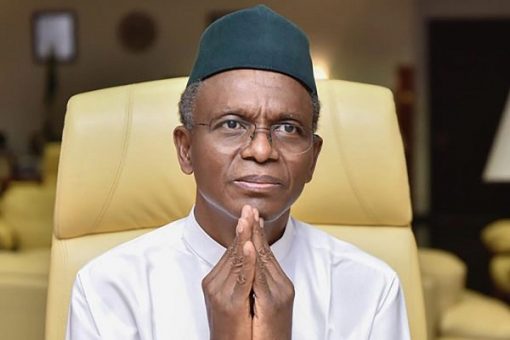
Following weeks of legal back-and-forth and intense public scrutiny, the Independent Corrupt Practices and Other Related Offences Commission (ICPC) has finally arraigned former Kaduna State Governor, Nasir El-Rufai.
The ICPC arraigned El-Rufai before the Federal High Court, Kaduna after 38 days in detention.
The former governor appeared in court under heavy security as the commission filed a 10-count charge bordering on money laundering, conversion of public property, and abuse of office.
According to the charge sheet (Suit No: FHC/KD/73/2026), the ICPC alleged that El-Rufai unlawfully took possession of over N579 million in severance allowances, a figure far exceeding the legally prescribed amount for a departing governor.
The prosecution further alleged that El-Rufai received illicit foreign currency payments totaling over $320,000 into private accounts.
The funds were allegedly funneled through various individuals, some of whom remain at large.
Pan-Atlantic Kompass reports that El-Rufai was brought before Justice Rilwan M. Aikawa on the 10-count charge.
The court subsequently fixed March 31, 2026, to hear pending applications, including a bail request by the former governor.
Counsel for El-Rufai, Ubong Akpan, who spoke with journalists after the proceedings, described the charges as largely relating to alleged deposits into his client’s domiciliary account and the monetisation of his earnings.
“Out of 10 counts, they joined him on only one,” Akpan said.
He disclosed that the defence raised objections to the arraignment on the grounds of a pending matter involving the presiding judge, but noted that the court proceeded regardless.
“What we have now is that they applied to arraign, and I respectfully pointed out that since Malam El-Rufai has a pending proceeding with respect to the judge himself, the court cannot proceed. However, the judge, in his wisdom, decided to go ahead with the arraignment,” he said.
Akpan added that the court adjourned the case to March 31 to take all pending applications.
The ICPC arraigned El-Rufai after a period marked by heated legal battles. El-Rufai was originally taken into custody on February 18, 2026, shortly after being released by the Economic and Financial Crimes Commission (EFCC).
His legal team and family had consistently decried the stay as “political persecution,” arguing that the commission was using “brazen self-help” to keep him behind bars without formal charges.
Despite these claims, the ICPC maintained that it followed the Administration of Criminal Justice Act, obtaining multiple remand extensions from the court to finalize its investigation into “deep-seated financial misconduct” during his 2015–2023 administration.
Meanwhile, speaking after the adjournment, a member of the House of Representatives representing Kaduna North, Bello El-Rufai, described his father as the “father of modern Kaduna,” citing infrastructural development during his tenure.
“I’m here in solidarity as his son and as a representative of the people. Malam El-Rufai, to us, is the father of modern Kaduna. We believe in the judicial process and the rule of law,” he said.
Supporters of the former governor also trooped to the court premises, chanting solidarity slogans and expressing confidence in his eventual acquittal.