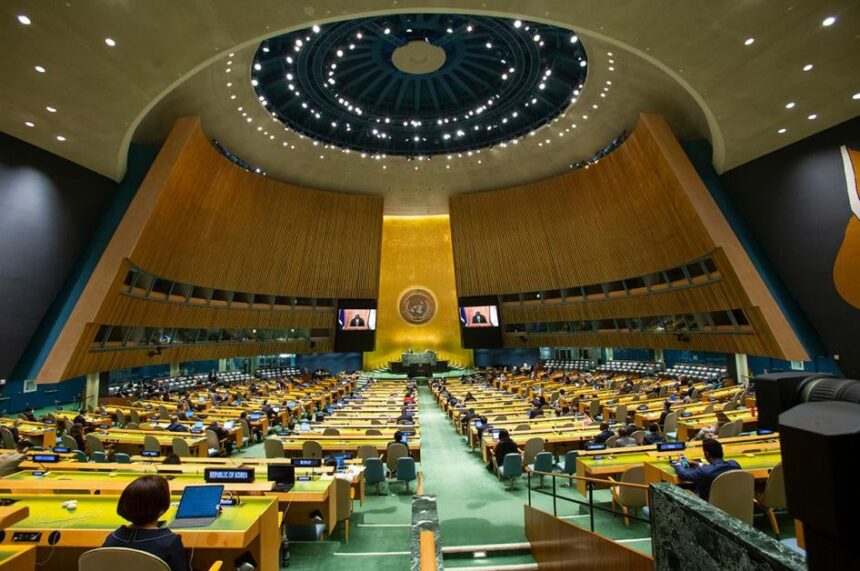
A heated debate erupted on the floor of the United Nations General Assembly on Wednesday during the adoption of a resolution declaring the transatlantic slave trade as the gravest crime against humanity.
The resolution prompted strong opposition from the United States, Israel, and Argentina.
The three countries voted against the resolution which called for reparatory justice for slavery as a necessary step toward healing the enduring scars of racialized chattel enslavement.
The United States in its argument called the text seeking the labelling of the slave trade as the gravest crime against humanity “highly problematic”.
“The United States also does not recognise a legal right to reparations for historical wrongs that were not illegal under international law at the time they occurred,” said US ambassador Dan Negrea.
“The United States also strongly objects to the resolution’s attempt to rank crimes against humanity in any type of hierarchy,” he added.
Also, the UK and EU countries advanced similar arguments while acknowledging the wrongs of slavery.
The resolution “risks pitting historical tragedies against each other that should not be compared, except at the expense of the memory of the victims,” said French representative Sylvain Fournel.
During the voting, the UK and EU member states were among 52 countries that abstained from voting.
However, despite the resistance, the resolution was adopted by the Assembly.
The resolution was adopted on the International Day of Remembrance of the Victims of Slavery and the Transatlantic Slave Trade.
Spearheaded by Ghana and supported by the African Union, the text described the slave trade as a “definitive break in world history” that continues to structure modern systemic racism and economic inequality.
The resolution received 123 votes in favour, while three countries, Argentina, Israel, and the United States, voted against it, and 52 abstained.
Ghana’s President John Mahama spoke ahead of the vote on behalf of the 54-member African Group, the largest regional bloc at the UN.
Mahama stated: “Today, we come together in solemn solidarity to affirm truth and pursue a route to healing and reparative justice.
“For more than 400 years, millions of people were stolen from Africa.
“They were put in shackles and shipped to the New World to toil in cotton fields and sugar and coffee plantations under scorching heat and the crack of the whip.
“They were denied their basic humanity and even their own names, forced to endure generations of exploitation with repercussions that reverberate today, including persistent anti-Black racism and discrimination.”
The resolution emphasised “the trafficking of enslaved Africans and racialised chattel enslavement of Africans as the gravest crime against humanity by reason of the definitive break in world history”.
It also noted the scale, duration, systemic nature, brutality, and enduring consequences that continue to structure the lives of all people through racialised regimes of labour, property, and capital.”
It affirmed the importance of addressing historical wrongs affecting Africans and people of the diaspora in a manner that promotes justice, human rights, dignity, and healing.
The resolution also emphasised that claims for reparations represent a concrete step towards remedy.
The adopted resolution encouraged UN member states to initiate discussions on reparative justice, including formal apologies, financial compensation, the return of stolen cultural artifacts, and guarantees that such abuses will never be repeated.
Commenting on the resolution, UN General Assembly President Annalena Baerbock said: “The slave trade and slavery stand among the gravest violations of human rights in human history.
Baerbock added that slavery was “an affront to the very principles enshrined in the Charter of our United Nations and the Universal Declaration of Human Rights, themselves born, in part, from these injustices of the past”.
Aside from labelling the slave trade as the gravest crime against humanity, UN Secretary-General António Guterres, in his remarks, called for confronting slavery’s lasting legacies of inequality and racism.
Guterres told the General Assembly that countries needed to take far stronger action to confront historical injustices and their modern consequences.
“Now we must remove the persistent barriers that prevent so many people of African descent from exercising their rights and realising their potential,” he said.
“We must commit, fully and without hesitation, to human rights, equality, and the inherent worth of every person.”
Guterres urged countries to drive action to eradicate systemic racism, ensure reparatory justice, and accelerate inclusive development, marked by equal access to education, health, employment, housing, and a safe environment.
“This includes commitments to respect African countries’ ownership of their own natural resources.
“And steps to ensure their equal participation and influence in the global financial architecture and the UN Security Council.”
Pan-Atlantic Kompass reports that while the adoption of the resolution marks a diplomatic victory for Africans, it is legally non-binding.