

Public school districts across the United States (U.S) are facing a mounting fiscal crisis after Immigration and Customs Enforcement (ICE) raids depleted classrooms.
Recent data and information emerging on Friday has revealed the extent to which the ICE raids depleted classrooms.
It was gathered that the aggressive impact of ICE raids on school enrollment has led to a significant loss of students, leaving administrators to grapple with massive budget shortfalls.
In states like Massachusetts and North Carolina, the sudden disappearance of students from classrooms is becoming a financial emergency.
In early 2025, a series of high-profile immigration enforcement actions under the administration of U.S President Donald Trump sent shockwaves through immigrant communities.
While the immediate effect was a spike in chronic absenteeism the long-term consequence has been a steady exodus from the public school system.
Families, fearing deportation or harassment, have either relocated, opted for homeschooling, or kept children hidden from public record.
In Chelsea, Massachusetts, there has been a report of a 5% drop in total enrollment, losing approximately 350 students.
Lynn, Massachusetts also saw a decline of over 600 students between January 2025 and January 2026.
Also, Charlotte-Mecklenburg, North Carolina experienced a single-day absence of 27,000 students following local federal activity, many of whom never consistently returned.
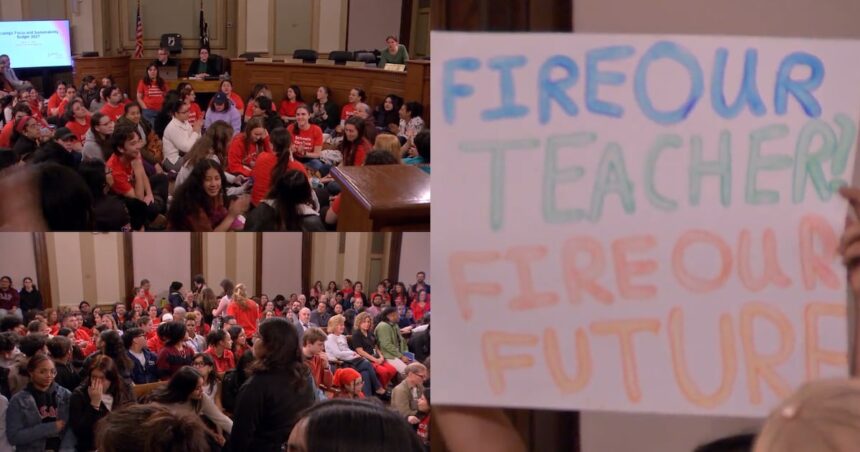
Meanwhile, in Chelsea, community members stormed a high school auditorium last month to oppose the school board’s plan to cut 70 positions, including reading coaches, special education staff, and counselors.
“I’ve been here 17 years, and even when we’ve had bigger cuts than these, I have never seen this amount of people show up in this room,” said Chelsea School Committee Chair Ana Hernandez.
Facing an $8.6 million budget deficit, the Chelsea School District proposed cutting about 70 educator positions, according to Superintendent Almi Guajardo Abeyta.
The shortfall is due to a loss of state funding based on enrollment after ICE raids depleted classrooms, which has declined by 350 students, Abeyta said.
This also comes as the Massachusetts state education agency estimates that the population of English learners in Massachusetts schools has dropped by 7,000 since 2024.
Officials from Chelsea and other metro-area districts say absenteeism increased as Immigration and Customs Enforcement agents conducted raids in Boston last fall.
The district is among several across the country now confronting the financial impact of the Trump administration’s immigration enforcement efforts. Whether students are absent from school, families have been detained, or they’ve left the district or the country on their own, the empty desks add up.
Districts no longer have federal COVID relief funds to fall back on, and many already saw steep enrollment declines during the pandemic. The Chelsea board is one of several in Massachusetts asking the legislature for one-time grants to help address the shortfall. With fixed costs like payroll and contracts with vendors, a sharp drop in enrollment “creates chaos,” Neville said.
In Texas, officials from Houston, San Antonio, and several districts in the Rio Grande Valley are among those who say the immigration crackdown has contributed to further enrollment loss and, with it, potential drops in state funding.
Districts’ heightened concerns over finances come as conservatives increasingly argue that American taxpayers shouldn’t be footing the bill to educate undocumented students in the first place.
During a heated hearing last month, members of a House judiciary subcommittee argued that the U.S. Supreme Court should overturn Plyler v. Doe, a landmark 1982 ruling in a Texas case that guaranteed children a right to a public education, regardless of citizenship status.
“The financial costs of Plyler are undoubtedly staggering, clearly representing a significant burden on localities,” said Texas Republican Rep. Chip Roy, who chaired the hearing. “But it isn’t just fiscal costs we should be worried about. Our nation’s classrooms routinely deal with illegal alien students, many of whom know little to no English and may struggle with other learning disabilities.”
Pointing to Census Bureau figures, a 2024 report from the subcommittee estimated that educating non-citizen students in U.S. schools costs about $68 billion a year. But during the hearing, Democrats highlighted long-term benefits of providing students access to education, like $633 billion paid in state and local income taxes and contributions to the U.S. economy worth more than $2.7 trillion.
The witnesses included James Rogers, senior counselor with the conservative America First Legal Foundation, who called the Plyler opinion ”egregiously wrong from the start” and an example of judicial overreach.
But Rep. Mary Gay Scanlon of Pennsylvania, the ranking Democrat on the subcommittee, said that excluding undocumented students from school or charging tuition would mean “only certain classes of children whose parents can afford to pay are entitled to the blessings of liberty and the hope of a better future.”
Thomas Saenz, president and general counsel for the Mexican American Legal Defense and Educational Fund, warned that at a time when chronic absenteeism remains above pre-pandemic levels, non-citizen children wouldn’t be the only ones out of school if the court overturned Plyler.
“It will extend beyond the families to peers and ultimately it will be impossible to enforce truancy laws,” he said. “Any child who doesn’t want to be in school will know to simply say ‘I’m undocumented.’ ”
For now, most Texas districts want to hang on to as many students as possible.
“When you’re a rural school district, every kid has a big impact on your bottom line,” said Kevin Brown, executive director of the Texas Association of School Administrators. “When you lose five or 10 kids, you have to cut programming. You can’t cut teachers, so you have to start looking for other ways to do it.”
He expects to see a request during next year’s legislative session to allow for some “transition period” before funding drops, but “whether something passes is another question.”
In Minnesota, districts are still hoping for some relief. On their behalf, a national nonprofit asked lawmakers to temporarily suspend a state law that requires districts to drop students from the rolls if they’ve been absent for 15 straight days. The legislation allows exemptions for emergencies.
Operation Metro Surge, in which the Trump administration deployed roughly 4,000 ICE agents to the Minneapolis area, “no doubt qualifies as a calamity that would trigger application of the exemption,” leaders of the National Center for Youth Law wrote to state House and Senate leaders last month.
“Some of our children have been in an apartment for 14 weeks and haven’t been able to leave,” Superintendent Brenda Lewis said on a recent webinar.
It was gathered that about 100 more have left since the surge, possibly taking advantage of the state’s open enrollment policy to relocate to other districts. The loss means a $1 million hit to the district’s $51 million budget. The district also missed out on $131,000 in meal reimbursements from the federal government because low-income students weren’t in school to eat breakfast and lunch, Lewis said.