
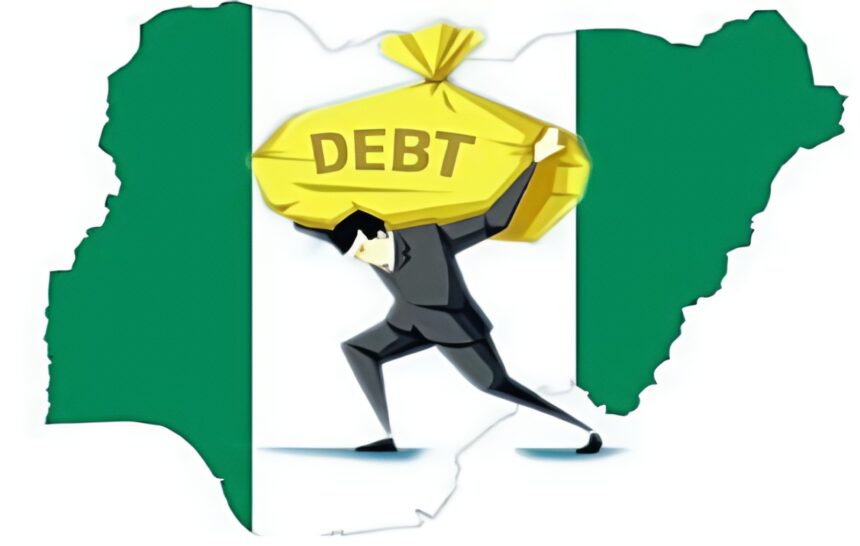
The Federal Government of Nigeria has officially increased the 2026 borrowing plan by N11.31trn.
This sharp upward revision brings the total projected debt financing for the year to N29.20 trillion, up from the initial estimate of N17.89 trillion.
The development was detailed in the 2026 Appropriation Bill recently approved by the National Assembly.
The figure represents an increase of N11.31tn when compared with the earlier N17.89tn borrowing projection contained in the 2026 Abridged Budget Call Circular issued by the Federal Ministry of Budget and Economic Planning.
The new borrowing estimate is contained in the 2026 Appropriation Bill, approved by the National Assembly, and detailed in the House of Representatives Order Paper dated Tuesday, March 31, 2026, as well as in the budget schedule attached to the proposal.
Further findings revealed that aside from the government having increased the 2026 borrowing plan, the total debt financing for 2026 is now put at N29.2tn, reflecting a sharp upward revision as expenditure rises significantly beyond earlier projections. The expansion is driven by a widening fiscal deficit, with total spending estimated at N68.32tn and aggregate revenues projected at N36.87tn, leaving a deficit of N31.46tn.
A breakdown of the financing plan shows that while the bulk of the deficit will be funded through borrowing, other sources remain relatively small.
Asset sales and privatisation are projected at N189.16bn, while multilateral and bilateral project-tied loans are expected to contribute N2.05tn.
The earlier 2026 borrowing projection of N17.89tn was based on a lower deficit estimate of N20.12tn contained in the budget call circular released in December 2025 by the Federal Ministry of Budget and Economic Planning.
However, the latest figures indicate that both the deficit and borrowing needs have risen sharply. Revenue for 2026 is now projected at N36.87tn, driven by federation revenues, independent revenues, and inflows from government-owned enterprises.
Specifically, the Federal Government expects to earn N25.92tn as its share of gross federation revenues, N4.31tn from independent revenues, and N5.85tn from government-owned enterprises. Other inflows include N1.37tn in aid and grants and N300bn from special funds.
On the expenditure side, debt service will account for N15.81tn, making it one of the largest spending components in the budget. Recurrent non-debt expenditure is projected at N15.43tn, while capital expenditure is estimated at N32.29tn, reflecting a strong allocation to infrastructure and development projects. Statutory transfers are put at N4.80tn.
Despite the relatively large capital allocation, analysis shows that debt service and recurrent spending continue to dominate the budget structure, limiting fiscal flexibility.
Further details indicate that domestic debt service will cost N10.16tn, while foreign debt service is estimated at N5.36tn, highlighting the growing burden of debt obligations. The sharp increase in borrowing comes even as the government projects higher revenues compared to earlier estimates, suggesting that expenditure growth has outpaced revenue gains.
This comes as President Bola Tinubu had written to the National Assembly seeking the approval of a N9.09 trillion increase in the 2026 budget. The government plans to finance the budget increase through crude oil gains linked to the United States-Iran conflict and by securing new loans
Tinubu’s N9.09tn request to the original proposal would bring the total to about N67.3tn. This indicates that the approved figure of N68.32tn includes an additional increase of roughly N1tn beyond the executive’s request.
The upward revision, according to lawmakers, is intended to clear legacy obligations, fund key infrastructure, strengthen the judiciary, boost healthcare interventions, and support preparations for the 2027 general elections. To finance the expanded budget, the committee proposed a combination of revenue measures and borrowing.
This includes a $10 per barrel increase in the oil benchmark, expected to generate about N2.592tn in additional revenue.
Recall also that the Senate, last week approved Tinubu’s request to secure fresh external loans totalling $6bn.
The loan is said to be aimed at plugging fiscal gaps and financing key infrastructure projects. The move has attracted criticism from opposition parties and economic experts.
The approval came within 3 hours Tinubu’s letter to the Senate was read on the floor of the house.