

The National Aeronautics and Space Administration (NASA) has officially released the first high-resolution images captured by the Artemis II crew members during their historic flyby of the Moon’s far side.
The images offer humanity its first “up-close” look at the rugged, crater-scarred lunar flipside through human eyes since the Apollo era.
This comes after a four-person Artemis II crew—Commander Reid Wiseman, Pilot Victor Glover, and Mission Specialists Christina Koch and Jeremy Hansen—passed behind the Moon on April 6, 2026.
During this period of radio silence, the astronauts utilized state-of-the-art camera systems to document the terrain.
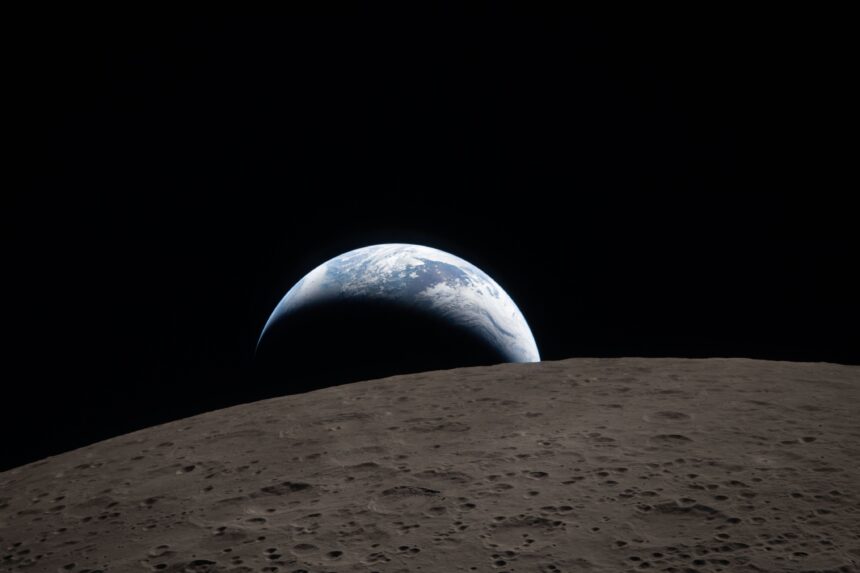
The results of the photography include a breathtaking “Earthset,” where a vibrant blue marble dips below the grayscale horizon of the lunar limb.
Captioning the images, NASA stated: “A muted blue Earth with bright white clouds sets behind the cratered lunar surface.
“The dark portion of Earth is experiencing nighttime. On Earth’s day side, swirling clouds are visible over the Australia and Oceania region. In the foreground, Ohm crater has terraced edges and a flat floor interrupted by central peaks. Central peaks form in complex craters when the lunar surface, liquefied on impact, splashes upwards during the crater’s formation.”
A second shows the solar eclipse that the Artemis II crew witnessed.
“From the crew’s perspective, the Moon appears large enough to completely block the Sun, creating nearly 54 minutes of totality and extending the view far beyond what is possible from Earth,” the caption reads.
“The corona forms a glowing halo around the dark lunar disk, revealing details of the Sun’s outer atmosphere typically hidden by its brightness. Also visible are stars, typically too faint to see when imaging the Moon, but with the Moon in darkness, stars are readily imaged. This unique vantage point provides both a striking visual and a valuable opportunity for astronauts to document and describe the corona during humanity’s return to deep space. The faint glow of the nearside of the Moon is visible in this image, having been illuminated by light reflected off the Earth.”
NASA’s Artemis II crew completed its historic trip around the moon on Monday afternoon.
The four-member crew surpassed the record for the farthest distance from Earth traveled by humans, set by Apollo 13 in 1970 at 248,655 statute miles.
“We will continue our journey even further into space before Mother Earth succeeds in pulling us back to everything that we hold dear,” Hansen told mission control. “But we, most importantly, choose this moment to challenge this generation and the next to make sure this record is not long-lived.”
During their seven-hour lunar flyby, the Artemis II astronauts took photos and made observations from the Orion spacecraft, dubbed Integrity, which lost contact with mission control for about 40 minutes as it passed behind the moon. The crew members became part of that elite group of humans who have ever witnessed an “Earthrise” as they cleared the far side of the moon. They also saw a solar eclipse from space.