

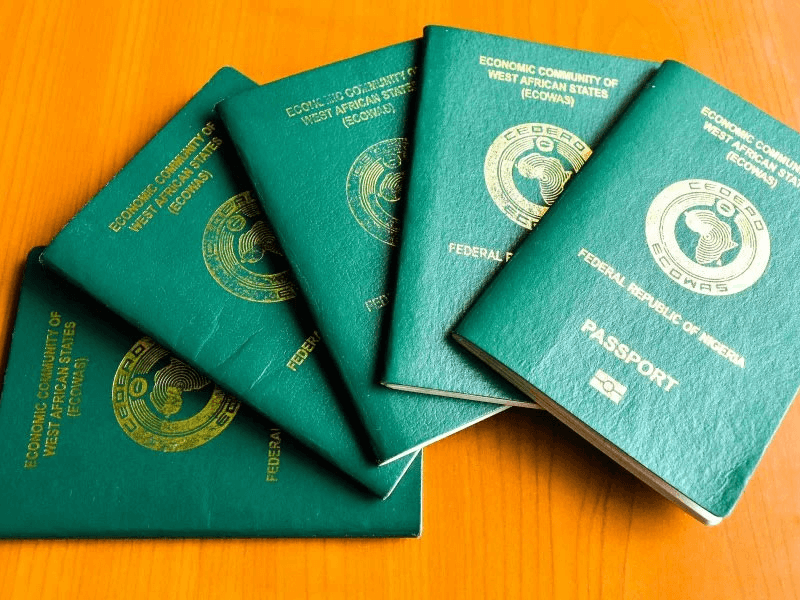
The Nigerian government has issued a directive to the Nigeria Immigration Service (NIS) to withdraw and deactivate the international passports of citizens who have formally renounced their nationality.
This move, announced on April 11, 2026, I’d said to be aimed at closing a loophole where citizens who had renounced their nationality continue to use Nigerian passports for travel purposes.
According to a statement from the Minister of Interior, Olubunmi Tunji-Ojo, the directive follows reports of individuals holding onto Nigerian passports even after they have been granted citizenship in other countries that do not allow dual nationality.
The Minister emphasized that once the President registers a declaration of renunciation, the individual legally “ceases to be a citizen of Nigeria” under Section 29 of the 1999 Constitution.
Consequently, the Minister added that retaining a Nigerian passport becomes an unlawful act.
The government stressed that citizenship is not only a legal status but also the basis for access to sovereign identity—and once it is relinquished, the privileges attached to it cease.
While the government did not provide a specific figure regarding the number of Nigerians who have formally renounced their citizenship, the policy signals a stricter enforcement stance by authorities on issues of nationality and documentation.
Pan-Atlantic Kompass reports that the minister anchored the directive on Section 29 of the Constitution of the Federal Republic of Nigeria 1999, which outlines the process and implications of renouncing Nigerian citizenship.
The statement reads in part: “Any citizen of Nigeria of full age who wishes to renounce his Nigerian citizenship shall make a declaration in the prescribed manner for the renunciation.
“The President shall cause the declaration made under subsection (1) of this section to be registered and upon such registration, the person who made the declaration shall cease to be a citizen of Nigeria.
“We will continue to strengthen systems that secure Nigeria’s borders, prevent identity fraud, preserve the sanctity of Nigerian citizenship, and facilitate legitimate travel while preventing unauthorized or ineligible access.”
Pan-Atlantic Kompass reports that under the law, a Nigerian of full age may voluntarily renounce citizenship by making a formal declaration.
Applicants seeking to renounce Nigerian citizenship are required to submit a formal application to the Ministry of Interior and complete the prescribed renunciation form (Form G), obtainable online or at the ministry.
The process includes the submission of supporting documents such as a birth certificate, indigeneship letter, passport photographs, a sworn oath of renunciation, and a copy of the applicant’s Nigerian passport.
Applicants must also provide a letter from the country whose citizenship they intend to acquire, confirming eligibility upon renunciation.
A processing fee of ₦20,000 is payable at the point of application, while an additional ₦50,000 is required upon approval.
Once the declaration is registered by the president, the individual ceases to be a citizen of Nigeria.