

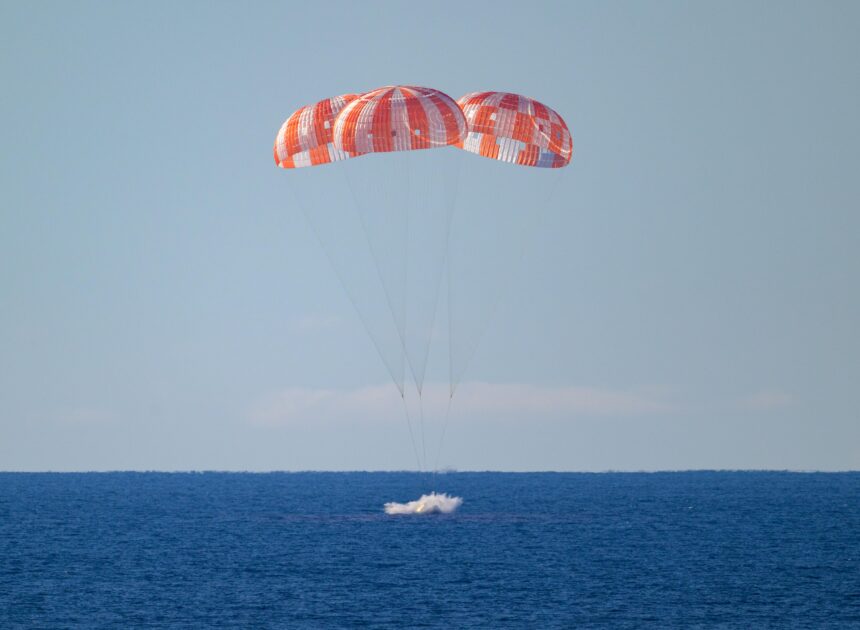
NASA has released stunning videos of how the Artemis II crew landed in the Pacific Ocean, capturing the precise moment the three main parachutes deployed to bring the four-person crew safely home.
This successful splashdown concludes a 10-day mission that saw humans travel further into space than at any point since the Apollo era.
The Artemis II crew landed through the hell of a recovery operation led by the U.S. Navy and NASA’s Exploration Ground Systems.
The operation was executed with surgical precision off the coast of Baja California.
The splashdown sequence, which began with the separation of the European Service Module, took about 42 minutes to complete.
The re-entry and subsequent splashdown are considered the most dangerous part of the Artemis II mission, with the Orion capsule enduring temperatures of nearly 2,760 °C — about half as hot as the Sun.
Shortly after landing, the astronauts – Wiseman, pilot Victor Glover, mission specialist Christina Koch, and Canadian astronaut Jeremy Hansen – were taken by helicopter to the USS John P Murtha, where they will undergo medical evaluations.
NASA said they would be flown to Houston to be reunited with their families on Saturday.
NASA has not yet confirmed when they will make their first public appearance.
At a press conference, Flight Director Rick Henfling said there had been a lot of anxiety but also a lot of confidence while bringing the Orion crew home.
“We all breathed a sigh of relief once the (capsule’s) side hatch opened up,” he said.
“The flight crew is happy and healthy and ready to come home to Houston.”
Lori Glaze, acting associate administrator at NASA, was full of praise for the astronauts.
She said the four were all individually impressive, but that she was proud of their “teamwork” and “camaraderie”.
“I think they really brought an amazing sense of what we were trying to achieve,” she added.
“It was a mission for all of humanity.”
The Artemis II mission began its final descent at 19:33EDT (23:33GMT) when the European Space Agency-built service module – the cylinder of engines and solar panels that powered Orion throughout its lunar journey – detached.
Speaking also at the press conference, NASA associate administrator Anita Kshatriya contrasted the precision of that angle with the 250,000-mile journey to the Moon.
“The team hit it, that is not luck, it is 1,000 people doing their jobs,” he said.
Recall that the Artemis programme was aimed at stepping up Moon exploration, landing humans on the Moon for the first time since 1972, setting up a permanent lunar base, and aiming for a crewed mission to Mars.
The next flight, Artemis III, has been redesigned under NASA’s new administrator Jared Isaacman to be an Earth-orbital mission to test rendezvous and docking with the SpaceX and Blue Origin lunar landers, and is pencilled in for mid-2027.
The first actual Moon landing – Artemis IV – is targeted for 2028, though there are doubts that the target is achievable.