
A Rivers State community has appealed a judgment of the Ordinary Court of Milan that dismissed claims seeking remediation and compensation for decades of flooding linked to oil industry infrastructure in Aggah, Ogba/Egbema/Ndoni Local Government Area of Rivers State in South-south Nigeria.
The appeal was filed by the Egbema Voice of Freedom (EVF), Advocates for Community Alternatives (ACA), and community activist Pastor Nicholas Evaristus Ukaonu against Italian energy company Eni S.p.A. and Oando Energy Resources Nigeria Limited, formerly known as the Nigerian Agip Oil Company (NAOC).
The appellants, who spoke at a media briefing on Tuesday, said they were challenging the April 9, 2026 judgment issued by a Milan Court, arguing that it failed to adequately address the continuing environmental, social, and economic impacts of flooding in the Rivers community.
The people of Aggah, an Egbema community whose livelihoods depend largely on farming and fishing, have endured annual flooding for decades, according to a statement issued by ACA’s Emyloia Kpadonou. The flooding is allegedly linked to embankments and raised access roads constructed in the Mgbede oil field by NAOC in the early 1970s, which obstruct the natural flow of streams through the area.
While the Milan court affirmed its jurisdiction to hear cases involving the overseas activities of Italian parent companies, it dismissed the claims for further remediation and compensation to the Rivers community. The court held that Eni and NAOC had fulfilled their obligations under a 2019 Terms of Settlement by constructing drainage channels and carrying out feasibility studies, even though flooding persists in the community.
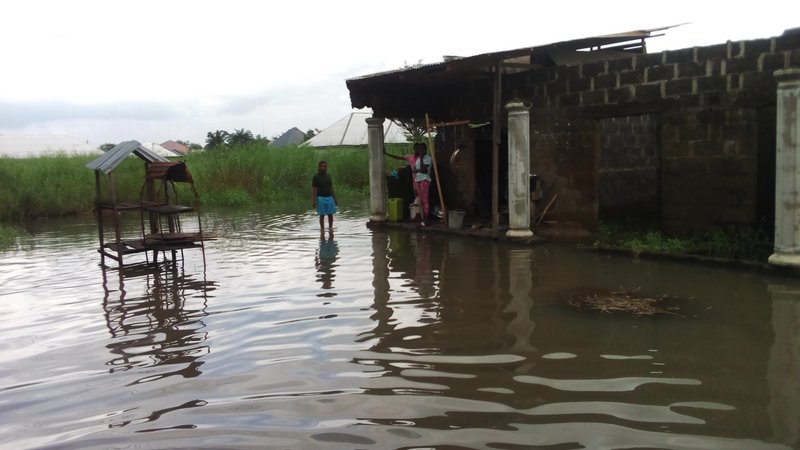
The statement criticised the ruling, arguing that it focused on whether infrastructure was built rather than whether it effectively solved the flooding problem.
Evidence presented before the court, according to the appellants, included the Final Flood Aggah Community Report, internal company documents, findings from the Rivers State Ministry of Environment, and a Nigerian civil judgment. The evidence allegedly showed that access roads connected to oil wells obstruct natural water flow and worsen flooding across the community.
Community member Evangelist Ubas was quoted as saying: “By focusing on whether infrastructure was built rather than whether it actually solved the flooding, the Court adopted an approach disconnected from the realities faced by the people of Aggah.
“A settlement cannot be considered fulfilled when families remain underwater, livelihoods are destroyed, and environmental harm continues unabated.”
The court also ruled that EVF lacked standing to pursue damages claims on behalf of affected residents and ordered the claimants to pay more than €180,000 in legal costs.
Plaintiffs Question Basis of Milan Ruling
Speaking at a media briefing titled ‘Justice for Aggah People’ on Tuesday, plaintiffs’ lawyer, Luca Saltalamacchia, said the judgment contradicted evidence presented during the trial and departed from the court’s earlier position.
“When we launched the suit, we had a very strong narrative and very strong evidence,” Saltalamacchia, an Italy-based lawyer said. “In fact, at the beginning of the trial, the judge put forward a settlement proposal asking NAOC-Eni to close the litigation and recognize some compensation to the plaintiffs.”
According to him, the final judgment appeared to adopt the defendants’ arguments while overlooking key evidence presented by the claimants.
“The judge copied in the ruling the narrative of Eni without taking into consideration all the evidence that we submitted,” he claimed.
In one of the most striking claims made at the briefing, Saltalamacchia disclosed that his legal team, in an expert review, found out that artificial intelligence may have been used in drafting the judgment.
“Important passages of the process, including the settlement proposal, were not mentioned,” he said, claiming that an expert reportedly found a “high possibility” that AI had been used in preparing the ruling.
The lawyer said the findings would form part of the grounds of appeal.
Saltalamacchia further described the legal costs awarded against the claimants as punitive.
“I have never seen in my 30 years of experience as a lawyer in this field such a big condemnation of plaintiffs to pay counterpart fees in such a large amount of money,” he said.
Community, Advocates Vow to Continue Legal Battle
Speaking on the Milan court judgment, Pastor Nicholas Evaristus Ukaonu argued that Eni’s own internal documents had acknowledged the flooding problem decades ago.
“It will surprise you to know that in 2024 and 2025, Eni was still building culverts. If it didn’t solve the problem in 1988 and didn’t solve the problem in 1992, would it solve the problem in 2024 and 2025? The answer is no,” Ukaonu said.
He questioned the decision to impose legal costs on the community.
“How can you ask the oppressed to pay the oppressor such an amount of money? Yet we are flooded,” he said.
“Now, the judge is giving us costs, asking the community who is oppressed, who is flooded as a result of the facilities built by these multinationals, you are asking us to pay 160,000 euros.
“If you add tax and some other calculations, it will amount to 200,000 euros. Do the mathematics, that’s close to 200 to 300 million naira. How can you ask the oppressed to pay the oppressor such an amount of money?” He asked.
Earlier in the briefing, Chima Williams, Executive Director of Environmental Defenders Network (EDEN), traced the origins of the dispute to a complaint filed through the OECD National Contact Point mechanism rather than through the courts.
According to Williams, the complaint became the first successful OECD complaint mechanism from Nigeria and resulted in a Terms of Settlement requiring drainage channels, bridges and culverts to restore the natural flow of water from Aggah into the Orashi River.
However, disagreements emerged when the companies maintained they had fulfilled their obligations, while the community argued that the flooding remained unresolved.
“Our complaint was not that you didn’t build drainages or culverts,” Williams said. “Our complaint was that the water is not flowing out of the community the way it naturally used to flow, so you have not satisfied the terms of settlement.”
Williams described the litigation as one of the first known attempts by an African community to seek judicial enforcement of a settlement reached through the OECD complaint mechanism.
The appellants said the appeal seeks a broader interpretation of corporate responsibility and argues that environmental remediation efforts should be assessed by their effectiveness in resolving harm rather than by the completion of technical measures alone.
They maintained that residents of Aggah continue to face recurring floods, unsafe water conditions, destruction of farmland, and economic displacement, and vowed to continue pursuing what they described as a permanent and effective solution to the community’s flooding crisis.