
The United States (U.S) government has announced new tariffs on the United Kingdom (UK), Canada, and other countries over alleged forced labour imports.
The move, announced by the Office of the U.S. Trade Representative (USTR), affects 60 economies and could reshape global supply chains.
The US Trade Department said these countries will face the tariffs because they failed to address the importation of goods made with forced labour.
The USTR identified nations, including the United Kingdom, Canada, the European Union, China, Australia, and others, for not effectively enforcing prohibitions on forced labour imports. Proposed additional tariffs range from 10% to 12.5%, depending on the severity of enforcement shortfalls.
This latest action builds on the U.S. government’s broader commitment to combating forced labour in international trade. Under Section 307 of the Tariff Act and related frameworks, Washington has intensified scrutiny of supply chains suspected of involving Uyghur forced labour in China or other exploitative practices worldwide.
U.S tariffs on the UK, Canada, and other countries over forced labour stem from reviews showing insufficient domestic measures to prevent tainted goods from entering their markets and subsequently the U.S. The Trump administration views this as both a human rights issue and an unfair trade practice that disadvantages American workers and compliant businesses.
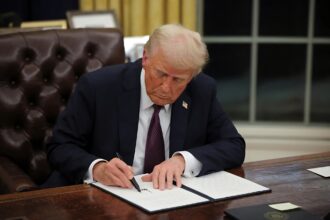
It is the second time President Donald Trump’s administration has announced new import taxes since the US Supreme Court struck down many of his previous duties in February.
The 60 trading partners listed – including the UK, the EU, Canada, India, and Japan – account for almost all of the goods sold to the U.S.
The US government’s stance is that trading with countries that buy things made with forced labour is unfair to the U.S.
U.S Trade Representative Jamieson Greer said it “creates a dynamic where American workers are forced to compete globally on an unlevel playing field”.
The tariffs announced have not yet been enforced. The Trump administration will need to go through a process to do so.
The proposed tariffs come after an investigation launched in March by Greer into the 60 trading partners, and whether those countries had failed to act on prohibiting forced labour.
The report into the investigations concluded that 54 of the countries had “failed to impose a legal prohibition on the importation of goods produced wholly or in part with forced labour and to effectively enforce such a prohibition”.
It said six other trading partners – Canada, the EU, Ecuador, Indonesia, Mexico, and Pakistan – had “failed to effectively enforce a forced labour import prohibition”.
The trade department said it would impose 10% tariffs on imports from Canada, the EU, Britain, Indonesia, Mexico, Pakistan, Argentina, Bangladesh, Cambodia, El Salvador, Guatemala, Malaysia, and Taiwan.
The remaining 45 countries, which include China and India, would face 12.5% duties.
China, in its reaction, said it opposed any form of unilateral tariff and denied allegations of forced labour.
“There is no so-called forced labour in China, and we oppose using this as an excuse for political manipulation,” Chinese foreign ministry spokesperson Mao Ning said.
Reacting also, the European Commission (EU) stated that the commission remained committed to the trade deal agreed with the Trump administration last year.
“The EU considers tariffs imposed on these grounds to be unjustified,” a spokesperson said. “On the EU side, we are on track to ensure implementation of our Joint Statement tariff commitments by the end of June.”
Ajay Srivastava of the Delhi-based think tank Global Trade Research Initiative said India should challenge the legal basis of the proposed tariffs, arguing they stretch the scope of Section 301 – a US trade law that allows Washington to investigate and penalise foreign trade practices deemed unfair.
The move appeared to be part of “broader US pressure tactics”, he said, and should be kept separate from ongoing trade negotiations.
“India should reassess its participation and consider stepping away from the bilateral trade agreement, as Malaysia has done,” Srivastava said.
The UK’s Independent Anti-Slavery Commissioner has previously said: “Since the Modern Slavery Act 2015 was passed, much has been achieved to improve our awareness and understanding of modern slavery and human trafficking.”
The tariff decision comes after the U.S began an investigation in March into the 60 trading partners, which comprise 99.4% of U.S imports, over the forced labour concerns.
Following its investigation, the U.S Trade Department said on Tuesday all 60 countries had “failed both to impose a legal prohibition on the importation of goods produced wholly or in part with forced labor (forced labor goods) and to effectively enforce such a prohibition”.