
Over the past weeks, questions about the fate of closed Nigerian businesses in South Africa have emerged on the front burner.
This comes as many Nigerians have been forced to abandon their livelihoods in South Africa due to the ongoing fears of xenophobic attacks.
Opening up on the fate of closed Nigerian businesses in South Africa, the Federal Government of Nigeria said it is set to launch a formal diplomatic initiative to secure financial compensation for its citizens.
Nigeria’s Acting High Commissioner to South Africa, Ambassador Alexander Ajayi, confirmed that the government has instructed returning citizens to meticulously catalog everything they left behind.
This documentation includes:
- Fixed retail shops and commercial properties
- Registered business assets and inventory
- Vehicles, personal property, and real estate
The embassy said it intends to use this verified data to present concrete financial claims directly to the South African government.
Ajayi made this known while addressing the press on Tuesday.
He said the Nigerians being repatriated voluntarily opted to return home ahead of the latest planned anti-immigrant protests, and that the Federal Government has begun documenting businesses and properties abandoned by returnees in preparation for compensation talks with South African authorities.
Ajayi said discussions with South African officials on the compensation issue are already underway, with returning Nigerians now being asked to formally document what they are leaving behind.
“In terms of the businesses, just three days ago, myself and the South African Deputy Minister of Finance were together and we were discussing this. I took up the discussion with her and we have agreed that we are going to ask our people who are returning to begin to document what they are leaving behind,” he said.
“I have asked them before they left yesterday to document very accurately those things they were leaving behind in terms of businesses, in terms of even cars, movable and immovable properties. We can now take it up with the South African government. That is the next step we are going to take,” he added.
Ajayi stressed that the repatriation effort would not end with simply bringing Nigerians home.
“This repatriation will not end with just taking people to Nigeria. We are going to systematically follow up on the information given to us, and I told them to be very accurate with what they are going to give because we are going to work with the South African government to get to the exact locations of all these businesses, shops and properties and present them to the South African government for possible compensation. After all, we will not allow the labour people have suffered to build over the years to just go down the drain or be taken over by people,” he said.
Ajayi pushed back on claims that most Nigerians in South Africa are undocumented, arguing that the majority migrated to the country through legal channels.
“In the last three or four years there has been a deluge of applications at the South African Home Office which were not attended to due to systemic issues. So, because of this many, not only Nigerian nationals, were caught in this web of delay, so you cannot rightly claim that these were undocumented because most of them came to the country legally in terms of how somebody should migrate,” he said.
“So, it is based on now wanting to renew their papers and get them when one expires that they were caught up in the unnecessary delays. So, when people try to say they were undocumented, I quite disagree with that because some of them, based on experience, have had their papers lag at the Home Office for years,” he added.
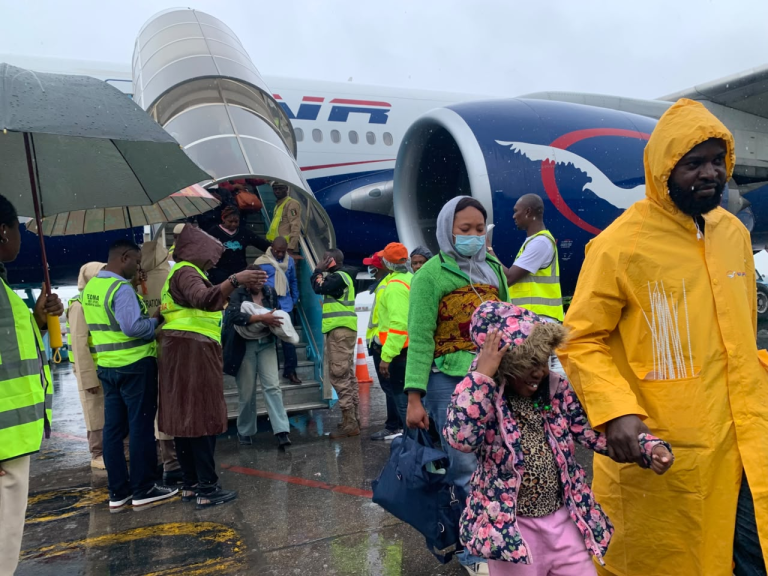
Pan-Atlantic Kompass reports that the revelation on the closed Nigerian businesses in South Africa comes as the third batch of Nigerians evacuated from South Africa has arrived in Lagos following weeks of anti-immigration protests and xenophobic tensions in the country.
The evacuees arrived aboard an Air Peace aircraft, which landed at the cargo terminal of the Murtala Muhammed International Airport, Ikeja, at about 10:54 a.m. on Tuesday.
According to the Ministry of Foreign Affairs spokesperson, Kimiebi Ebienfa, the number is in addition to 66 others that arrived via South African Airways and facilitated by a good-spirited Nigerian on June 24.
“The batch of 269 evacuees, escorted by officials of the Nigerian mission in South Africa, was officially received at the airport by senior officials of the Ministry of Foreign Affairs, led by the Director, African Affairs Department, Amb. Haruna Ali-Gombe.
“He conveyed the heartfelt greetings and assurances of President Bola Ahmed Tinubu to the returning nationals, reaffirming the Federal Government’s steadfast commitment to ensuring the safety of Nigerian nationals living outside the country.
“With the June 30 deadline for undocumented foreigners to leave South Africa, the federal government wishes to reiterate the fact that the evacuation process is still on course,” Ebienfa said.
Recall also that the first batch – 258 Nigerians – was received on June 11, bringing the total number, as at June 30, to 593.
Ebienfa added that more flights were expected in the country in the next few days to evacuate all Nigerians already screened and cleared to voluntarily return home.