

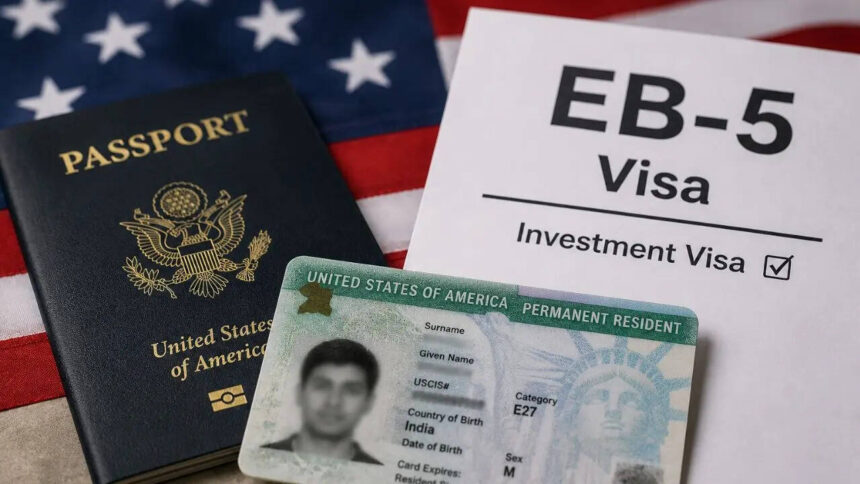
The Department of Homeland Security (DHS) has officially announced a massive overhaul of the rules guiding the U.S EB-5 Immigrant Investor visa Program.
Scheduled for formal publication in the Federal Register, the new proposed rule marks the most significant regulatory shakeup for foreign investors looking to secure U.S. permanent residency (green cards) since 2022.
The proposed framework is designed to formally codify the EB-5 Reform and Integrity Act (RIA) passed by Congress, while introducing anti-fraud provisions, stricter definition shifts, and a brand-new investment price bracket.
While the baseline investment amounts established by the RIA remain unchanged—$800,000 for Targeted Employment Areas (TEAs)/infrastructure projects and $1.05 million for standard urban developments—the government is proposing a completely new third tier.
DHS intends to introduce a High Employment Area (HEA) designation. Under the proposal, if an investor funds a project located in an area where the local unemployment rate is substantially lower than the national average (specifically, where the national average unemployment rate is at least 150% of the project area’s rate), the minimum required investment will spike to $1,400,000.
This is the first time High Employment Areas will be categorized as a distinct, premium investment tier.
The proposal on the new rules for the investor visa program will be open for public comments for 60 days after its publication in the July 2 edition of the U.S Federal Register. Once reviewed, the rules could become final within a few months.
Key Changes Proposed by DHS
Among the most important updates are:
- Confirms the current minimum EB-5 investment of US$1.05 million.
- Raises the investment threshold for newly defined High Employment Areas to US$1.4 million.
- Keeps the US$800,000 minimum for qualifying Targeted Employment Areas (TEAs) and infrastructure projects.
- Requires investors to commit their funds before obtaining conditional permanent residence.
- Makes it mandatory for investments to remain available to the job-creating business when the immigrant petition is filed.
- Allows investors to retain their EB-5 priority date in certain cases, including Regional Centre closure or project changes, provided eligibility requirements are met.
- Introduces clearer rules for DHS audits, record-keeping, penalties, suspensions, and debarment of Regional Centres.
- Gives DHS authority to collect biometrics during the EB-5 petition process.
- Digital Assets May Continue as a Funding Source
The proposal confirms that cryptocurrencies and other digital assets may continue to qualify as a lawful source of EB-5 investment funds if they satisfy existing capital and source-of-funds requirements. At the same time, DHS is asking whether the final regulation should include separate evidence standards for digital assets.
That reflects a wider trend across global investor migration programmes, where governments are accepting newer forms of wealth but demanding much tighter proof of their origin.
The proposed regulation also introduces clearer legal definitions for terms such as capital, comprehensive business plan, redeployment, and high employment areas.
For investors, that means more predictable rules. For Regional Centres, it means higher compliance standards and more extensive project documentation.