
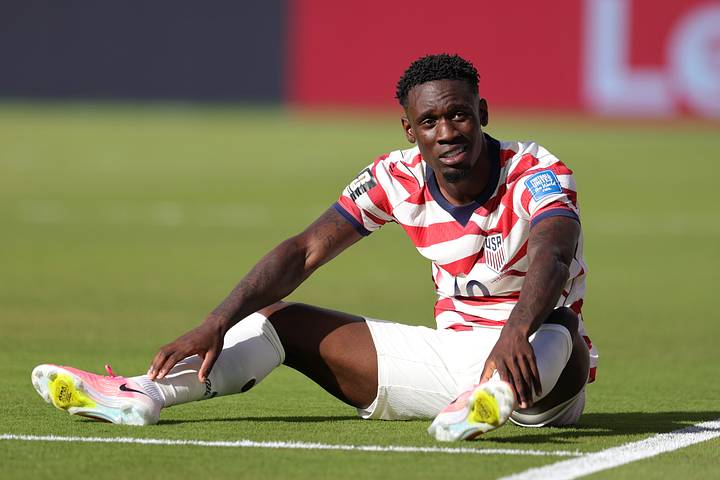
In a controversial decision just hours before a critical 2026 FIFA World Cup Round of 16 match, FIFA’s Disciplinary Committee has lifted U.S striker Folarin Balogun’s one-game red card ban, clearing him to face Belgium on Monday in Seattle.
FIFA’s decision on Balogun’s red card has immediately triggered backlash from the Royal Belgian Football Association (RBFA) and raised eyebrows globally, coming on the heels of direct political commentary from the highest levels of U.S leadership.
Balogun, who has been in sensational form had been ruled out of the Round of 16 Clash against Belgium.
Pan-Atlantic Kompass reports that Balogun’s red card came during the USA’s 2-0 Round of 32 victory over Bosnia and Herzegovina.
While he scored the opening goal, he was later shown a straight red card in the 64th minute for stepping on the ankle of Tarik Muharemovic.
Under normal circumstances, FIFA regulations mandate an automatic, non-appealable one-match ban for a direct red card.
The USMNT appeared destined to face European powerhouse Belgium without its most lethal attacking threat.
In a Sunday evening announcement, FIFA shocked the football world by invoking Article 27 of the FIFA Disciplinary Code to suspend Balogun’s match ban.
”In line with Article 27 of the FIFA Disciplinary Code, the implementation of the match suspension is suspended for a probationary period of one year,” FIFA announced in an official statement.
Essentially, Article 27 grants FIFA’s Judicial Bodies the discretion to pause the enforcement of a disciplinary sanction, replacing it with a probationary period. If Balogun avoids committing a similar serious infraction over the next 12 months, the red card suspension will never be served. If he offends again, the ban is immediately reinstated, along with new penalties.
This means Balogun, with three goals in three matches, is now available to face Belgium.
The Royal Belgian Football Association did not hold back, releasing a scathing statement questioning the integrity of the tournament’s regulatory framework.
The RBFA highlighted an apparent contradiction between FIFA’s ad-hoc ruling and the tournament’s official bylaws.
The association cited Article 66.4 (FIFA Disciplinary Code) which explicitly states that a sending-off automatically results in a suspension for the team’s next match.
They also cited Article 10.5 (2026 World Cup Competition Regulations) which reaffirmed that a direct or indirect red card forces an automatic subsequent-match ban.
The statement reads: “The Royal Belgian Football Association (RBFA) is astonished by FIFA’s decision to declare suspended United States player Folarin Balogun eligible to play in the USA–Belgium match on Monday, 6 July at 5:00 p.m. (Seattle time).
FIFA bases its decision on Article 27 of the FIFA Disciplinary Code.
“This provision states that the FIFA Disciplinary Committee may decide to suspend the enforcement of a previously imposed disciplinary sanction.
“However, Article 66.4 of the same FIFA Disciplinary Code clearly provides that a red card (sending-off) automatically results in a suspension for the team’s next match, as has been the case for all previous red cards issued during this FIFA World Cup.
“Furthermore, and irrespective of the above, the decision is in direct contradiction with the provisions of the FIFA World Cup 2026 Competition Regulations, as set out in Article 10.5:
“If a player or team official is sent off as a result of a direct or indirect red card (second caution), they will automatically be suspended from their team’s subsequent match. In addition, further sanctions may be imposed.”
“The automatic nature of such a suspension was also explicitly reaffirmed in FIFA World Cup 2026 Circular No. 16, which was distributed to all participating member associations on 12 May 2026.
“The same rule is reiterated at every FIFA World Cup 2026 Match Coordination Meeting before each match and is included in all FIFA World Cup 2026 workshop presentations.
“To safeguard the legitimate rights of all participating teams and to protect the fundamental principles of fair play in our sport, both at this FIFA World Cup and at future editions of the tournament, the RBFA is investigating all potential options.”
Adding fuel to the conspiracy fire, the decision quickly shifted from a sports dispute to a political talking point.
Shortly after FIFA publicised the suspension lift, U.S President Donald Trump took to Truth Social to praise the decision.
“Thank you to FIFA for doing what was right, and reversing a great injustice!” Trump posted.
Also speaking at the White House on Monday, Trump said he had asked FIFA to review the decision because he “didn’t think it was a foul”.
Although Trump confirmed he spoke to Fifa president Gianni Infantino, he said “all” he did was ask for a review and added that he did not tell the Swiss he had to suspend Balogun’s ban.
“I thought it was two great athletes who crashed into each other and got entangled,” said Trump
“I think it [the suspension] would have left a big stain. I can’t tell them what to do. I don’t believe they made the decision; I believe it was the commission that made the decision. And it was the right decision.”
The public intervention has led many to question whether political and commercial pressures—given the United States’ role as primary tournament hosts—influenced the independent disciplinary committee’s sudden leniency.
Article 27 Precedents
While the application of Article 27 has made headlines, Pan-Atlantic Kompass reports that this is not the first time FIFA has leaned on this mechanism.
The most notable precedent occurred ahead of the 2026 FIFA World Cup tournament, when Portugal captain Cristiano Ronaldo had the final two games of a three-match qualification ban deferred under a one-year probation period.
That intervention ensured his availability for Portugal’s opening group matches. A similar last-minute Article 27 probation was quietly granted recently to Argentine defender Nicolás Otamendi.