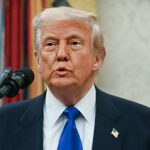

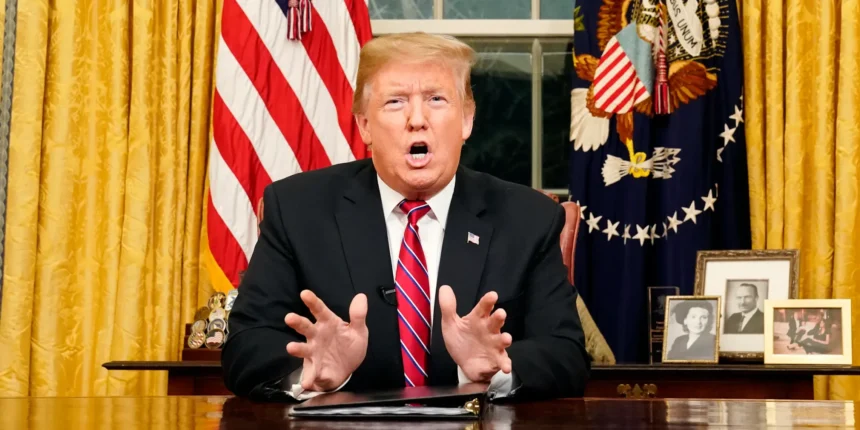
United States President Donald Trump has announced his decision to impose a 25% tariff on Iran’s trading partners.
Trump declared that any country conducting business with Iran will face an immediate 25% tariff on all trade with the United States.
The announcement, made via Truth Social on January 12, 2026, comes amid Iran’s ongoing anti-government protests, where hundreds have reportedly been killed in a government crackdown.
“Effective immediately, any country doing business with the Islamic Republic of Iran will pay a tariff of 25% on any and all business being done with the United States of America. This order is final and conclusive,” said the U.S. president.
It was reported that this secondary tariff measure aims to isolate Iran further economically, targeting its global trading relationships, including Nigeria, as the U.S weighs additional responses, including potential military options.
The 25% tariff on Iran’s trading partners, described by Trump as “final and conclusive,” applies broadly to any nation “doing business” with Iran, though details on implementation, legal basis, and exact scope remain unclear from official White House sources.
Major Iranian trade partners like China (its largest buyer of oil), India, Turkey, the United Arab Emirates, and Iraq could face significant disruptions, as tariffs are paid by U.S. importers of goods from these countries. The move builds on Trump’s history of using tariffs to pressure adversaries and their allies.
Nigeria emerged on this list because of its trade relationship with Iran in recent years. Pan-Atlantic Kompass gathered that non-oil commodities from Iran to Nigeria were valued at $46.5 million in the first seven months of 2023, while African exports to Iran in the same year were 38,122 tons of goods valued at $47.43 million.
Nigeria’s top exports to Iran during according to Export Genius, between April 2024 to March 2025, are Aircraft, Spacecraft, and Parts, which contributed $0.06 million, Miscellaneous Edible Preparations, accounting for $0.02 million, Miscellaneous Chemical Products, of $0.01 million, Printed Books, Newspapers, Pictures, and Milling industry products.
While trade volume between Iran and Nigeria is currently very low, following several years of sharp decline, the two countries last December reaffirmed their commitment to deepening bilateral relations, with a renewed focus on trade, investment, energy cooperation, and multilateral engagement.
Iran and Nigeria agreed to improve bilateral relations following a high-level meeting at the Ministry of Foreign Affairs in Abuja.
The meeting included the ministry’s permanent secretary, Dunoma Umar Ahmed, and the Iranian ambassador to Nigeria, Gholamreza Madhavi Raja, marking one of the first formal engagements since the Iranian envoy presented his letters of credence to President Bola Tinubu.
At the meeting, Raja underscored Nigeria’s strategic importance in Iran’s foreign policy, describing the country as a gateway to West Africa and a critical partner for engagement with the African continent.
China Reacts to 25% Tariff on Iran’s Trading Partners
However, China has kicked against Trump’s 25% tariff on Iran’s trading partners. The Chinese government said it “will take all necessary measures to safeguard its legitimate rights and interests” after Donald Trump announced a tariff against those doing business with Iran.
China is Iran’s largest trading partner, followed by Iraq, the United Arab Emirates, Turkey, and India.
In a post on X, a spokesperson for the Chinese embassy in Washington says: “China’s position against the indiscriminate imposition of tariffs is consistent and clear.
“Tariff wars and trade wars have no winners, and coercion and pressure cannot solve problems. Protectionism harms the interests of all parties.”