

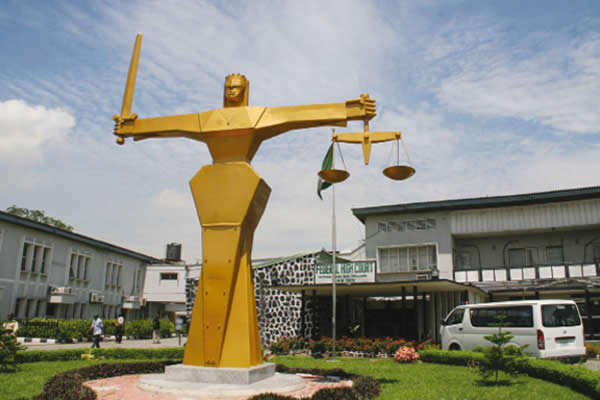
The Federal Government of Nigeria has announced a move to launch fast-tracked courts in a major judicial reform aimed at clearing the backlog of insurgency cases currently clogging the legal system.
It was gathered that about 5,000 terror suspects will face fast-tracked courts, ensuring that justice is served for both victims of violence and those awaiting trial in detention facilities.
Pan-Atlantic Kompass reports that for years, security operatives have been arresting thousands of individuals suspected of affiliation with Boko Haram, ISWAP, and other armed groups.
However, they have remained in custody at various correctional centers with their trials hanging in the balance.
Human rights organizations have frequently raised concerns over the prolonged detention without trial, prompting the Ministry of Justice to collaborate with the National Counter Terrorism Centre (NCTC).
In the 2025–2030 Strategic Plan of the National Counter-Terrorism Centre, it was gathered that the Federal government of Nigeria will launch fast-tracked courts.
According to the plan, by establishing these specialized judicial panels, the government aims to provide a swift resolution to these cases.
The initiative ensures that 5,000 terror suspects will face fast-tracked courts under a framework that prioritizes efficiency without compromising the legal rights of the accused.
The trials will involve judges from the Federal High Court and defense counsel provided by the Legal Aid Council of Nigeria to maintain international standards of fairness.
“At present, there are approximately 5,000 individuals suspected of having been involved in terrorism-related offences who are being held in pre-trial detention. This has resulted in a significant backlog of cases, and the NCTC legal team has been working with the Defence Staff and the Federal Ministry of Justice to support the review of these case files and, where appropriate, to help to either expedite these prosecutions or to dismiss outstanding charges that have not been sufficiently substantiated to proceed to trial.
‘’NCTC has also been coordinating case hearings held by the Federal High Court sitting both in Wawa Military Cantonment in Kanji, Niger State, and in Abuja,” the document partly read.
The NCTC said in 2024, the support provided through this framework led to the prosecution of 393 terrorism-related cases, resulting in 329 convictions.
This, it added, pushed Nigeria’s conviction rate in terrorism cases to 84 per cent, a sharp increase from 41.5 per cent recorded in 2018.
The NCTC said charges against about 1,200 detainees were reviewed and ultimately dismissed, leading to their release and resettlement into their communities.
“In 2024, the support provided to the Federal Ministry of Justice and the Federal High Court helped to enable the prosecution of 393 new cases, resulting in 329 terrorism-related convictions. Indeed, the conviction rate in terrorism-related cases has increased markedly from 41.5% in 2018 to 84% in 2024.
‘’The charges against a further 1,200 individuals were reviewed and ultimately dismissed, resulting in their release from custody and resettlement back into their communities.”
Also, according to the document, Nigeria is set to introduce DNA profiling into a proposed National Database on Terrorism as part of renewed efforts to strengthen investigations, prosecutions, and intelligence-sharing on terrorist groups.
It outlined how biometric data — including DNA — will be used to identify, track, and prosecute members of proscribed terrorist organisations.
According to the document, the database will be domiciled within the Office of the National Security Adviser and will serve as a central repository of information on known and suspected terrorists.
“Nigeria currently lacks a central National Database on Terrorism accessible to every agency engaged in the fight against terrorism. The NACTEST (National Counter-Terrorism Strategy) identified the need for such an information-sharing system to be located within ONSA, and NCTC has been tasked by the National Security Adviser with establishing this database as part of NACTEST’s “Identify” and “Implement” work streams.
“The intention is that this database will contain full identifying particulars on known and suspected members of terrorist groups (including, where possible, biometric data and a DNA profile), information on terrorist modus operandi, and intelligence on reported terrorist activity. It will be populated with information and intelligence provided by correctional and detention facilities, law enforcement and security partners, and intelligence recovered and developed by staff from the Directorate of Intelligence.”
The move by the Federal Government of Nigeria to launch fast-tracked courts comes amid increased international scrutiny on the country.
Nigeria has been facing pressure from the United States since the designation of the country as a Country of Particular Concern (CPC) over Christian genocide.
Recall also that on Christmas Day, December 25, 2025 U.S, in collaboration with the Nigerian government, launched airstrikes in Sokoto State.