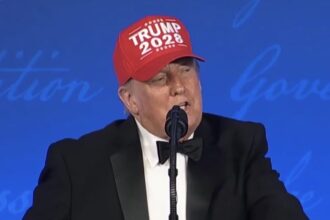

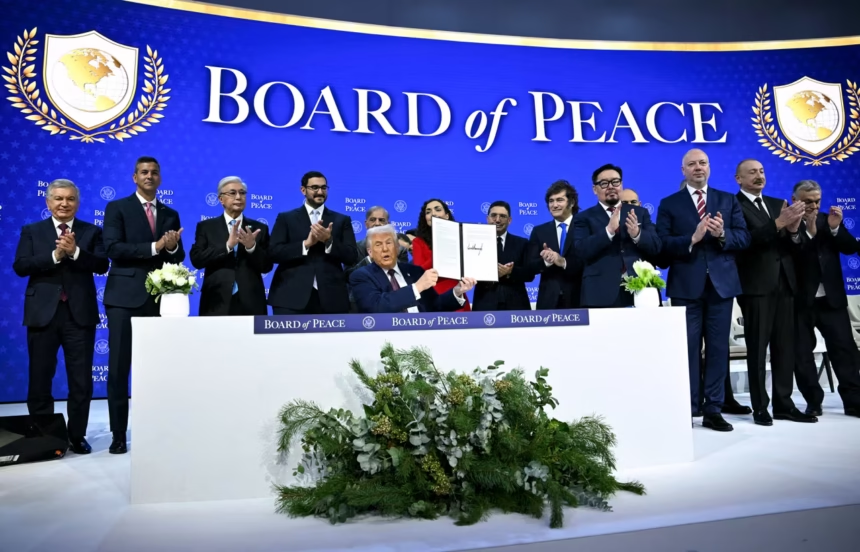
United States President Donald Trump formally signed the founding charter of the “Board of Peace” today, Thursday, January 22, 2025, at the World Economic Forum (WEF) in Davos, Switzerland.
Billed as a revolutionary body for international conflict resolution, the signing ceremony effectively establishes a new international organization aimed at reshaping global stability, starting with the Gaza Strip.
Addressing a packed audience of world leaders and business titans, Trump described the Board of Peace as “one of the most consequential bodies ever created in the history of the world.”
Pan-Atlantic Kompass reports that the signing ceremony for the new “Board of Peace” featured representatives from fewer than 20 countries — and few of the US’ European allies.
The nations represented on stage in Davos skewed heavily toward the Middle East and South America, with leaders from Saudi Arabia, Qatar, the United Arab Emirates, Argentina and Paraguay among those attending. The leader of Hungary, Viktor Orban, was among the leaders who appeared on stage with Trump.
“We are truly honored by your presence today,” Trump said, referring to them as in “most cases very popular leaders, some cases not so popular.”
While the initiative was initially conceived as a transitional administration to oversee the reconstruction of Gaza following the October 2025 ceasefire, the newly signed charter reveals a broader mandate. The document defined the Board of Peace as an organization dedicated to promoting “stability, dependable governance, and enduring peace” in any region threatened by conflict.
Trump also announced that the Board of Peace has started work already and “it’s running beautifully.”
“We have a great group of people and incredible young people that are leading it from within,” he said during the announcement of the board in Davos.
The unveiled members include few of the United States’ European allies, and Trump said of the collected group, “I like, actually, this group. I like every single one of them. Can you believe it?” and added “Usually I have two or three that I don’t like. I don’t find them up here.”
Trump also touted the work on a peace plan for the conflict in Gaza, saying, “we released a plan for the permanent end to the conflict in Gaza, and I’m pleased to say that our vision was unanimously adopted by the United Nations Security Council late last year.”
The U.S President added on Thursday that he wants his new “Board of Peace” to work “in conjunction” with the United Nations, even as he criticized the UN for failing to live up to its potential.
“Once this board is completely formed, we can do pretty much whatever we want to do, and we’ll do it in conjunction with the United Nations,” he said in Davos. “I’ve always said the United Nations has got tremendous potential. Has not used it, but there’s tremendous potential.”
Trump had previously suggested that the “Board of Peace,” which he formed chiefly to help rebuild Gaza, “might” eventually replace the UN. But on Thursday he said he wanted the two to work in combination, contending it could result in “something very, very unique for the world.”
“On the eight wars that I ended, I never spoke to the United Nations, not any of them,” Trump said. “They tried, I guess, and some of them, but they didn’t try hard enough.”
In his address, the U.S Secretary of State Marco Rubio said Trump is willing to speak to anyone in what he described as the pursuit of peace.
“We are here today because of President Trump’s vision,” Rubio said.
He added that “a few months ago, people thought it was impossible to solve”, referring to ongoing conflicts, and said that “all these hostages being held [in Gaza] – nobody thought that would come to a resolution”.
Rubio went on to argue that existing institutions had been unable to act, saying Trump instead had “the vision and the courage to dream the impossible”.
“A lot of times, people like to give speeches, and they’re not useless – they have utility in many cases – but oftentimes in international affairs, we often find ourselves at events where people are reading these scripted statements, these strongly worded letters that they put out, but no action. Nothing happens,” Rubio said at the signing ceremony in Davos. “This is a group of leaders that are about action.”
Rubio said the board’s work in Gaza can “serve as an example” of what it can do.
“If we put the time and the effort that it requires – that I know this board will do – but I also think it will serve as an example of what’s possible in other parts of the world without losing focus on what’s before us now,” he said.
Below is the full list of the members of the “founding executive council” of the Board of Peace – with Trump as chairman,
- Tony Blair, former British prime minister
- Jared Kushner, Trump’s son-in-law
- US Secretary of State Marco Rubio
- US special envoy to the Middle East Steve Witkoff
- Marc Rowan, CEO of financial firm Apollo Global Management
- Ajay Banga, World Bank Group president
- Robert Gabriel, a US deputy national security adviser.