
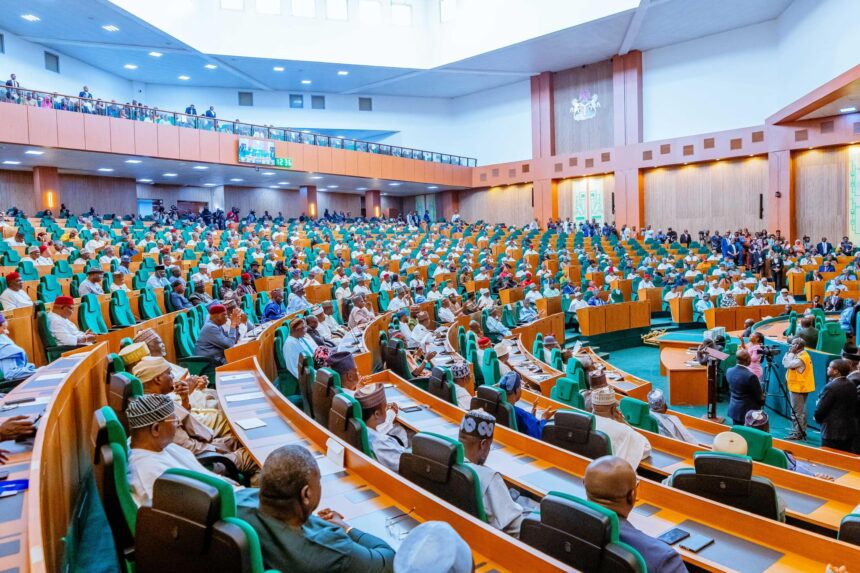
The Minority Caucus of the House of Representatives has raised a massive alarm over what it describes as “unauthorized and illegal alterations” in Nigeria’s newly enacted tax laws.
In a statement released on Friday, January 23, 2026, the caucus confirmed that an interim investigation revealed significant discrepancies between the versions of the tax bills passed by the National Assembly and the versions eventually published in the official government gazette.
The controversy began when Hon. Abdulsamad Dasuki raised a point of order on the floor of the House, alerting lawmakers that the gazetted copies of the tax acts—the primary legal documents for the country’s fiscal policy—did not match the documents debated and approved by parliament.
In response, a seven-member fact-finding committee, led by Hon. Afam Victor Ogene, was constituted on January 2, 2026.
The committee’s interim report has now confirmed the worst fears of alterations in the tax laws.
Ogene said the directive of the leadership of the red and green chambers to the clerk to “take steps to align” the Acts passed by the parliament with the federal government printing press to ensure accuracy, conformity, and uniformity is a “clear indication that there were some procedural anomalies in the previously gazetted version that illegally encroached on the core mandate of the national assembly”.
The lawmaker said Kingsley Chinda, minority leader of the house, constituted a committee on January 2 to thoroughly investigate the “scandal”.
He said the committee comprises lawmakers from the six geopolitical zones — Aliyu Garu (Bauchi), Stanley Adedeji (Oyo), Ibe Osonwa (Abia), Marie Ebikake (Bayelsa), Shehu Fagge (Kano), and Gaza Jonathan (Nasarawa).
Ogene said preliminary findings, based on a comparison of the certified true copies (CTCs) released by the house and the gazetted copies, indicated that the laws were altered.
“There were three different versions of the documents in circulation, particularly the Nigeria Tax Administration Act, 2025,” the statement reads.
“The Nigeria Tax Administration Act (NTAA), 2025, has several discrepancies from the version passed by the National Assembly and the version earlier published in the official gazette. These discrepancies are obvious, going by the released Certified True Copies (CTCs) by the House referenced earlier.”
He said under section 29(1), the version certified by the national assembly set the tax compliance reporting threshold at N50 million for individuals and N100 million for companies, but the gazetted copy lowered the threshold for individuals to N25 million and altered the threshold for companies.
“This is a clear case of the executive undermining legislative powers by illegally altering an already passed law to drag more taxpayers into the net,” the legislator said.
In section 41, Ogene said the gazetted version introduced new subsections 41(8) and 41(9), which require taxpayers to deposit 20 percent of the disputed tax amount as a condition for appealing decisions of the tax appeal tribunal to the high court.
He added that the provisions were not included in the version passed by the national assembly.
He said in section 64, the gazetted law “illegally increased the powers of the tax authority to include the power to arrest individuals suspected of tax violations through law enforcement agencies, and allowed for the sale of seized assets without a court order”.
Ogene also pointed out that in section 3(1)(b), the version certified by the national assembly defined federal taxes to include income tax, petroleum income tax, stamp duties, and VAT, but the gazetted copy removed petroleum income tax and VAT from the definition of taxes administered by the federal government.
“We consider this an affront to the exclusive powers of the national assembly to make laws,” he said.
The lawmaker said section 39(3) of the gazetted law was “illegally altered” to mandate that tax computations for petroleum operations be carried out in US dollars, contrary to the version passed by the national assembly, which provided that tax calculations be done in the currency of the transaction.
In sections 30(1)(d) and 30(3) of the National Revenue Service (Establishment) Act, Ogene said the version passed by the national assembly empowered lawmakers to summon officials, demand reports, and enforce accountability in line with their constitutional oversight role.
The lawmaker said the gazetted version deleted the provisions requiring quarterly and annual reports to parliament, describing it as a disregard for the national assembly and the doctrine of checks and balances.
“Given the anomalies, illegalities, and impunity observed, which clearly undermine the national assembly’s constitutional powers and democracy, the committee finds the current evidence sufficient to warrant a deeper investigation,” Ogene said.
“This will ensure accountability for the affront against the legislature. To achieve this, the Committee respectfully requests an extension to conduct a more thorough examination of the matter.”
This is the latest development regarding the new tax laws that took effect on January 1, 2026.
Recall that alterations in the tax laws have sparked public outrage, with some Nigerians calling for a suspension of the implementation of the laws.
On December 16, the leadership of the Senate and House of Representatives directed Kamoru Ogunlana, clerk of the National Assembly, to work with relevant agencies in the executive branch in a bid to re-gazette the tax laws.
The tax laws are the Nigeria Tax Act, 2025; the Nigeria Tax Administration Act, 2025; the Joint Revenue Board of Nigeria (Establishment) Act, 2025; and the Nigeria Revenue Service (Establishment) Act, 2025.