

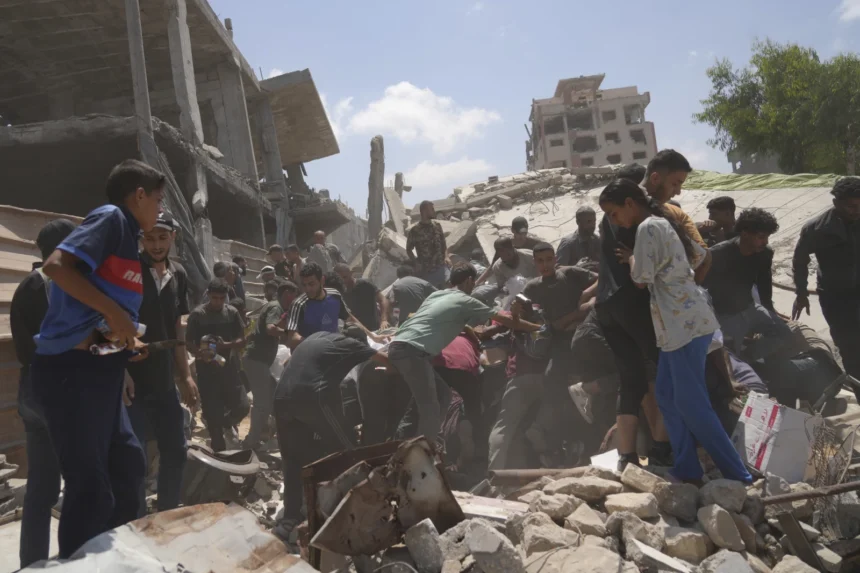
The Israeli Defense Forces (IDF) confirmed on Monday the recovery of the remains of Ran Gvili, the final hostage held in Gaza, as phase 2 of the ceasefire deal begins.
This development effectively concludes the primary humanitarian conditions of the initial truce and signals that the Gaza ceasefire phase 2 is now officially in motion.
Gvili, a 24-year-old special forces police officer, was killed during the October 7, 2023, attacks, and his body was subsequently taken into the enclave.
His recovery followed a “large-scale operation” in northern Gaza over the weekend, where Israeli search teams utilized precise intelligence to locate his remains in a cemetery in the Tuffah neighborhood of Gaza City.
The return of Ran Gvili’s body will mark an end to the more than two-year saga for captives’ families, and is supposed to be followed by a partial reopening of the Rafah crossing with Egypt.
For months, only one hostage body remained in Gaza, that of Ran Gvili, a 24-year-old police officer killed during the Hamas-led attack on Oct. 7, 2023.
The Israel Defense Forces said in a statement Monday that Gvili’s family had been informed “that their loved one has been identified and will be returned for burial.”
“With this, all hostages from the Gaza Strip have been returned,” it said.
Hamas spokesman Hazem Qassem, in a separate statement, confirmed the last of the hostage remains had been found, saying the development confirmed its commitment to the requirements of the ceasefire deal.
On Sunday, Israeli officials said they had launched a “large-scale operation” to locate Gvili’s body amid growing pressure to move into the second phase of its ceasefire deal with Hamas.
“Ran Gvili, the last hostage in Gaza, has been brought home,” the Hostages and Missing Families Forum, which represents the families of Israeli hostages, said in a statement Monday.
“First to enter. Last to return,” it said, noting that Israeli authorities have concluded that Gvili was killed in battle during the Oct. 7 attack before his remains were taken into Gaza.
The development marks the completion of a key pillar of the truce brokered in part by United States President Donald Trump, after months of mounting tension over delays and alleged violations.
It will be followed by the partial reopening of Gaza’s key Rafah border crossing with Egypt, Israel has said.
Israel and Hamas have faced pressure to move on to phase two of the truce, which is planned to include the withdrawal of Israeli forces and the establishment of a transitional government to oversee the reconstruction of the enclave.
The Gaza phase 2 ceasefire deal, which Trump said earlier this month was getting underway, would also require the disarmament of Hamas, a key sticking point in negotiations, and the makeup of Trump’s international force to oversee security in Gaza.
Under phase one of the truce, which came into effect on October 10, 2025, Hamas agreed to release all living and dead hostages in Gaza. In exchange, Israel released scores of Palestinian prisoners and detainees back to Gaza, including remains.
The completion of the first phase was delayed, however, as Hamas said it had struggled to locate all the remains under the rubble of buildings destroyed during Israel’s military assault on the Palestinian enclave.
Many of the 251 total hostages held in Gaza had been released under previous ceasefire deals throughout the conflict, while several, including Noa Argamani, were rescued in operations carried out by Israeli forces.
Hostages have also been killed under Israel’s military operations in Gaza, with soldiers accidentally shooting and killing three Israeli hostages in an incident in December 2023.
The fragile truce has been strained throughout, with Israeli forces launching deadly strikes after accusing Hamas of attacking Israeli forces and violating the ceasefire.
The militant group has denied those accusations and alleged that Israel has itself violated the truce by killing Palestinians in Gaza, with more than 480 people killed in the enclave since the ceasefire began, according to Gaza health officials.
The focus will now shift to the next phases of the plan, which are ultimately expected to bring an end to the conflict in the enclave.
Trump has pushed forward with his plan for a “Board of Peace,” which he first pitched as a body to oversee peace efforts in the Gaza Strip before broadening its remit. Key U.S. allies have opted out amid concerns over its charter, which makes no mention of Gaza and is viewed by some as undermining the United Nations.