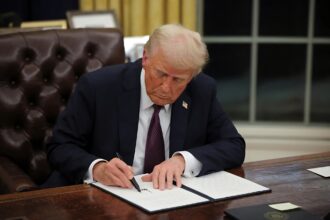

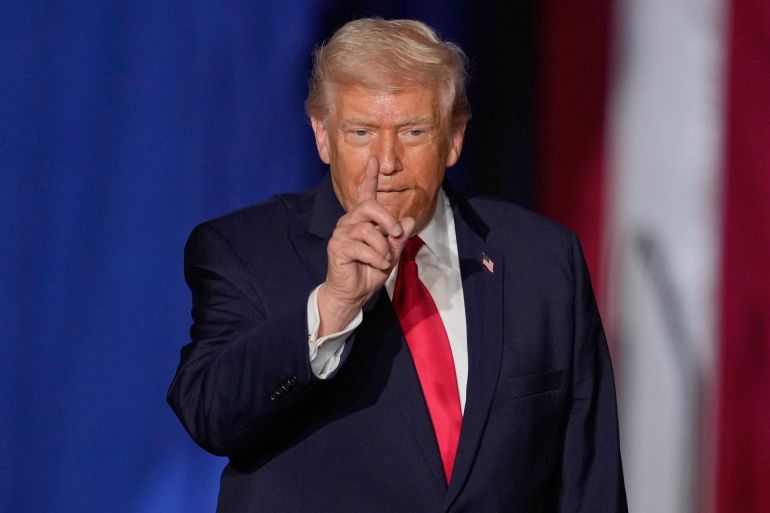
United States President Donald Trump issued a warning to Iran on Wednesday, demanding an immediate return to the negotiating table or the country face what he described as ‘far worse’ strikes.
Taking to his Truth Social platform, the President cautioned that failure to reach a “fair and equitable” deal regarding its nuclear program would trigger U.S. military action against Iran that would be significantly more devastating than previous encounters.
The warning comes as a massive naval armada, led by the aircraft carrier USS Abraham Lincoln, arrived in Ian.
Trump described the fleet as “larger than the one sent to Venezuela,” emphasizing that it is “ready, willing, and able” to fulfill its mission with “speed and violence” if diplomacy fails.
The President specifically referenced Operation Midnight Hammer—the June 2024 strikes on Iranian nuclear facilities—noting that while that mission caused “major destruction,” the next phase of U.S. military action against Iran would be “far worse.”
“A massive Armada is heading to Iran. It is moving quickly, with great power, enthusiasm, and purpose. It is a larger fleet, headed by the great Aircraft Carrier Abraham Lincoln, than that sent to Venezuela. Like with Venezuela, it is, ready, willing, and able to rapidly fulfill its mission, with speed and violence, if necessary,” Trump said in a post on his Truth Social platform.
“Hopefully Iran will quickly ‘Come to the Table’ and negotiate a fair and equitable deal — NO NUCLEAR WEAPONS — one that is good for all parties. Time is running out, it is truly of the essence!
“As I told Iran once before, MAKE A DEAL! They didn’t, and there was ‘Operation Midnight Hammer,’ a major destruction of Iran. The next attack will be far worse! Don’t make that happen again. Thank you for your attention to this matter!” Trump said on Wednesday.
Reacting to Trump’s ‘far worse’ strikes threat Iran’s mission to the United Nations in New York said in a social media post on Wednesday, said that the country “stands ready for dialogue based on mutual respect and interests—BUT IF PUSHED, IT WILL DEFEND ITSELF AND RESPOND LIKE NEVER BEFORE!”
“Last time the U.S. blundered into wars in Afghanistan and Iraq, it squandered over $7 trillion and lost more than 7,000 American lives,” the Iranian mission said.
Also, Iran’s army commander reiterated recent statements on Wednesday from the country’s leaders, saying Iran was ready for any attack by its enemies.
“The Islamic Republic of Iran Army is always ready to confront any threat, and if anything happens, the enemy will certainly suffer severe damage,” Rear Admiral Habibollah Sayyari, Chief of Staff and Deputy Coordinator of the Islamic Republic of Iran Army, said Wednesday, according to Iranian state media. “We stand against any threat on land, in the air, and at sea, and the army is always ready to confront any threat.”
Iran’s Foreign Minister Abbas Araghchi, meanwhile, said Wednesday that he was in “continuous contact” with his counterparts in other regional countries, including U.S. ally Qatar, and that they agreed any new military action against Tehran would destabilize the Middle East.
“Last night, I spoke with the Foreign Minister of Qatar,” Araghichi was quoted as saying by Iranian media. “The prevailing view across the region is that any military threat, given the nature of the U.S. presence here, would lead to instability throughout the entire region.”
Araghchi was quoted as telling reporters on the sidelines of a weekly cabinet meeting in Tehran that he had had no contact with U.S. special envoy Steve Witkoff in recent days, and that Iran had not sought new negotiations with Washington, though he added that the two sides remained in touch through intermediaries.
“Our position is precisely that pursuing diplomacy through military threats cannot be effective,” he said. “If they want negotiations to take place, they must set aside threats, excessive demands, and the raising of illogical issues. Negotiations have their own principles and must be conducted on an equal footing and based on mutual respect.”