
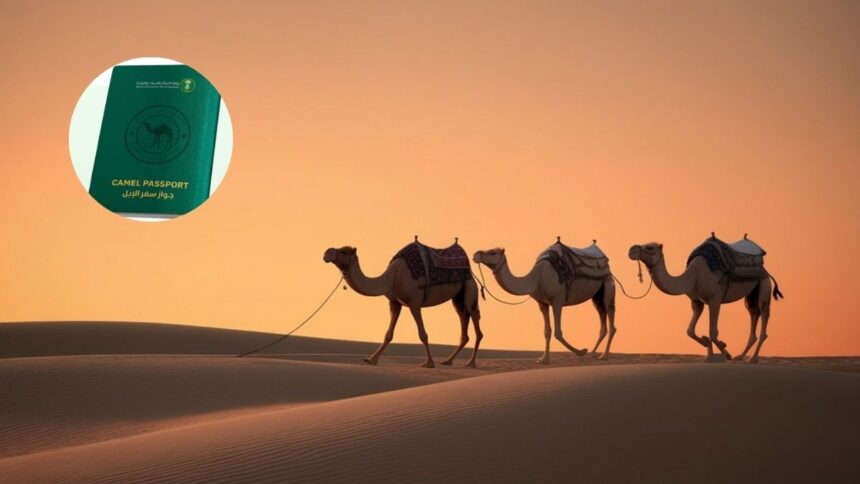
The Kingdom of Saudi Arabia has launched a passport scheme for camels in the country.
The official launch of the passport for camel was announced by the Ministry of Environment, Water, and Agriculture (MEWA), signaling a revolutionary shift in how the nation manages its multi-billion-dollar camel industry.
It was gathered that the passport scheme for camels serves as a comprehensive identification document that includes biometric data, microchip integration, and health records.
This initiative, inaugurated by Deputy Minister Mansour Al-Mushaiti, is a key component of the National Program for the Development of the Livestock and Fisheries Sector. It aims to protect owners’ rights and ensure that every “ship of the desert” has a verifiable digital identity.
The initiative seeks to unify regulatory and digital frameworks for the camel sector by documenting camel data, ownership, breeds, and health records, creating an officially recognized reference that supports veterinary response, market transparency, and regulatory oversight.
According to the ministry, the camel passport serves as a comprehensive identification document, containing a microchip number, passport number, camel name, date of birth, breed, gender, color, place of birth, date and place of issuance, as well as photographs of the animal from both sides to ensure precise identity verification.
The passport also includes a dedicated vaccination record, detailing veterinary immunizations, and is certified with the name, signature, and stamp of the attending veterinarian.
The ministry said the initiative will regulate sales and trading activities by organizing transport, ownership transfers, and official documentation, protecting owners’ rights, and increasing confidence among market participants.
It is also expected to enhance the market value of camels by enabling pricing based on accurate data such as health status, breed, and lineage, while increasing transparency in local and international auctions.
In addition, the project will support strategic planning by providing accurate data on camel populations by age, gender, breed, and color, helping guide national livestock distribution and improve breeding efficiency through genetic performance analysis and local breed improvement programs.
In 2024, the government announced that there were around 2.2 million camels in the kingdom.
Camels have long been a vital mode of transportation in Arabia, conferring status on their owners and fuelling the rise of a lucrative breeding industry.
The kingdom also hosts beauty contests for camels at annual festivals, where Saudi enthusiasts spend hundreds of thousands of dollars on animal contestants — and the unscrupulous sometimes seek an illegal advantage.
Organisers have in recent years cracked down on cosmetic enhancements, a malpractice that has thrived amid stiff competition and despite heavy penalties.
Methods to make the camels’ lips droopier and their humps more shapely are particularly frowned upon by the authorities, who want to encourage a natural look.
Camels have been essential to life on the Arabian Peninsula for millennia, with research published in 2021 suggesting life-sized carvings of camels and horses hewn into rock faces in Saudi Arabia could be around 7,000 years old.