
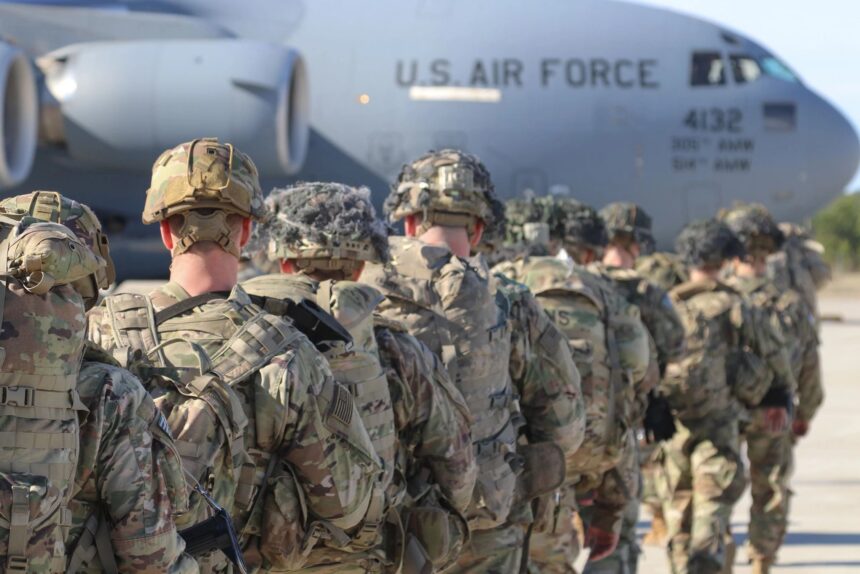
The United States government is reportedly in talks with the Nigerian government to finalize a move to establish a U.S. drone refueling base in Nigeria.
According to reports that quoted high-level defense sources, the facility is intended to serve as a logistical hub for Intelligence, Surveillance, and Reconnaissance (ISR) missions across the Sahel and Lake Chad Basin.
Pan-Atlantic Kompass reports that the move to establish a U.S drone refueling base in Nigeria follows the withdrawal of American forces from Niger in 2024.
According to sources, the withdrawal of the American troops from Niger is part of the reason the U.S has taken an interest in Nigeria for a military partnership.
The development also follows renewed partnership between the U.S government and the administration of President Bola Tinubu, particularly after the U.S President designated Nigeria as a Country of Particular Concern (CPC).
Meanwhile, the proposed U.S drone refueling base in Nigeria is expected to be located in the country’s northeastern region, a strategic choice given its proximity to ongoing counter-terrorism operations.
Unlike the sprawling “Air Base 201” formerly occupied in Niger, this new installation is said to have been characterized as a “logistical station” rather than a full-scale combat base.
While the specific platforms involved have not been officially disclosed, it’s most likely the MQ-9 Reaper. These drones are powered by Honeywell TPE331-10 turboprop engines and typically run on JP-8 or similar kerosene-based fuels.
It was also gathered that the primary function of the U.S base would be to allow long-endurance unmanned aerial vehicles (UAVs) to top up fuel and extend their loiter time over conflict zones without returning to more distant hubs in Ghana or the Gulf of Guinea.
Drones can be refueled in multiple ways, depending on their design and fuel type, extending their operational range beyond battery or fuel limits.
Most consumer and commercial drones (battery-powered or fuel-based) are routinely recharged or refuelled on the ground at stations.
Hydrogen-powered unmanned aerial vehicles (UAVs), for example, use methods like blowdown filling from high-pressure sources or boost compression to top up compressed tanks quickly.
If approved, the refueling station would enable the U.S. to operate more efficiently from Ghana, while flying into Nigeria to coordinate intelligence support and operational planning with Nigerian forces.
The development also comes after Dagvin Anderson, the general in charge of US Africa Command (AFRICOM), last week, confirmed that the U.S had dispatched a “small team” of troops to Nigeria following recent security cooperation between both countries.
Anderson’s disclosure sparked an uproar, seeing as it was the first official acknowledgement of U.S boots on the ground in Nigeria since the Christmas Day strike.
The development also comes as Tinubu played host to a high-level delegation from the United States Africa Command (AFRICOM), led by its Commander, Anderson, at the State House, Abuja, on Sunday.
Senior Special Assistant to the President on Social Media, Dada Olusegun, who disclosed this via his verified X handle, @DOlusegun, said the Sunday evening meeting was also attended by top brass of Nigeria’s military and security organisations.
According to Olusegun, President Tinubu, alongside the National Security Adviser (NSA), Mallam Nuhu Ribadu, and the service chiefs, received General Anderson, members of his team, and the Charge d’Affaires of the US Embassy in Nigeria, Mr. Keith Heffern.
Those present on the US side included the Charge d’Affaires, Mr. Keith Heffern; the Commander of AFRICOM, General Dagvin Anderson; the Command Sergeant Major, Garric M. Banfield, who is the Command Senior Enlisted Leader of AFRICOM; and the Senior Foreign Policy Adviser, AFRICOM, Ambassador Peter Vrooman.
On the Nigerian side, President Tinubu was joined by the National Security Adviser, Mallam Nuhu Ribadu; the Minister of Defence, General Christopher Musa (rtd); Chief of Defence Staff, General Olufemi Oluyede; Chief of Army Staff, Lieutenant-General Waidi Shaibu; Chief of Defence Intelligence, Lieutenant-General Emmanuel Uandiandeye; the Director-General of the National Intelligence Agency (NIA), Mohammed Mohammed; and the Director-General of the Department of State Services (DSS), Tosin Ajayi.