
The United States (U.S) Supreme Court on Friday has declared U.S President Donald Trump’s tariffs on Nigeria and other countries as illegal.
In a 6-3 decision on Friday, February 20, the apex court declared that Trump exceeded his executive authority by using the International Emergency Economic Powers Act (IEEPA) to bypass Congress and unilaterally impose sweeping import taxes.
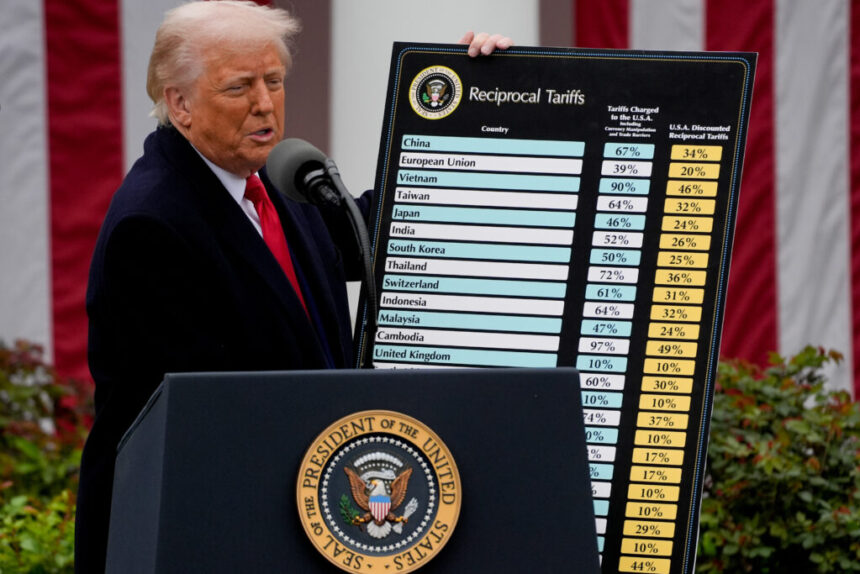
The ruling provides immediate relief for several nations that have been under the weight of the administration’s “reciprocal tariff” policy. Since April 2025, Nigeria has been hit with a 15% duty on non-oil exports, a move the administration justified by citing Nigeria’s trade surplus and its recent entry into the BRICS alliance.
Chief Justice John Roberts, writing for the majority, clarified that the 1977 IEEPA law was designed for financial sanctions during emergencies, not as a permanent “switch” for the President to rewrite the nation’s tax code.
However, Justices Brett Kavanaugh, Clarence Thomas, and Samuel Alito dissented.
“IEEPA contains no reference to tariffs or duties. The Government points to no statute in which Congress used the word ‘regulate’ to authorize taxation. And until now, no President has read IEEPA to confer such power,” Roberts wrote in a portion of the decision joined by Justices Neil Gorsuch and Amy Coney Barrett. “We claim no special competence in matters of economics or foreign affairs. We claim only, as we must, the limited role assigned to us by Article III of the Constitution. Fulfilling that role, we hold that IEEPA does not authorize the President to impose tariffs.”
The court upheld a ruling from the U.S. Court of Appeals for the Federal Circuit that ruled Trump’s tariffs on Nigeria and other global communities were illegal. The majority did not appear to address the issue of refunds for businesses that paid tariffs on imports.
In a dissenting opinion, Kavanaugh wrote that tariffs, like quotas and embargoes, are a “traditional and common tool” to regulate importation, which is a power specified in the IEEPA.
“The tariffs at issue here may or may not be wise policy,” Kavanaugh, joined by Thomas and Alito, wrote. “But as a matter of text, history and precedent, they are clearly lawful.”
The legal battle over Trump’s tariffs marked the first in which the Supreme Court evaluated the legal merits of one of his second-term policies. The high court has allowed the president to enforce many of his plans temporarily while legal proceedings moved forward, but its decision invalidating Trump’s global tariffs is so far the most significant loss of his second term.
Tariffs are a centerpiece of Trump’s economic agenda in his second term. The president has used the threat of levies to push trading partners to negotiate trade deals that are more favorable to the U.S. and has argued that they will help boost domestic manufacturing.
Trump claimed ahead of a decision that because of tariffs, “our Country is financially, AND FROM A NATIONAL SECURITY STANDPOINT, FAR STRONGER AND MORE RESPECTED THAN EVER BEFORE.” He also warned that an adverse ruling would force the U.S. to pay back significant sums of money to importers, which would be “a complete mess, and almost impossible for our country to pay.”