

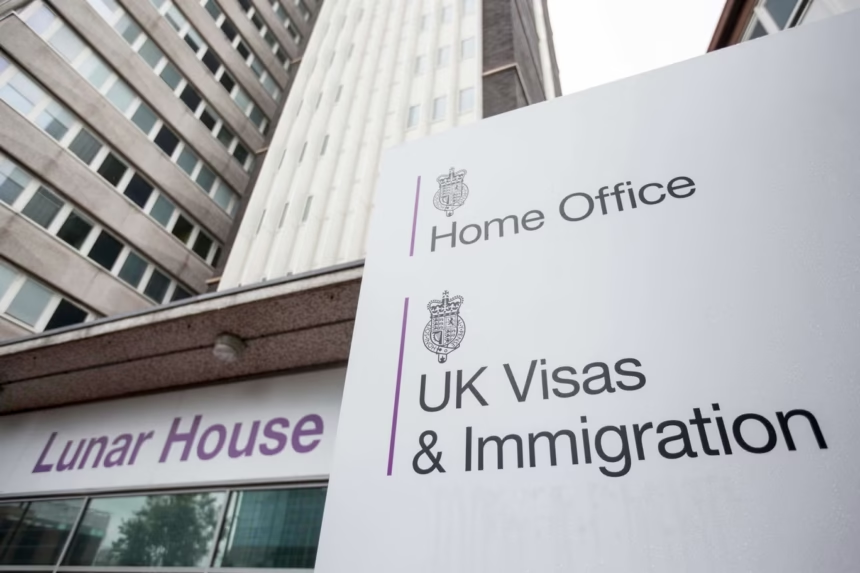
The United Kingdom (UK) government has officially halted student visas for four countries.
Home Secretary Shabana Mahmood announced on Tuesday that the UK has halted UK study visas for four countries, Afghanistan, Cameroon, Myanmar, and Sudan, citing a sharp rise in asylum claims originating from individuals who entered the country on legal student credentials.
The decision follows recent Home Office data revealing that 39% of the 100,000 asylum claims made in 2025 came from individuals who originally arrived via legal migration routes.
According to the Home Secretary, the primary reason the government chose to halt UK student visas for four countries was a five-fold increase in asylum applications from these specific nationalities between 2021 and late 2025.
Mahmood said: “Britain will always provide refuge to people fleeing war and persecution, but our visa system must not be abused.
“That is why I am taking the unprecedented decision to refuse visas for those nationals seeking to exploit our generosity. I will restore order and control to our borders.”
According to Home Office figures, asylum applications by students from Afghanistan, Cameroon, Myanmar, and Sudan accounted for the most significant increase between 2021 and September 2025, the Home Office stated.
The policy changes, which are set to be formally introduced into immigration rules this Thursday, include several strict measures:
Suspension of Student Routes: No new study visas will be issued to nationals of Afghanistan, Cameroon, Myanmar, and Sudan for the foreseeable future.
Work Visa Restrictions: In addition to study bans, the UK has also halted work visas for Afghan nationals.
Status Reviews: All refugees will be informed that their status is temporary, with mandatory reviews every 30 months.
Returns Policy: The government has signaled that refugees whose home countries are eventually deemed “safe” will be expected to return.
This latest development comes after Mahmood had previously threatened a similar halt to all visas for Angola, Namibia, and the Democratic Republic of Congo in November, unless their governments agreed to take people back from the UK.
This led to cooperation agreements with all three countries and people being returned via deportation flights.
Mahmood is expected to lay out measures to toughen up the UK asylum system in a speech on Thursday, having announced that from this week every refugee will be told that their status is temporary and will last just 30 months.
Claimants whose countries are deemed to be safe by the UK government will from now on be expected to return.
The development also comes days after new asylum rules began in the UK.
The new UK asylum rules which began on March 2, 2026 has transformed refugee status from a permanent sanctuary into a temporary grant of leave.
Under these regulations, most adults and accompanying children granted asylum will now receive only 30 months of protection, after which their cases will be mandatorily reviewed to determine if their home countries are safe for return.
Previously, refugees were typically granted five years of protection followed by a path to permanent settlement.
Key updates under the new UK asylum rules include:
30-Month Reviews: Frequent status checks to evaluate the safety of the refugee’s country of origin.
Extended Settlement Wait: The qualifying period for Indefinite Leave to Remain (ILR) for refugees is set to increase from 5 years to 20 years.
Earned Settlement: A new “points-based” framework requiring individuals to demonstrate economic or societal “contributions” before gaining permanent residency.
New “Protection Work and Study” Route: To reduce dependence on state support, the Home Office has introduced a “Protection Work and Study” visa. This allows refugees to transition into standard work or study streams if they meet specific language and income thresholds. Home Secretary Shabana Mahmood stated that the new UK asylum rules 2026 are intended to eliminate “pull factors” that encourage dangerous channel crossings while maintaining support for those in genuine, immediate need.
Tighter Compliance and Enforcement: The government has also clarified that support will no longer be an automatic right. New measures allow for the swifter withdrawal of financial aid for claimants who break the law or fail to comply with removal directions. Furthermore, the appeals process is being streamlined into a single-stage system to prevent “repeated or late claims” from delaying deportations.