
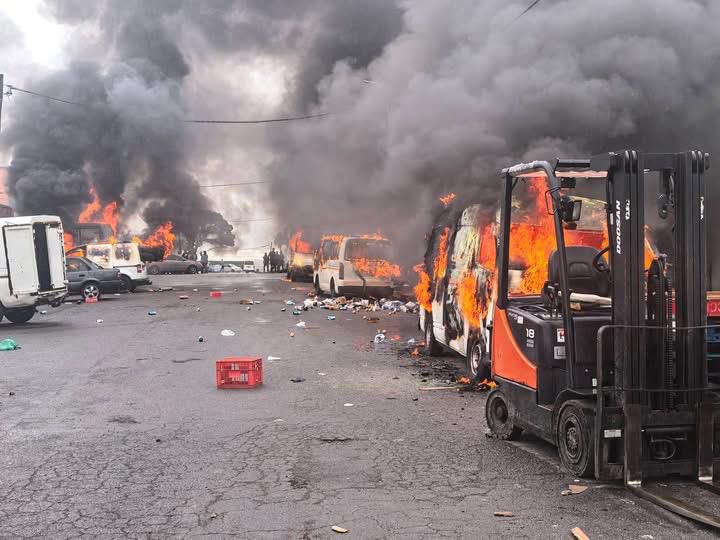
Tensions reached a breaking point on Monday as violent demonstrations erupted in the Eastern Cape over the installation of an Igbo King in South Africa.
What began as a planned march by traditional leaders and political groups quickly spiraled into chaos in KuGompo (formerly East London), leading to the torching of vehicles, the looting of foreign-owned shops, and several reported injuries.
The unrest was triggered by the recent coronation of Chief Solomon Ogbonna Eziko as the “Igwe Ndigbo Na East London.”
Residents and South African traditional authorities, including the AbaThembu Royal Council, have condemned the move as an “act of terror” and a direct affront to the sovereignty of indigenous South African kingships.
The march, supported by political parties like ActionSA and the Patriotic Alliance, was intended to be a peaceful demonstration to hand over a petition to the Department of Cooperative Governance and Traditional Affairs (COGTA).
ActionSA’s Eastern Cape chair, Athol Trollip, reaffirmed the party’s opposition to the coronation in East London, describing it as unlawful and inconsistent with South Africa’s traditional leadership framework.
He said the party stood firmly with recognised traditional authorities, insisting that due process must be followed in matters of cultural and traditional governance.
However, as the crowd moved through the city center, the protests escalated into violence.
Witnesses reported that the Igbo King installation in South Africa has become a flashpoint for deeper frustrations regarding national identity and immigration.
At least twelve vehicles were set on fire, and several buildings allegedly belonging to foreign nationals were targeted.
“Protesters have torched vehicles and buildings allegedly belonging to foreign nationals in protest against the installation of a Nigerian king in the Eastern Cape,” Newsroom Afrika reported.
Police were forced to deploy stun grenades, rubber bullets, and tear gas to disperse the rioters as the violence threatened to consume the central business district.
Traditional leaders in the Eastern Cape have been vocal in their opposition to the installation of the Igbo King, stating that South Africa is a sovereign nation and cannot host parallel traditional authorities.
Chief Xhanti Sigcawu of the Amathole House of Traditional Leaders stated, “This is Xhosa territory. We are the descendants of King Phalo. Installing a foreign king on our soil undermines the dignity of our own traditional institutions.”
Prince Zolile Burns-Ncamashe, Deputy Minister of COGTA, joined the protesters, labeling the coronation “unlawful and non-existent.”
CDR Africa said the unrest reflected growing outrage over the coronation, with foreign-owned properties becoming primary targets.
The situation further deteriorated, with eNCA reporting that violence turned deadly after a stabbing incident allegedly involving Ethiopian shop owners.
At least two people were said to have been injured and taken to the hospital for treatment, while several vehicles were destroyed in the chaos.
Video circulating on social media showed some protesters issuing stark warnings, vowing to escalate resistance if authorities fail to address their concerns on the installation of the Igbo King in South Africa.
One demonstrator reportedly said residents were prepared to “take up arms” if the matter remained unresolved, while others called for the deportation of Nigerians linked to the coronation.
The protesters had earlier marched through parts of the province demanding immediate government intervention, warning that failure to act could trigger further unrest.
Pan-Atlantic Kompass reports that this development comes amid xenophobic attacks in South Africa.
The deadliest wave of violence occurred in May 2008, starting in Alexandra, Johannesburg. Over 60 people were killed, and tens of thousands were displaced as mobs targeted migrants from Zimbabwe, Mozambique, and Nigeria.
In recent years, movements like Operation Dudula have institutionalized anti-migrant sentiment, conducting “cleanup” operations that target undocumented foreigners.