

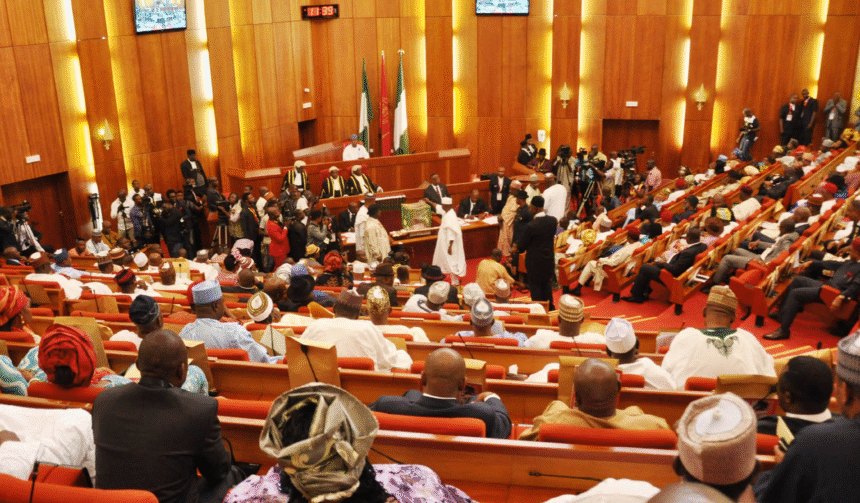
The Nigerian Senate has officially passed the constitutional amendment bill to establish state police.
The passage of the Constitution Alteration Bill (Sixth Alteration), 2026 (SB. 1055) marks a victory for decentralizing the nation’s security architecture. It effectively ends decades of exclusive federal control over policing.
Pan-Atlantic Kompass reports that the legislation fundamentally alters Section 214 of the 1999 Constitution, transitioning policing from the Exclusive Legislative List to the Concurrent Legislative List. This legal shift allows both the federal government and state authorities to operate parallel police services.
The approved framework includes several critical operational guidelines:
Dual Command Structure: The existing Nigeria Police Force will be rebranded as the Federal Police Service, managed by the Inspector-General of Police. Simultaneously, State Police Services will be introduced across the 36 states.
Appointment Powers: State Governors are empowered to appoint a Commissioner of Police for their respective states. This appointment is subject to confirmation by the local State House of Assembly.
National Standards: No subnational police force can begin operations until its enabling state law is certified as meeting national minimum standards prescribed by the National Assembly.
Federal Safeguards: The Federal Police retain the right to intervene in local jurisdictions only during a total breakdown of law and order, at the explicit request of a governor, or if a state force faces operational collapse.
During the plenary session led by the President of the Senate, Senator Godswill Akpabio and the lawmakers overwhelmingly backed the bill via a manual voting process following a clause-by-clause review.
Senate Leader Opeyemi Bamidele, who led the debate, emphasized that decentralization is intended to complement—not weaken—the federal structure.
Pan-Atlantic Kompass reports that the Senate passed the State Police bill hours after President Bola Tinubu sent the bill to the House.
The development also comes after the House of Representatives had passed the State Police bill.
Because the House of Representatives previously approved its version of the state police bill, both chambers must ensure their passed texts are identical. From there, the bill will be transmitted to the 36 State Houses of Assembly. It requires a two-thirds majority approval (at least 24 states) before it can finally return to President Tinubu for executive assent.