
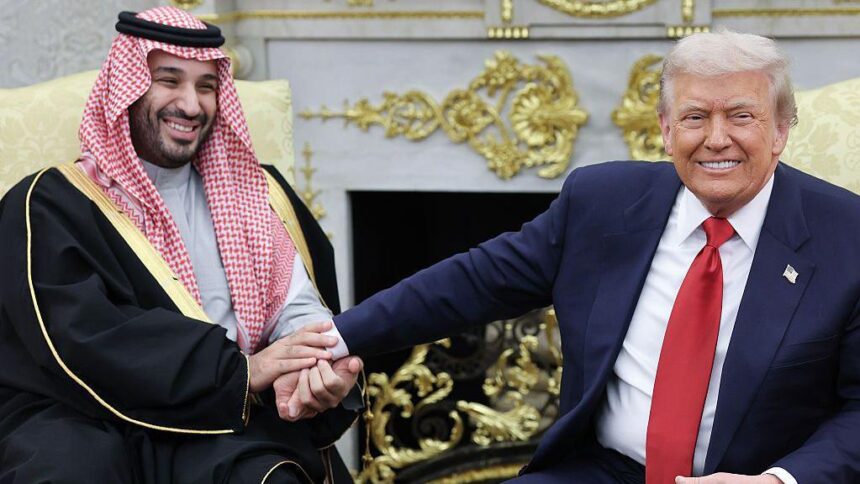
United States President Donald Trump has reportedly approved a 30-year civil nuclear cooperation deal with Saudi Arabia.
It was gathered that the reported deal opens the door for American companies to build nuclear infrastructure in Saudi Arabia and could eventually allow Riyadh to enrich uranium on its own soil.
Citing people familiar with the discussions, the Wall Street Journal and The New York Times reported on Tuesday that Trump is reportedly expected to ask Congress to approve the agreement, which could pave the way for US companies to help build Saudi Arabia’s nuclear industry.
It was also reported that the pact, which is expected to be submitted under Section 123 of the U.S. Atomic Energy Act, represents a multi-billion-dollar opportunity for the U.S nuclear sector while bypassing traditional safeguards that critics argue could trigger a regional arms race.
Key Takeaways: What Is in the U.S.-Saudi Nuclear Deal?
30-Year Framework: Sets up a multi-decade operational roadmap for American companies—such as Westinghouse—to lead Saudi Arabia’s transition toward civilian nuclear power.
Potential Domestic Enrichment: Subject to a joint U.S.-Saudi feasibility study, the deal allows for the potential construction of a uranium enrichment facility within the kingdom.
Decoupled from Israel Normalization: Unlike prior negotiation attempts under previous administrations, Trump approved the deal without requiring Saudi Arabia to first normalize diplomatic ties with Israel.
Omission of the “Gold Standard”: The arrangement omits the strict non-proliferation clause (the “Gold Standard”) that prohibits domestic fuel enrichment and reprocessing.
Bilateral Safeguards: Bypasses the International Atomic Energy Agency’s (IAEA) Additional Protocol, establishing inspection guardrails directly between Washington and Riyadh instead of relying on expanded UN oversight.
Pan-Atlantic Kompass reports that the timing of the nuclear deal with Saudi Arabia is controversial.
This comes as reports revealed that one of Trump’s objectives with the deal is in line with the military campaign against Iran.
It was reported that the nuclear deal with Saudi Arabia is to prevent it from acquiring the ability to build a nuclear weapon.
Saudi Arabia has long sought a civilian nuclear programme as part of plans to diversify its economy and reduce its dependence on oil.
Negotiations over U.S nuclear cooperation have stretched across multiple administrations. Under former President Joe Biden, talks were tied to a broader package that included Saudi recognition of Israel, according to The Times.
Those negotiations stalled after Israel’s genocidal war on Gaza, but the Trump administration revived discussions, removing the normalisation requirement.
During Saudi Crown Prince Mohammed bin Salman’s visit to the U.S last year, the two countries announced a framework for civilian nuclear cooperation, laying the groundwork for what they described as a long-term partnership built on non-proliferation standards.
Meanwhile, any civilian nuclear cooperation agreement must be submitted to Congress, which has the power to review and block so-called “123 agreements”.
Congress would need a two-thirds majority to block the proposed agreement and override any presidential veto.
The proposal is expected to face scrutiny from lawmakers in both parties over the safeguards governing Saudi uranium enrichment.
Here are some of the key milestones in talks between the United States and Saudi Arabia co-operating on a civil nuclear programme;
- From 2017 to 2019, the US granted seven American companies authorisation to engage in “civil nuclear discussions” with Saudi Arabia.
- However, in 2020 the US Government Accountability Office reported that the two nations had “not made significant progress” due to “persistent differences” over conditions including restrictions on enrichment.
- In 2022, the US and Saudi Arabia signed a new MoU on “the exchange of technical information and cooperation in nuclear safety matters”.
- In 2023, the Wall Street Journal reported that the US was considering a US-run uranium enrichment operation within Saudi Arabia.
- In November 2025, the U.S and Saudi Arabia signed a joint declaration which the Trump administration said “builds the legal foundation for a decades-long, multi-billion-dollar nuclear energy partnership”