
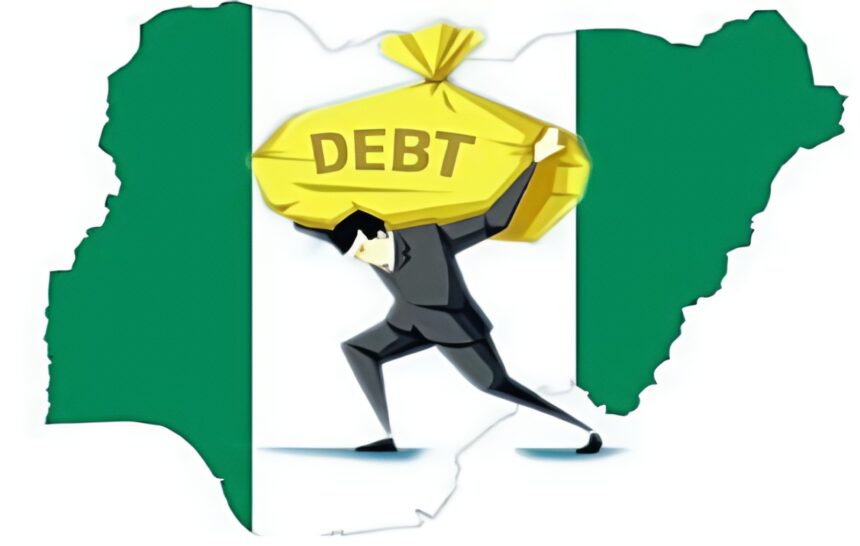
Fresh economic concerns have emerged following official reports showing that the Nigerian government significantly exceeded its statutory borrowing limits.
Driven by mounting revenue shortfalls and an expanding fiscal deficit, new borrowings reached N12.62 trillion in a single fiscal year, pushing the national debt-to-GDP ratio past critical safety thresholds.
According to the latest Consolidated Budget Implementation Report released by the Budget Office of the Federation, the Nigerian government exceeded its approved borrowing limit of N7.83 trillion by N4.79 trillion—a 61.2% over-borrowing margin.
The primary catalyst for the surge in public debt remains a persistent revenue performance deficit. While aggregate spending reached N34.49 trillion (closely matching the approved budget of N35.06 trillion), actual government revenue stood at N20.98 trillion, missing expectations by nearly 19%.
This N4.9 trillion shortfall in anticipated income left fiscal authorities with little choice but to rely on local and international credit markets to plug the widening N13.51 trillion fiscal deficit.
The higher borrowing requirement followed a substantial revenue shortfall, which pushed the fiscal deficit to N13.51tn, well above the approved deficit of N9.18tn.
The report showed that aggregate Federal Government revenue stood at N20.98tn, compared with the budget estimate of N25.88tn, representing a shortfall of N4.90tn.
Total expenditure, however, amounted to N34.49tn, only N561.29bn below the approved estimate of N35.06tn, indicating that the wider fiscal gap was driven primarily by weaker revenue rather than higher spending.
The report read, “The revenue and expenditure outturn of the Federal Government resulted in a fiscal deficit of N13.51tn in the 2024 fiscal year. This was N4.34tn (47.33 per cent) above the projected budget deficit estimate for the year.”
It added that the deficit also exceeded the N10.55tn recorded in 2023, showing the increasing pressure on the country’s public finances.
An analysis of the government’s financing profile showed that domestic borrowing remained exactly on target at N6.06tn, but higher foreign borrowing and budget support significantly increased overall borrowings.
Foreign borrowing rose from the budgeted N1.77tn to N3.37tn, representing an increase of N1.60tn above target.
Also, the Federal Government received N3.19tn in budget support, despite making no provision for such financing in the 2024 budget. The source of the budget support, which was classified as new borrowing, was not disclosed.
Together, domestic borrowing, foreign borrowing and budget support brought total new borrowings to N12.62tn, exceeding the approved borrowing programme by N4.79tn.
An analysis of the Budget Office report showed that new borrowings financed about 36 per cent of the Federal Government’s 2024 budget, highlighting the country’s continued dependence on debt to fund public expenditure.
Separate from the new borrowings, the report showed that multilateral and bilateral project-tied loans amounted to N1.98tn, compared with the budget estimate of N1.05tn, representing a positive variance of N929.45bn.
The report also showed that expected privatisation proceeds of N298.49bn did not materialise, as no revenue was realised from that source during the fiscal year.
According to the report, the fiscal deficit “was financed through multi-lateral/bilateral project-tied loans of N1.98tn, domestic borrowing of N6.06tn, foreign borrowing of N3.37tn and budget support of N3.19tn in the period under review.”
The report attributed the wider financing gap largely to revenue underperformance.
It stated that total Federal Government revenue stood at N20.98tn, representing an increase of N8.50tn, or 68.11 per cent, over the N12.48tn generated in 2023. However, revenue remained N4.89tn, or 18.92 per cent, below the annual budget target.
It stated, “Total Revenue Inflow of the Federal Government stood at N20.98tn at the end of December 2024. This represents an N8.50tn (68.11 per cent) increase when compared to N12.48tn that was reported at the end of 2023, but N4.89tn (18.92 per cent) lower than the 2024 annual budget estimate.”